The city council voted to apply for a $1 million federal grant to study the potential benefits of building a park over downtown freeways.


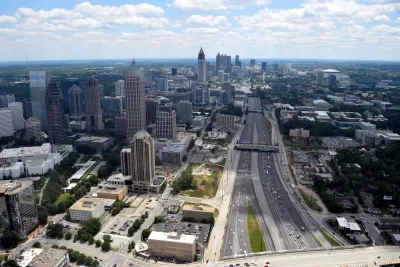
An Atlanta highway cap could finally become a reality, writes John Green. "Recent actions by the Atlanta City Council and Georgia legislators could lend hope for greenspace advocates that downtown’s grandiose, highway-capping 'Stitch' proposal still has a pulse."
Despite popular support, "[i]n more recent years, Stitch studies, panelist conferences, and calls among stakeholders for launching fundraising and engineering efforts haven’t translated to a shovel’s worth of dirt being turned. But with a transportation infrastructure push afoot in Washington, D.C., the Stitch concept is showing signs of renewed interest—and possible viability." To move the project forward, "the Atlanta City Council voted to move forward in applying for a $1 million federal grant that would help fund a study for implementing the Stitch, which advocates say would effectively weave interstate-bisected parts of downtown back together." However, "that federal cash boost would be a far cry from the Stitch’s estimated cost of $300 million or more, per ADID’s ongoing analyses. "
"But ADID officials are optimistic for what the Stitch could mean for downtown: between $1.1 and $3.1 billion in value creation; up to $58 million in new revenue; and a boost in the city’s bonding capacity from $308 to $847 billion 'by increasing the value of existing properties and catalyzing the redevelopment of underutilized properties,' per the most recent summary." The city is weighing creating a 25-acre park that would cap the I-75 and I-85 freeways and "reconnect neighborhoods torn apart by the interstate."
FULL STORY: Downtown's highway-capping 'Stitch' project shows signs of life

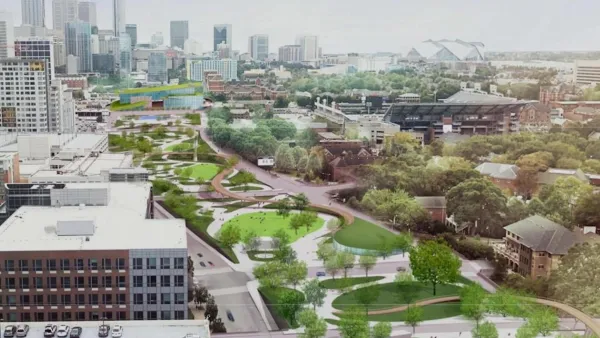
Atlanta Receives $3.2 Million for Freeway Cap Plan
The federal funding will help move forward planning for an ambitious proposal to cap a downtown Atlanta freeway with a 25-acre park.
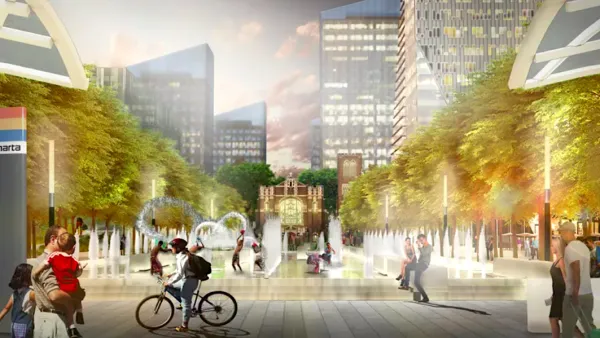
Atlanta Launches Website for Highway Cap Project
Residents can view plans for the 14-acre project that include public plazas and green spaces connecting local landmarks, employment centers, and transit stations.
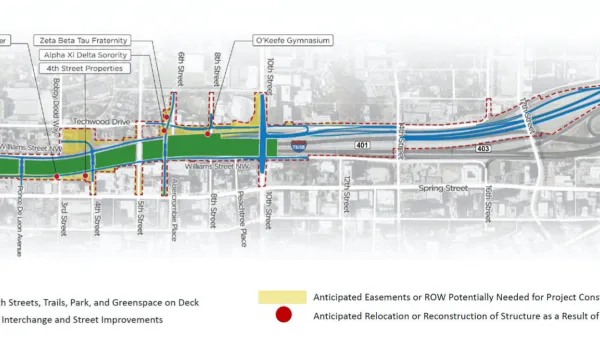
Atlanta Weighs 'Midtown Connector' Freeway Cap
The billion-dollar project would create a 25-acre park and 3.5 miles of new bike and pedestrian routes.

Planetizen Federal Action Tracker
A weekly monitor of how Trump’s orders and actions are impacting planners and planning in America.

The state-sanctioned urbicide of Austin
People don’t kill cities. Freeways do.

US to reduce Colorado River water deliveries to Mexico
A new Colorado Treaty amendment reduces Mexico’s Colorado River water allocation by 250,000 acre feet.

5 New England states march closer to 800 megawatt wind energy project
Securing federal approval for the project may be complicated under the Trump administration, which has historically been hostile towards domestic wind power.

Baltimore to break ground on $50 million Transit Priority Project
The project will bring faster bus trips, safer streets and better bike connections to Baltimore.

Airbnb launches $250 million 'last-dollar financing' housing accelerator, makes first investment in Austin
The company will put $6.4 million towards affordable housing development in Texas’ capital.

FREE Course: Walkable City 1: Why Walkability?
After describing his path towards focusing on walkability as the essence of good planning, Jeff Speck marches through his five principal reasons for making more walkable places.
Reinventing Malls: Planning Alchemy—Turning Gray Fields Into Gold
The course focuses on the opportunities and imperatives that shape reinvention of mall sites.

Eagle County Government
Harvard University Graduate School of Design
Nashville Planning Department
The Architects Foundation
University of Cincinnati Online
The Pocatello Development Authority
The Urban Renewal Agency of the City of Pocatello
Journal of the American Planning Association