Open data that no one knows how to use is hardly open at all. A new platform from Esri aims to improve the situation.


Laura Bliss reports:
Launched Monday by the global GIS mapping software giant Esri, ArcGIS Hub is an online platform that clusters datasets around specific citywide initiatives, in the hope that people can more readily tap into information applicable to their lives.
According to Bliss, ArcGIS Hub responds to the difficulty in accessing and using data shared on open data portals—although open data has gained wide adoption by governments and agencies of all shapes and sizes, the potential of the platform is still severely limited by poor user experience.
Bliss examines a few case studies for how ArcGIS Hub improves open data, including the example of South Bend, Indiana, one of the early adopters of the platform. Bliss details the functions of the Hub too, which functions in ways like a "social network built on civic duty."
Read the full story: An Open Data Hub That Builds Better Citizens

Washington DC Launches Open Data Chatbot
City data is now available literally at the public’s fingertips, no data analytics skills required.

New Interactive Mapping Tool Tracks all of NYC's Infrastructure Projects, Housing Permits, and City Facilities
The New York Department of City Planning has taken its open data practices to a new level with the launch of the Capital Planning Explorer.
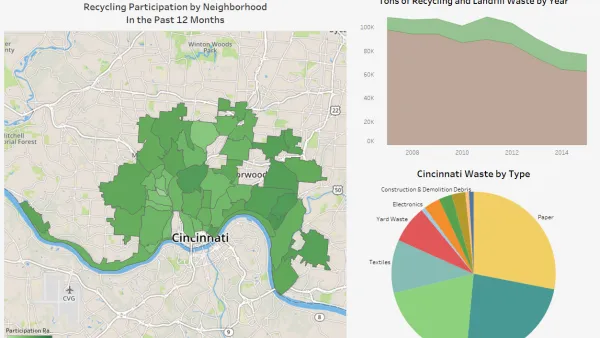
Who Recycles in Cincinnati?
A new CincyInsights dashboard shows recycling participation rates all over the city.

Desperate measures: Advocates weigh draining Lake Powell to fill Colorado River
Draining the reservoir could reduce evaporation losses by a couple hundred thousand acre-feet.

Eastern Nebraska is running out of electricity
Data centers and electrification are straining eastern Nebraska’s grid, throttling economic development.

Move over, LA: St. Louis gears up for Olympics, invests millions in downtown redevelopment
The Missouri city will host the 2028 Olympic soccer group stage and knockout matches.

MTA sends Dem leaders a wish list to mend Trump’s damages
Requests include exempting new train and bus components from tariffs and increasing transit security funding.

Mass. votes against statewide minimum lot size for single-family homes
Over 2 million residents voted on Question 7; it was decided by just over 30,000 votes.

Maryland’s $15 billion bridge project gains key approval
The Maryland Transit Authority said the project will create over 60,000 jobs and add $23 billion to the local economy.

FREE Course: Walkable City 1: Why Walkability?
After describing his path towards focusing on walkability as the essence of good planning, Jeff Speck marches through his five principal reasons for making more walkable places.
Reinventing Malls: Planning Alchemy—Turning Gray Fields Into Gold
The course focuses on the opportunities and imperatives that shape reinvention of mall sites.

City of Rosemead
Rutgers University, Edward J. Bloustein School of Planning and Public Policy
One Hundred Miles
University of Michigan School for Environment and Sustainability (SEAS)
Hunter College, City University of New York (CUNY)
The Architects Foundation
City of Cambridge
The Pocatello Development Authority
The Urban Renewal Agency of the City of Pocatello