A new CincyInsights dashboard shows recycling participation rates all over the city.


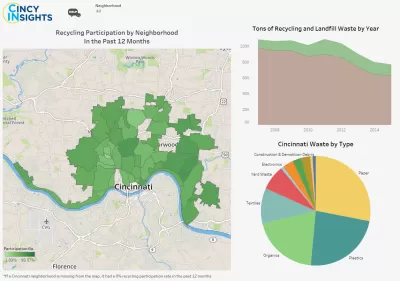
The Cincinnati Office of Performance and Data Analytics (OPDA) and the Office of Environment and Sustainability (OES) have created a new dashboard that shows recycling participation rates at the neighborhood level for the entire city.
The "CincyInsight: Recycling Participation" dashboard actually shares two kinds of information: 1) "an overview of neighborhood recycling participation for the past 12 months, and a summary of waste types and tonnage," and 2) individual address recycling participation. On that second count, "users may search by street and ZIP code, and change the date range to see recycling participation data as far back as January 2016."
"The data powering this new feature is generated by RFID technology, which enables the City to track each time a City-issued recycling bin is lifted," according to n announcement of the new dashboard posted on the city's website.
The new recycling participation dashboard is the latest in a series—the total number of CincyInsights dashboards now reaches 18, and the city is soliciting ideas for new dashboards.
Read the full story: City Debuts New Neighborhood-based Recycling Participation Dashboard

New Interactive Mapping Tool Tracks all of NYC's Infrastructure Projects, Housing Permits, and City Facilities
The New York Department of City Planning has taken its open data practices to a new level with the launch of the Capital Planning Explorer.

Measuring Job Densification Trends in U.S. Metropolitan Areas
A new report details the trend of jobs densification in U.S. metropolitan areas between 2004 and 2015, finding a few large metropolitan areas leading an overall increase in jobs density. Still, many areas are seeing jobs disperse around the region.
Compare Transit Ridership in U.S. Cities
A new interactive tool called Transit Insights offers access to the local trends of transit ridership.

Desperate measures: Advocates weigh draining Lake Powell to fill Colorado River
Draining the reservoir could reduce evaporation losses by a couple hundred thousand acre-feet.

Eastern Nebraska is running out of electricity
Data centers and electrification are straining eastern Nebraska’s grid, throttling economic development.

Malls are becoming the midtowns of the future
Mall and office park redevelopments are a generational opportunity to create new nodes of urbanity.

NYC breaks ground on anti-flooding infrastructure project
New York City's new system will reduce stormwater flows to local sewers by 90%.

One Kentucky town’s secret to affordable housing
The Smoketown Community Land Trust has already built seven affordable homes for community members.

Houston gains petal-shaped cooling infrastructure to make streets more ‘delightful’
The city has installed the pavilions along 15 blocks in Houston.

FREE Course: Walkable City 1: Why Walkability?
After describing his path towards focusing on walkability as the essence of good planning, Jeff Speck marches through his five principal reasons for making more walkable places.
Reinventing Malls: Planning Alchemy—Turning Gray Fields Into Gold
The course focuses on the opportunities and imperatives that shape reinvention of mall sites.

City of Rosemead
Rutgers University, Edward J. Bloustein School of Planning and Public Policy
One Hundred Miles
University of Michigan School for Environment and Sustainability (SEAS)
Hunter College, City University of New York (CUNY)
The Architects Foundation
City of Cambridge
Montrose County
The Pocatello Development Authority