The Federal Highway Administration approved 50 applications of red transit-only lanes to be painted throughout San Francisco. Already used on four streets in a pilot program, the lanes have proven effective but are opposed by some business owners.


The bus-only, red-colored transit lanes first appeared in 2013 as part of a demonstration project after gaining permission from state and federal authorities a year earlier. Very early on, they were shown to improve transit service, but they also provoked controversial among some business owners, homeowners and drivers who claimed they made auto travel more difficult and reduced access by motorists to stores adjacent to the transit lanes as some turns are prohibited.
On June 2, after reviewing the San Francisco Municipal Transportation Agency's Red Transit Lanes Final Evaluation Report of three such lanes, the Federal Highway Administration approved the agency's application for 50 additional streets, including "existing transit lanes and those proposed as part of projects like the Van Ness Improvement Project, the Geary Rapid Project and others in the Muni Forward Rapid Network," writes Aaron Bialick for SFMTA.
"Overall collisions on three red-colored streets — Geary, Third and O’Farrell streets — dropped by 16 percent and injury collisions dropped by 24 percent at a time when they did not change significantly citywide," reports Joe Fitzgerald Rodriguez, who covers transportation for the San Francisco Examiner.
“The data we’ve already seen shows this is a proven treatment that works. It works to improve reliability, and to reduce collisions, and that is a huge win,” said Rachel Hyden, executive director of the San Francisco Transit Riders advocacy group.
However, the lanes are still experiments, but "that soon may change," wrote Doug Hecox, a spokesperson for the administration, to the Examiner in an email.
If the lanes prove successful, red lanes will be approved by the National Committee on Uniform Traffic Control Devices, although they also are being used in the District of Columbia.
When installed, the SFMTA will report back to the highway administration on the number of vehicles driving in transit-only lanes, parking violations in the lanes, the behavior of private vehicles turning and blocking buses, collisions and transit travel time to measure their success.
For more findings on SFMTA's red lane evaluation report and a second analysis, see Bialick's April 7 blog, "Red Transit-Only Lanes Work: Two New Studies Show Their Benefits."

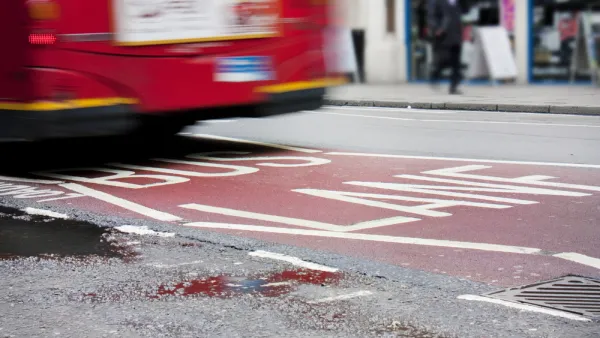
Red transit-only lanes on Market Street. Credit: SFMTA
FULL STORY: Federal approval will see Muni red lanes spread to 50 streets across SF

San Francisco's Red Carpet Transit Lanes to Continue Through March Evaluation
San Francisco's red, transit-only lanes are a demonstration project. The lanes first appeared in 2013 and were supposed to last two years, with state and federal regulators to determine whether they would continue. The state evaluation began Dec. 6.
San Francisco's First BRT Line Closer to Opening
The Van Ness Avenue Bus Rapid Transit project will bring the first dedicated BRT corridor to San Francisco, nearly two decades after voters approved the project.
More Details of Bus Rapid Transit's Expanding Reach in San Francisco
The Geary bus corridor was the #1 pick for a subway according to a Muni survey, but commuters will have to settle for bus rapid transit. A milestone was reached when the San Francisco County Transportation Authority approved the design and EIR.

Planetizen Federal Action Tracker
A weekly monitor of how Trump’s orders and actions are impacting planners and planning in America.

The state-sanctioned urbicide of Austin
People don’t kill cities. Freeways do.

US to reduce Colorado River water deliveries to Mexico
A new Colorado Treaty amendment reduces Mexico’s Colorado River water allocation by 250,000 acre feet.

5 New England states march closer to 800 megawatt wind energy project
Securing federal approval for the project may be complicated under the Trump administration, which has historically been hostile towards domestic wind power.

Baltimore to break ground on $50 million Transit Priority Project
The project will bring faster bus trips, safer streets and better bike connections to Baltimore.

Airbnb launches $250 million 'last-dollar financing' housing accelerator, makes first investment in Austin
The company will put $6.4 million towards affordable housing development in Texas’ capital.

FREE Course: Walkable City 1: Why Walkability?
After describing his path towards focusing on walkability as the essence of good planning, Jeff Speck marches through his five principal reasons for making more walkable places.
Reinventing Malls: Planning Alchemy—Turning Gray Fields Into Gold
The course focuses on the opportunities and imperatives that shape reinvention of mall sites.

Eagle County Government
Harvard University Graduate School of Design
Nashville Planning Department
The Architects Foundation
University of Cincinnati Online
The Pocatello Development Authority
The Urban Renewal Agency of the City of Pocatello
Journal of the American Planning Association