The oldest commuter rail line west of the Mississippi is also unique in another way—it lacks a dedicated source of operating revenue. Legislation has been introduced to allow Peninsula counties to vote to increase sales taxes by 0.125 percent.


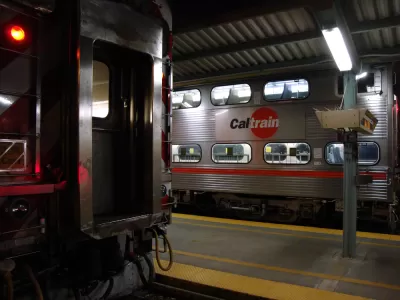
While Caltrain has one of the highest farebox recovery ratios in North America at 63 percent, that still leaves about 37 percent that is filled by "voluntary contributions from the three counties participating in the joint powers authority, and is the only passenger rail service in the U.S. to be financed in that manner," reports Sara Gaiser of Bay City News.
Senate Bill 797, introduced by state Sen. Jerry Hill, D-San Mateo, along with several other Bay Area senators and Assembly members, would authorize the Peninsula Corridor Joint Powers Board, which runs Caltrain, to place a one-eighth-cent sales tax on the ballot in San Francisco, San Mateo and Santa Clara counties.
SB 797 is intended to end fluctuations in those contributions and establish a reliable funding source, according to Hill.
The bill, introduced late in the legislative season on June 21 through the gut-and-amend process, i.e., stripping an unrelated bill that had cleared the Senate on May 31 and inserting the new text, so the bill went directly to the Assembly Rules Committee. While the bill need only pass with a majority vote and be signed by Gov. Jerry Brown, there are additional challenges.
The measure could only be placed on the ballot once the joint powers board gives it two-thirds approval. The boards of supervisors for San Francisco, San Mateo and Santa Clara counties and transportation authorities in the three counties would also have to approve it [by majority vote].
The final step is approval by the voters, also by a two-thirds supermajority. The legislation does not set a date for the election.
"The bill is backed by business groups including the Silicon Valley Leadership Group (SVLG) and SAMCEDA, the San Mateo County Economic Development Association," reports Adina Levin for Friends of Caltrain. According to Katy Murphy of The Mercury News, SVLG is sponsoring the bill.
“We all pay a little bit and we all prosper a lot,” said Carl Guardino, CEO of the business group.
"The revenue would generate roughly $100 million annually for Caltrain," adds Murphy. Caltrain's fiscal year 2017 budget [pdf] is $146,392,029.
Caltrain will begin a $2 billion modernization project this summer, including electrification of the diesel-powered line that runs 92 trains daily. While electrification should decrease operating costs, the number of trains should increase greatly.
Too many sales taxes?
"The statewide sales tax is 7.25 percent, but many cities and counties have their only sales taxes," notes Murphy. "If voters in three Bay Area counties agree to increase the sales tax by an eighth of a cent to help fund Caltrain, this is what the new rates would be:"
Santa Clara County: 9.125 percentSan Mateo County: 8.875 percent.San Francisco: 8.625 percent
Source: Board of Equalization
Competing transportation tax measure
Legislation authorizing another Bay Area transportation ballot measure, SB 595, also known as Regional Measure 3, would permit voters in all nine Bay Area counties to increase tolls on the seven state-owned Bay Area toll bridges (the Golden Gate Bridge not being one of them) by as much as 60 percent.
Presumably, but not necessarily, the Metropolitan Transportation Commission, the administrative body behind RM 3, would work with the Caltrain board to ensure both measures do not appear on the same ballot should both bills become law and be approved by their governing bodies.
Read the full story: Home Local News State / National / World Sports Opinion / Letters Business Arts / Entertainment Lifestyle Obit

Three Transportation Ballot Measures Could Be Headed to Bay Area Voters Next Year
The California Legislature approved bills to allow voters to decide on hiking sales taxes and tolls for regional transportation. Gov. Jerry Brown already signed a bill to allow San Mateo County voters to hike sales taxes for transportation.
Caltrain Electrification Broke Ground on Friday
Gov. Jerry Brown, Peninsula congresswomen, including House Minority Leader Nancy Pelosi, and state legislative leaders gathered in Millbrae with shovels-in hands to mark the beginning of a four-year construction project to electrify Caltrain.

$100 Billion Bay Area Transportation Tax Considered for November 2020 Ballot
Two years after voters in the nine-county Bay Area agreed to hike tolls on the region's seven state-owned bridges, regional business leaders are hoping they will approve a one-cent regional sales tax to fund $100 billion in transportation projects.

Planetizen Federal Action Tracker
A weekly monitor of how Trump’s orders and actions are impacting planners and planning in America.

Northwest rail fans eager for Sept. 30 debut of Amtrak’s Airo fleet
Get ready for that new train smell and more seats. But they won’t go faster or run more frequently on the Cascades route in Washington and Oregon.

Trump is considering data centers on 6 states' public land — some state officials say they had no idea
If the administration approves the proposed projects, data center and data center-related developments will cover 17,600 acres of public land.

After decades of planning, Sacramento gains new light rail station
Trains will arrive every 15 minutes during peak hours and every 30 minutes during non-peak hours.

Massive tunnel-boring machine breaks ground on Gateway Project
The Trump administration revoked funding for the project in October 2025, and then restored it earlier this year.

Airo trainsets begin service on Amtrak Cascades route
The trains feature panoramic windows, complementary wifi and over 300 seats per train set.

FREE Course: Walkable City 1: Why Walkability?
After describing his path towards focusing on walkability as the essence of good planning, Jeff Speck marches through his five principal reasons for making more walkable places.
Reinventing Malls: Planning Alchemy—Turning Gray Fields Into Gold
The course focuses on the opportunities and imperatives that shape reinvention of mall sites.

City of Thousand Oaks
City of Wisconsin Rapids
Harvard University Graduate School of Design
The Architects Foundation
University of Cincinnati Online
Northern Illinois Transit Authority (NITA)
The Pocatello Development Authority
The Urban Renewal Agency of the City of Pocatello