In a region with a full calendar of transit construction projects and high hopes for a positive stream of news, a premier and historic project has not gone as smoothly as hoped.


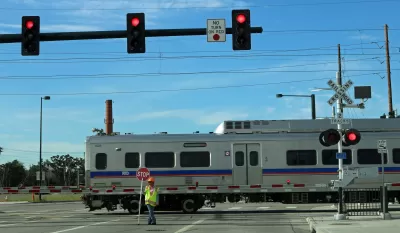
John Aguilar reports: "The price tag to man the 11 at-grade crossings along the 23-mile train route out to Denver International Airport since it opened a year ago: nearly $6 million and counting, according to calculations made by The Denver Post."
The high price tag isn't being paid by taxpayers (the Regional Transportation District's private sector partner Denver Transit Partners gets that privilege), but it's "perhaps the most visible and vexing sign that the state’s pre-eminent transit project has had a far rockier rollout than many had hoped."
Moreover, the problems with the gates have "ripple effects" to other parts of the RTD's capital investment program. According to Aguilar, "[a]s long as hang-ups persist with the timing of the gates that stop motorists from driving onto the tracks, there can be no progress on opening the G-Line to the western suburbs."
The cost comes from stationing officers in both the Denver and Aurora police departments at the crossings, as well as flaggers. RTD and Denver Transit Partners officials have not set any timetable for the reduction of staffing requirements at the A-Line's grade crossings.
Read the full story: One year in: Denver’s airport train navigates interruptions, a $6 million gate glitch and surprisingly strong ridership

Is it Fair to Blame Commuter Rail Woes on Private Operators?
Recent problems on the commuter rail operations contracted out by the Massachusetts Bay Transportation Authority and Denver's Regional Transportation District caught the eye of Governing's transportation and infrastructure reporter.
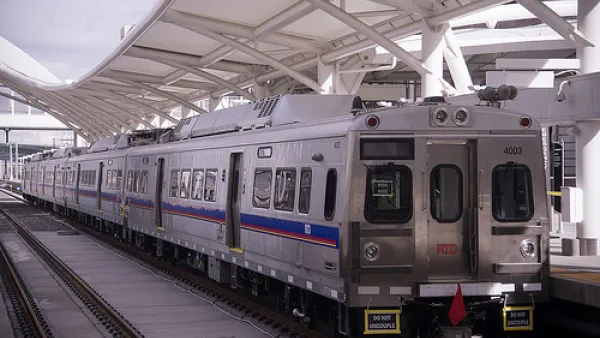
Denver Train Problems Caused by Tall Buildings: RTD
The A and G Lines use GPS for their crossing gates, they claim that a new software patch and other improvements would resolve those issues and put the G line on schedule.
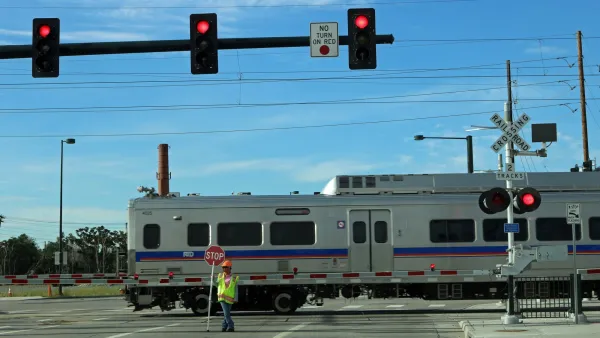
Train to Denver Airport Threatened with Closure over Crossing Gate Woes
The Federal Railroad Administration is threatening to revoke the waiver that allows the A-Line to operate with flaggers at grade crossings unless the Regional Transit District presents a plan by mid-month to fix the crossing gate problems.

Planetizen Federal Action Tracker
A weekly monitor of how Trump’s orders and actions are impacting planners and planning in America.

California plans to bury El Niño’s downpour
If the state plays its cards right, it may be able to store a billion acre-feet of El Niño’s water in aquifers.

Chicago breaks ground on $3 billion megadevelopment
The new neighborhood, titled Foundry Park, will one day host 3,700 residences.

California High-Speed Rail Authority CEO resigns after $600,000 scandal
Under Ian Choudri, the authority used taxpayer dollars to fund first class flights and trips to nightclubs.

Want to study the Missouri River? Soon, you may need unanimous approval from 10 states
Legislation would require 10 governors’ permission to study or build projects moving water outside the basin.

Desperate measures: Advocates weigh draining Lake Powell to fill Colorado River
Draining the reservoir could reduce evaporation losses by a couple hundred thousand acre-feet.

FREE Course: Walkable City 1: Why Walkability?
After describing his path towards focusing on walkability as the essence of good planning, Jeff Speck marches through his five principal reasons for making more walkable places.
Reinventing Malls: Planning Alchemy—Turning Gray Fields Into Gold
The course focuses on the opportunities and imperatives that shape reinvention of mall sites.

City of Rosemead
Rutgers University, Edward J. Bloustein School of Planning and Public Policy
One Hundred Miles
Hunter College, City University of New York (CUNY)
The Architects Foundation
University of Cincinnati Online
City of Cambridge
Montrose County
The Pocatello Development Authority