The Federal Railroad Administration is threatening to revoke the waiver that allows the A-Line to operate with flaggers at grade crossings unless the Regional Transit District presents a plan by mid-month to fix the crossing gate problems.


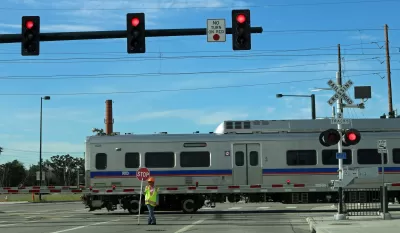
"In a Nov. 15 letter made public this week, Robert Lauby, chief safety officer at the Federal Railroad Administration, called 'unacceptable' the Regional Transportation District’s ongoing failure to provide warning times at its crossings that are within federally mandated ranges," reports John Aguilar for The Denver Post.
See CBS4 newscast on the FRA notice with excellent video of the trains themselves as well as flaggers working at grade crossings.
The A-Line has operated under an FRA waiver ever since the line opened in April 2016 because of the crossing gate challenges, which revolve around difficulties deploying new wireless signaling technology along the 23-mile line. The gates generally close earlier and lift up later than federal standards require.
The most recent waiver granted by the FRA, which required that flaggers be present at every crossing to provide a safety backstop, was for five years and was granted in September 2017.
Just six months after the A-Line opened, the FRA threatened the RTD with its shutdown along with the B-Line, a 6.2 mile, two-station electrified commuter rail line to Westminster which opened in July 2016, over the crossings gate problem. A 90-day waiver was granted.
RTD's plans to correct the problem ran afoul with the Colorado Public Utilities Commission in September 2017. Labor costs for the flaggers who must perform traffic duty at the A Line's 11 at-grade crossing amounted to $6 million for the first year, paid by Denver Transit Partners (DTP), a public-private partnership that is building and operating the A-Line, B-Line and G-Line, an 11-mile, 8-station electrified commuter rail line that will go to Wheat Ridge.
The two entities have filed lawsuits against one another as the crossing gate issue has dragged out for more than two years and RTD leaders have expressed concern about how the ongoing problems with crossing gate technology are harming the agency’s reputation.
Notwithstanding the signaling problems at intersections, the A and B lines have achieved an on-time performance rate exceeding 97 percent according to DTP.
Hat tip to AASHTO Daily Transportation Update.
FULL STORY: Feds threaten RTD over A-Line crossing gate problems

Denver Still Seeking a Solution to At-Grade Crossings on New Rail Lines
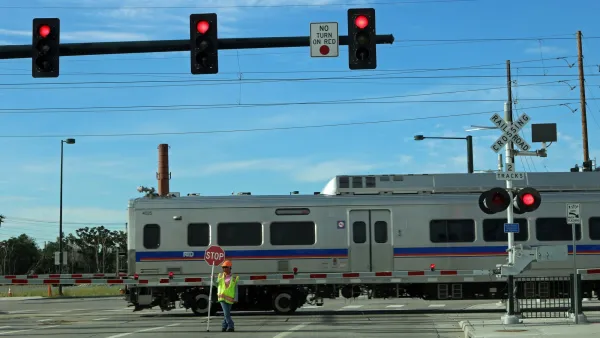
Seemingly esoteric matters of crossing safety and gate activation times are presenting a major obstacle for RTD's commuter rail expansion projects in the Denver area.
Problems on Denver's New Commuter Rail Lines Threaten Shutdown by Federal Regulators
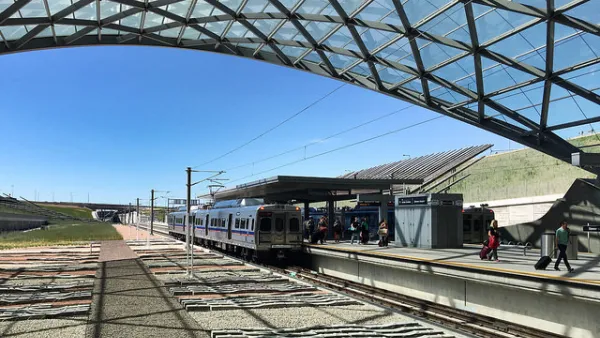
The problems caused by crossing gates for the new A and B Lines are so serious that the Federal Railroad Administration had threatened to close both lines on Nov. 5. They granted the Regional Transit District a 90-day waiver.
Grade Crossings Racking Up Costs on Denver's New A-Line
In a region with a full calendar of transit construction projects and high hopes for a positive stream of news, a premier and historic project has not gone as smoothly as hoped.

Planetizen Federal Action Tracker
A weekly monitor of how Trump’s orders and actions are impacting planners and planning in America.

The state-sanctioned urbicide of Austin
People don’t kill cities. Freeways do.

US to reduce Colorado River water deliveries to Mexico
A new Colorado Treaty amendment reduces Mexico’s Colorado River water allocation by 250,000 acre feet.

5 New England states march closer to 800 megawatt wind energy project
Securing federal approval for the project may be complicated under the Trump administration, which has historically been hostile towards domestic wind power.

Baltimore to break ground on $50 million Transit Priority Project
The project will bring faster bus trips, safer streets and better bike connections to Baltimore.

Airbnb launches $250 million 'last-dollar financing' housing accelerator, makes first investment in Austin
The company will put $6.4 million towards affordable housing development in Texas’ capital.

FREE Course: Walkable City 1: Why Walkability?
After describing his path towards focusing on walkability as the essence of good planning, Jeff Speck marches through his five principal reasons for making more walkable places.
Reinventing Malls: Planning Alchemy—Turning Gray Fields Into Gold
The course focuses on the opportunities and imperatives that shape reinvention of mall sites.

Eagle County Government
Harvard University Graduate School of Design
Nashville Planning Department
The Architects Foundation
University of Cincinnati Online
The Pocatello Development Authority
The Urban Renewal Agency of the City of Pocatello
Journal of the American Planning Association