The 6.2 mile, two-station electrified commuter rail line is opening as expected next Monday, July 25, but future service to the northwestern counties of Broomfield and Boulder will be delayed due to an unexpected funding shortfall.


Festivities for the Regional Transit District's (RTD) new B Line are planned at the line's two initial stations, Union Station and Westminster Station, located in the northwest suburb of Westminster, a city of 106,000 (2010 census), located in Adams and Jefferson counties.
"The 11-minute, one-way ride will cost $2.60," reports John Aguilar for The Denver Post. However, residents in Broomfield and Boulder counties will have to wait for some time before they see service.
But for many living farther up the northwest corridor — in communities such as Broomfield, Louisville, Boulder and Longmont — the B-Line opening will feel less satisfying. Louisville Mayor Bob Muckle characterized his invitation to the ribbon-cutting at the new Westminster Station...as “sort of bittersweet.”
Courtesy of Regional Transit District (RTD)

The delay results from a severe funding shortfall due to "tax revenue projections that outstripped collections and higher-than-anticipated construction costs...much of it falling disproportionately on the northwest corridor," adds Aguilar.
It may even take as long as 2042, depending on the cash flow situation at the RTD, before the full line is up and running.
An October 2013 post compares rail vs. bus rapid transit for the corridor. At that time, light rail, not commuter rail, was being considered.
Unlike the 23-mile, eight-station A Line from Union Station to Denver International Airport, with headways of 15 minutes, the initial B Line to Westminster will have half-hour peak and hourly off-peak headways.
RTD will open two more rail lines this year: the G commuter rail line in the fall and R light rail line extension in winter.
Hat tip to Annie Dawid.
FULL STORY: B-Line opening forges rail link to Denver’s northern suburbs for the first time

Denver's B Line to Westminster Now Open for Service
After Monday's celebrations at the new, electrified commuter rail line's only two stations, Union Station and Westminster Station, commuters now have the option of taking an 11-minute, six-mile ride to Denver, costing $2.60.
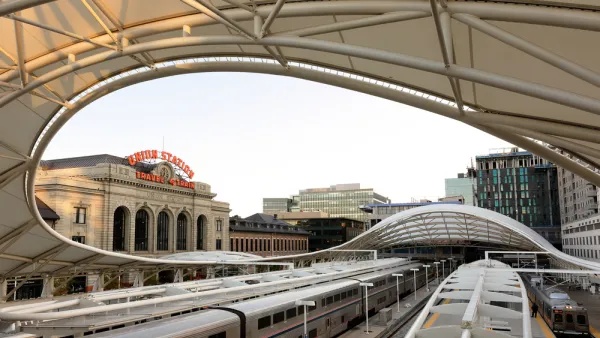
B Line Commuter Rail Extension Gets a Green Light in Colorado
The Board of Directors for the Regional Transportation District has given a preliminary green light to accelerate planning work on the B Line extension from Denver to Boulder and Longmont.
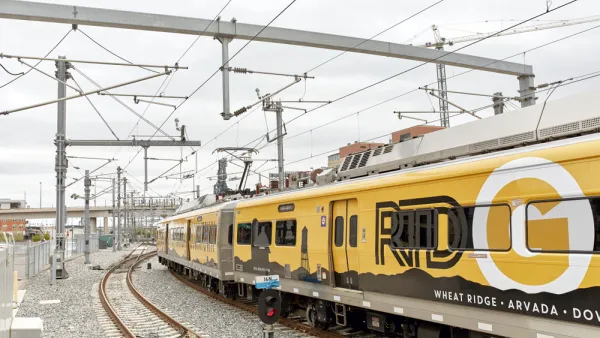
Political Pressure Reinvigorates B Line Extension Plans in Colorado
The CEO of the Regional Transportation District speculated recently about whether a planned extension of the B Line to Boulder was necessary or desirable. The governor doesn't think the speculation was necessary or desirable.

The state-sanctioned urbicide of Austin
People don’t kill cities. Freeways do.

US to reduce Colorado River water deliveries to Mexico
A new Colorado Treaty amendment reduces Mexico’s Colorado River water allocation by 250,000 acre feet.

New Jersey’s second-largest city bans standalone data centers
Jersey City will continue to allow co-location facilities, such as those meant for research institutions that store their own data.

Amtrak not solely to blame for New Jersey commuter rail's unreliability, report finds
A new study from the Garden State Initiative found that NJ Transit’s budget grew 20% across a 4 year period, but reliability declined significantly over the same period.

EPA erases limits on planet-warming pollution from power plants
Under Monday’s plan, power plants would still have some limits on how much mercury, arsenic and other contaminants they can emit.

Phoenix announces new on-demand transit service, more frequent RAPID buses
Both new services will launch in October, and are part of Phoenix's Project Effective Access Solutions for Easing Congestion.

FREE Course: Walkable City 1: Why Walkability?
After describing his path towards focusing on walkability as the essence of good planning, Jeff Speck marches through his five principal reasons for making more walkable places.
Reinventing Malls: Planning Alchemy—Turning Gray Fields Into Gold
The course focuses on the opportunities and imperatives that shape reinvention of mall sites.

Eagle County Government
Harvard University Graduate School of Design
Nashville Planning Department
The Architects Foundation
University of Cincinnati Online
The Pocatello Development Authority
The Urban Renewal Agency of the City of Pocatello
Journal of the American Planning Association