The Denver Regional Transportation District is forecasting an increasing gap between what it will cost to complete the region's FasTracks light rail system and how much taxpayer money will be available to fund its construction.


"RTD also is using a lower forecast for sales-tax collections, which are a key component of the revenue stream that will pay for FasTracks, the nation's most ambitious mass- transit expansion program.
The agency now is forecasting that it will have about $4.2 billion available from tax collections, federal funds and other sources to build the project by 2017 unless metro Denver voters approve a doubling of the existing 0.4 percent FasTracks sales tax in November.
Last year's revenue forecast was $4.8 billion."
RTD expects to be about $2.5 billion short of what it needs to complete the system by 2017.
Thanks to Reconnecting America
Read the full story: FasTracks funding gap widens

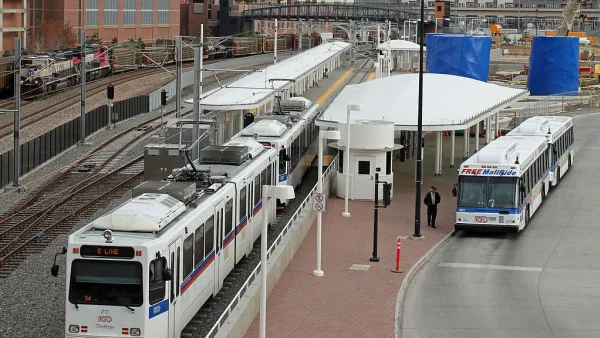
Denver Faces Light Rail vs. Bus Decision
The financial data is clear: BRT costs much less to go further and serve far more riders. Case closed, or is it? The Denver Post editors look at HNTB's cost and ridership estimates for the Northwest Rail Line and offer a recommendation, sort of.
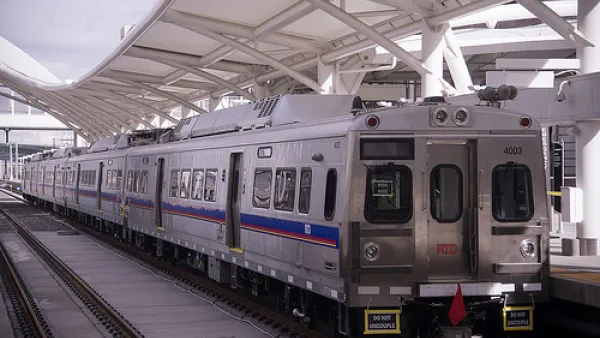
Denver Train Problems Caused by Tall Buildings: RTD
The A and G Lines use GPS for their crossing gates, they claim that a new software patch and other improvements would resolve those issues and put the G line on schedule.
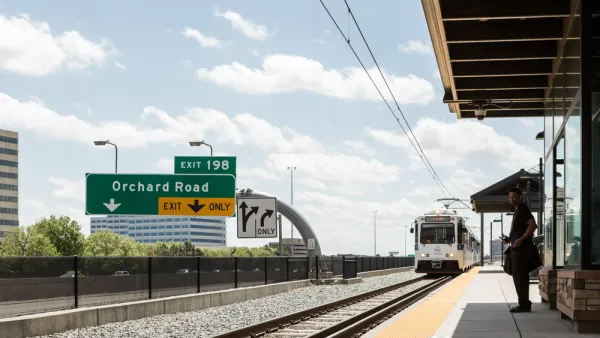
A Planning Controversy of the Transit Oriented Variety in Suburban Denver
A controversy has erupted over a proposed vision for transit oriented mixed in a Denver suburb.

Planetizen Federal Action Tracker
A weekly monitor of how Trump’s orders and actions are impacting planners and planning in America.

California plans to bury El Niño’s downpour
If the state plays its cards right, it may be able to store a billion acre-feet of El Niño’s water in aquifers.

Chicago breaks ground on $3 billion megadevelopment
The new neighborhood, titled Foundry Park, will one day host 3,700 residences.

California High-Speed Rail Authority CEO resigns after $600,000 scandal
Under Ian Choudri, the authority used taxpayer dollars to fund first class flights and trips to nightclubs.

Want to study the Missouri River? Soon, you may need unanimous approval from 10 states
Legislation would require 10 governors’ permission to study or build projects moving water outside the basin.

Desperate measures: Advocates weigh draining Lake Powell to fill Colorado River
Draining the reservoir could reduce evaporation losses by a couple hundred thousand acre-feet.

FREE Course: Walkable City 1: Why Walkability?
After describing his path towards focusing on walkability as the essence of good planning, Jeff Speck marches through his five principal reasons for making more walkable places.
Reinventing Malls: Planning Alchemy—Turning Gray Fields Into Gold
The course focuses on the opportunities and imperatives that shape reinvention of mall sites.

City of Rosemead
Rutgers University, Edward J. Bloustein School of Planning and Public Policy
One Hundred Miles
Hunter College, City University of New York (CUNY)
The Architects Foundation
University of Cincinnati Online
City of Cambridge
Montrose County
The Pocatello Development Authority