A news report on Charlotte's Lynx Blue Line looks at whether ride-hailing services are complementing rail transit by providing vital first mile-last mile service or whether customers are forgoing the transit trip entirely. Ridership has been falling.


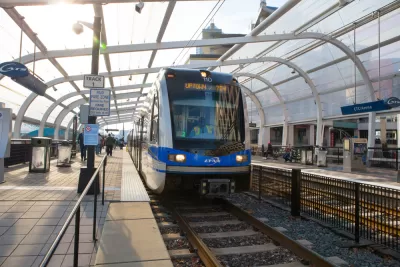
A March study by the American Public Transportation Association concluded that the two mobility providers, public transit operators and transportation network companies like Lyft and Uber, "are largely complementary," as are car and bike sharing services, all working together to enable a 'car-lite' lifestyle. However, a news report on Charlotte's gentrifying South End suggests that ride-hailing may be chipping away not only at bus ridership, but also potential passengers for the 9.6-mile light rail Lynx Blue line.
"For much of the past year, ridership on Charlotte Area Transit System buses and the Lynx Blue Line has declined," writes Steve Harrison for The Charlotte Observer. "For the first nine months of the fiscal year, ridership on all CATS services, including buses and the light rail, was down 4.3 percent compared with the same period a year earlier.
Just how much of that decrease can be placed on ride-hailing is unclear. Cheap gas and even broken counters on fare box machines may play a significant role.
Residents of transit oriented developments may prefer Uber
Another significant factor is that the gentrifying South End has displaced many transit-dependent residents. The new, all-market rate, transit-oriented apartments cater to millennials who don't appear to mind the higher ride-hailing costs and value their convenience.
Developers use the rail line as a marketing tool. For instance, the Fountains South End apartments has a first-floor Lynx Lounge, where people can wait inside a climate-controlled room before walking about 30 yards to the station.
Ridership on light rail in the South End, which opened in November 2007, has increased 30 percent since 2009 while population increased 135 percent.
Perhaps the most interesting part of Harrison's piece are his many interviews with area residents — all give high marks to Uber.
Raj Naik, general manager of Uber North Carolina, said the ride-hailing company has seen a significant increase in requests from South End, though he said it’s no greater than other parts of the city.
Partnering with Uber
It’s unclear whether companies like Uber are going to chip away at transit ridership – or whether CATS can partner with ride-hailing companies to make bus and train trips easier and grow ridership.
Earlier this year, CATS chief executive John Lewis said ride-hailing companies were a “challenge” for the transit industry, especially for trips on nights and weekends.
CATS said its plans to partner with ride-hailing providers are still “in the conceptual stage.”
SEPTA has already gone from conceptual to a summer pilot program in their partnership with Uber. Targeted are stations with oversubscribed parking. Subsidizing ride-hailing services could prove to be a competitive alternative to increasing parking.
"Under the partnership, Uber rides will be discounted by 40 percent to-and-from 11 suburban Regional Rail stations in Bucks, Chester, Delaware and Montgomery Counties, with a maximum discount of $10 per ride," notes the SEPTA May 25 press release.
The stations selected for inclusion in this pilot program are among SEPTA's busiest, with high ridership and limited availability of parking spaces. Several are key points for Airport travel, and others are at locations where parking is temporarily restricted due to construction.
However, it's questionable how transferable the findings from a commuter rail pilot program serving low dense areas will be with light rail serving Charlotte's higher density, transit-oriented South End.
Read the full story: Some Charlotte residents jump on Uber over train in South End

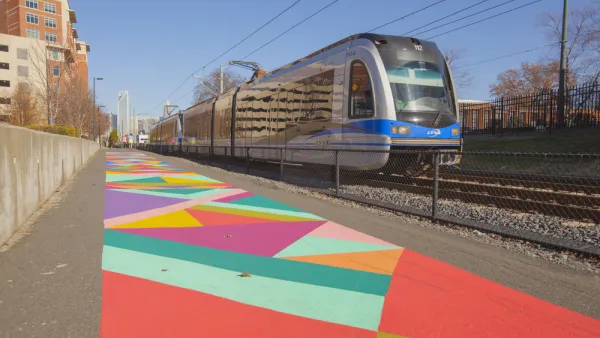
Charlotte's LYNX Light Rail: Ten Years Later
How has Charlotte evolved ten years since opening the LYNX Blue Line light rail system?
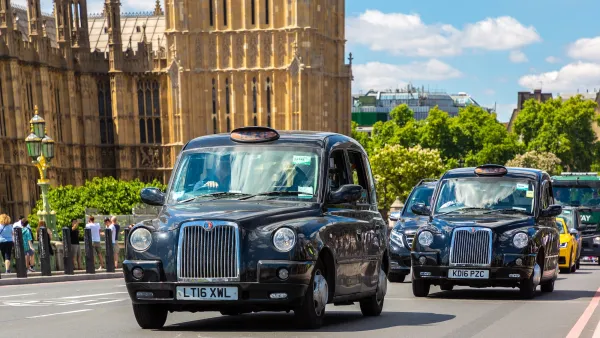
Can Robotaxis Handle London's Famously Tangled Streets?
Black Cab drivers say autonomous cars won’t be able to handle London’s unique conditions.
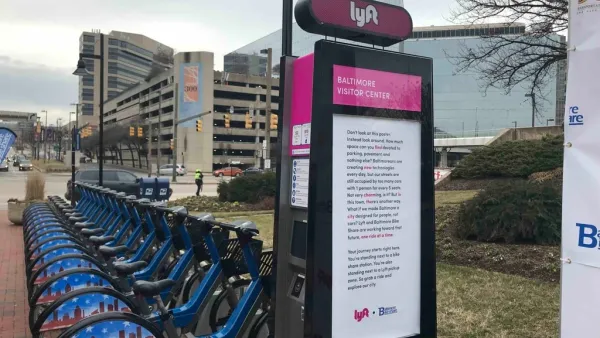
Uber and Lyft: A Tale of Two Companies
After years of resisting efforts by cities to regulate their business and constant—but unprofitable—growth, Uber and Lyft are homing in on their unique strengths.

Planetizen Federal Action Tracker
A weekly monitor of how Trump’s orders and actions are impacting planners and planning in America.

Amtrak, CN end decades-long dispute with eight-year agreement
The new operating agreement establishes an updated framework for the companies to work together, including processes to resolve disputes.

Nation's most wind-powered state turns to coal as data centers increase energy demand
For the first time in decades, Iowa has increased its generation of coal power.

Alabama scores up to $2.5 billion federal loan for largest infrastructure project in state’s history
The Mobile River Bridge and Bayway Project aims to ease congestion at Alabama’s worst bottleneck.

Trump is considering data centers on 6 states' public land — some state officials say they had no idea
If the administration approves the proposed projects, data center and data center-related developments will cover 17,600 acres of public land.

Despite court ruling, Trump is keeping nearly all wind projects in the US on hold
At least 110 wind energy projects have not heard from the government since a federal judge ruled that the Trump administration's freeze on wind turbine clearances was likely illegal.

FREE Course: Walkable City 1: Why Walkability?
After describing his path towards focusing on walkability as the essence of good planning, Jeff Speck marches through his five principal reasons for making more walkable places.
Reinventing Malls: Planning Alchemy—Turning Gray Fields Into Gold
The course focuses on the opportunities and imperatives that shape reinvention of mall sites.

KFH Group Inc.
Greater Baltimore Committee
Eagle County Government
The Architects Foundation
University of Cincinnati Online
The Pocatello Development Authority
The Urban Renewal Agency of the City of Pocatello