Apparently to galvanize public support, the Colorado Department of Transportation and an Ohio chamber of commerce have produced videos touting the benefits of widening projects for low-income communities.



In what Angie Schmitt has dubbed "highway propaganda," the Colorado DOT has spent over $80,000 to produce a half-hour promo video for its I-70 expansion project. A shorter production has also emerged from an Ohio chamber of commerce, promoting the Opportunity Corridor.
In Colorado, "the I-70 project will replace 12 miles of aging highway with a new highway, adding four lanes in the process. Because 900 feet of the new highway trench will be covered with a park, the CDOT video helpfully explains that the widening is really all about doing right by immigrant neighborhoods — not moving traffic. Many residents affected by the project beg to differ."
After their widespread vilification in many circles, big roads are resorting to overt public relations. The argumentative thrust of these videos is something like: "This highway isn't like the bad highways of the past — a new breed of road builder has figured out how to make asphalt and traffic lanes work wonders for struggling neighborhoods."
See the full story to watch the videos.
Read the full story: Highway Propaganda Vids Sell City Residents on the Wonders of Wider Roads


Denver's I-70 Expansion Undercuts Alternatives
To fund a wider I-70 on its route through Denver, the regional planning commission set aside $50 million in federal funds before considering other projects.
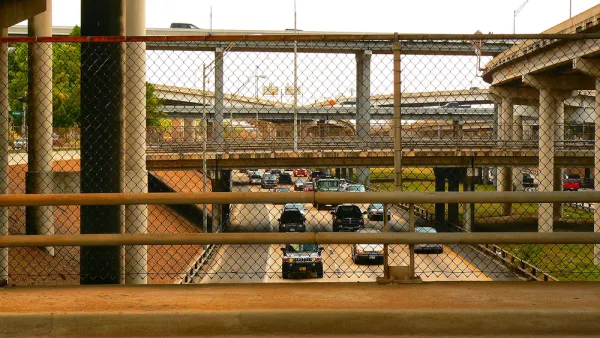
Freeway Expansions Continue to Threaten Black and Brown Communities
Despite calls to center equity in infrastructure projects, highway construction and expansion still disproportionately impacts communities of color, according to a Los Angeles Times investigation.

Induced Demand: Why Highways Still Reign in Dallas
Regional planners and Dallas officials aren't confident that the area's highway-centric worldview (and budget) will change anytime soon. The city's competitiveness in the national job market may be on the line.

Planetizen Federal Action Tracker
A weekly monitor of how Trump’s orders and actions are impacting planners and planning in America.

California plans to bury El Niño’s downpour
If the state plays its cards right, it may be able to store a billion acre-feet of El Niño’s water in aquifers.

Chicago breaks ground on $3 billion megadevelopment
The new neighborhood, titled Foundry Park, will one day host 3,700 residences.

California High-Speed Rail Authority CEO resigns after $600,000 scandal
Under Ian Choudri, the authority used taxpayer dollars to fund first class flights and trips to nightclubs.

Want to study the Missouri River? Soon, you may need unanimous approval from 10 states
Legislation would require 10 governors’ permission to study or build projects moving water outside the basin.

Desperate measures: Advocates weigh draining Lake Powell to fill Colorado River
Draining the reservoir could reduce evaporation losses by a couple hundred thousand acre-feet.

FREE Course: Walkable City 1: Why Walkability?
After describing his path towards focusing on walkability as the essence of good planning, Jeff Speck marches through his five principal reasons for making more walkable places.
Reinventing Malls: Planning Alchemy—Turning Gray Fields Into Gold
The course focuses on the opportunities and imperatives that shape reinvention of mall sites.

City of Rosemead
Rutgers University, Edward J. Bloustein School of Planning and Public Policy
One Hundred Miles
Hunter College, City University of New York (CUNY)
The Architects Foundation
University of Cincinnati Online
City of Cambridge
Montrose County
The Pocatello Development Authority