San Diego's Draft Downtown Mobility Plan is laudable but consists of basic generalities and vanilla concepts, ignoring how an urban environment functions, writes Jimmy Parker, former president of the city's most urban business district.


The city of San Diego recently released its long-anticipated Draft Downtown Mobility Plan for comment. The plan, based on a complete streets concept, is long on generalities and suburban notions of urban tranquility but short on a detailed and practical understanding of the workings of an urban environment, writes Jimmy Parker, former Gaslamp Quarter business improvement district (BID) president and urban consultant. Parker acknowledges:
The plan clearly illustrates that they listened to the cycling community in San Diego and incorporated cycling safety ideas from around the country. They are championing more green in our urban street diet, consistent with the downtown community plan and the desire of many groups interested in downtown.
So what's wrong with the plan? Parker writes:
We all too often attempt to recreate what we value in our suburban neighborhoods without the understanding of what it takes establish and sustain these ideas, designs and initiatives in a dynamic urban setting.
For one, the plan's drafters fail to address how the proposed widened sidewalks operate, inter-relate with their adjacent uses, and need to be maintained, writes Parker. Parker also criticizes the plan for continuing to focus on traffic flow (including dedicated bicycle lanes) rather than creating a calmer and more cohesive urban environment.
Parker has several specific criticisms and recommendations borne of decades of hands-on management of the San Diego's downtown historic district and dining and entertainment destination, the Gaslamp Quarter.
Read the full story: Downtown San Diego Mobility Plan – Vision for the Future or A Well Intentioned Waste of Money?

Transforming Downtown San Diego's Grid for Biking and Walking
By virtue of super small blocks, San Diego's downtown has more space dedicated to cars than most cities. That's about to change. San Diego urban design activist Bill Keller explains how they’ll do it.
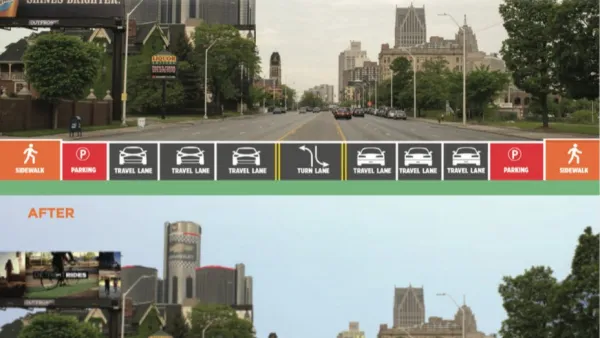
Major Street Reconfiguration Underway in Detroit
A $1 million project to reduce vehicle lanes on Detroit's Jefferson Boulevard is designed to increase safety along the busy corridor.
California Environmental Law Continues to Frustrate Bike Planning (for Now)
Help is on the way. The law that requires the governor's planning office to devise an alternative method for measuring vehicle traffic for environmental compliance will also take up where an earlier law that exempted bike lanes from CEQA left off.

Planetizen Federal Action Tracker
A weekly monitor of how Trump’s orders and actions are impacting planners and planning in America.

Amtrak, CN end decades-long dispute with eight-year agreement
The new operating agreement establishes an updated framework for the companies to work together, including processes to resolve disputes.

Judges permit Denver to divert 77,000 acre feet from the Colorado River for reservoir expansion
Overuse and climate change have caused the Colorado River’s water levels to plummet.

NYC DOT wants faster, more permanent street upgrades
The city is examining ways to build more concrete infrastructure without getting entangled in 'decades-long' projects.

'Something we’ve never seen before:' rising utility rates could strain city finances nationwide
Data centers, climate change and other factors have caused utility rates in the United States to increase by 38% since 2020.

Trump to overrule local leaders, lease millions of acres of America’s Pacific Island territories’ seafloors to mining companies
International law says that the Indigenous people of America’s territories have a right to prior and informed consent regarding projects that impact their countries.

FREE Course: Walkable City 1: Why Walkability?
After describing his path towards focusing on walkability as the essence of good planning, Jeff Speck marches through his five principal reasons for making more walkable places.
Reinventing Malls: Planning Alchemy—Turning Gray Fields Into Gold
The course focuses on the opportunities and imperatives that shape reinvention of mall sites.

Harvard University Graduate School of Design
KFH Group Inc.
Greater Baltimore Committee
The Architects Foundation
University of Cincinnati Online
The Pocatello Development Authority
The Urban Renewal Agency of the City of Pocatello