By virtue of super small blocks, San Diego's downtown has more space dedicated to cars than most cities. That's about to change. San Diego urban design activist Bill Keller explains how they’ll do it.


Downtown San Diego's population is ramping up quickly, and it’s making life for bicyclists and pedestrians unpleasant and dangerous on downtown's wide street small block one-way auto-oriented grid. But that's about to change, explains longtime San Diego planning advocate Bill Keller.
Civic San Diego last year initiated the Downtown San Diego Mobility Plan, which includes goals such promoting everyday commuter and recreational bike trips, creating a network of streets to keep bicyclists and pedestrians safer, and reducing greenhouse gas emissions, according to Keller.
"While autos will continue to have priority on certain streets, other streets may get bike lanes, cycle tracks or bike boulevards. Underutilized one-way streets (like E St, 6th & 7th Ave) might be converted to two-way or designated for diagonal parking."
Read the full story: Downtown San Diego by Bike – changes coming

Op-Ed: San Diego's Draft Downtown Mobility Plan Suffering From Suburban Myopia
San Diego's Draft Downtown Mobility Plan is laudable but consists of basic generalities and vanilla concepts, ignoring how an urban environment functions, writes Jimmy Parker, former president of the city's most urban business district.
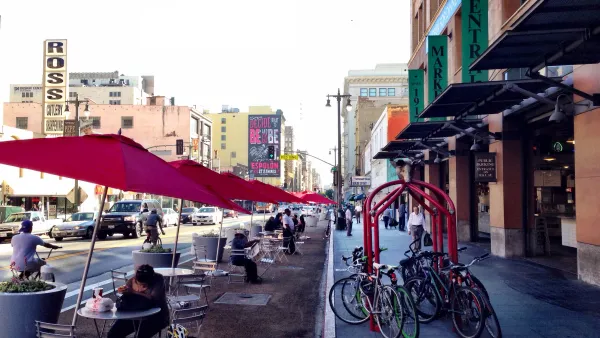
Auto-Centric City Dichotomy: More Mobility Options and More Risk
As cities strive to improve mobility for all users, the existing auto paradigm is slow to change
Complete Streets Policies Still Seeking Equity
Though the quick expansion of complete streets policies is worth celebrating, minority and low-income communities are still being left behind, and killed at a disproportionate rate.

Planetizen Federal Action Tracker
A weekly monitor of how Trump’s orders and actions are impacting planners and planning in America.

California plans to bury El Niño’s downpour
If the state plays its cards right, it may be able to store a billion acre-feet of El Niño’s water in aquifers.

Chicago breaks ground on $3 billion megadevelopment
The new neighborhood, titled Foundry Park, will one day host 3,700 residences.

Want to study the Missouri River? Soon, you may need unanimous approval from 10 states
Legislation would require 10 governors’ permission to study or build projects moving water outside the basin.

Desperate measures: Advocates weigh draining Lake Powell to fill Colorado River
Draining the reservoir could reduce evaporation losses by a couple hundred thousand acre-feet.

This road in NYC is infamously dangerous — and Mamdani can't fix it
New York City's Ocean Parkway is known for reckless driving, but the power to implement safety measures lies with the state rather than the city.

FREE Course: Walkable City 1: Why Walkability?
After describing his path towards focusing on walkability as the essence of good planning, Jeff Speck marches through his five principal reasons for making more walkable places.
Reinventing Malls: Planning Alchemy—Turning Gray Fields Into Gold
The course focuses on the opportunities and imperatives that shape reinvention of mall sites.

City of Rosemead
Rutgers University, Edward J. Bloustein School of Planning and Public Policy
One Hundred Miles
Hunter College, City University of New York (CUNY)
The Architects Foundation
University of Cincinnati Online
City of Cambridge
Montrose County
The Pocatello Development Authority