With gas prices the lowest since 2009, ten state legislatures and governors consider raising state gas taxes, though many are accompanied by fiscally questionable tax shifts. Some tried and failed last year. All of the proposed increases are modest.


2015 was a good year for determined governors and state legislators to raise gas taxes (see below). "With most state legislative sessions now underway, all signs point to that trend continuing this year," writes Carl Davis, research director of the Institute on Taxation and Economic Policy (ITEP). "There are at least nine states where gas tax increases will receive serious consideration in 2016." Keep an eye on Alaska's proposal (see below), the most ambitious one.
While that may please transportation infrastructure advocates, it doesn't necessarily make for good fiscal policy when "these long-overdue gas tax updates are only being considered on the condition that they are coupled with an equal, or larger, cut in other taxes," adds Davis. "Since those other taxes tend to fund services such as education and health care, these 'tax shift' efforts have more to do with reshuffling state investments than with enhancing them."
Case in point: Michigan. "(L)awmakers approved increases to gas taxes and vehicle registration fees last November but also offset new revenue with future cuts to the state’s top income tax rate," wrote ITEP's senior analyst, Lisa Christensen Gee.
"That being said, some amount of tax cutting alongside a gas tax increase can be justified," writes Davis, who acknowledges that gas taxes can be viewed as regressive, and recommends how to mitigate them.
Lower- and moderate-income families are less able to afford a higher gas tax, so there is good reason to consider pairing gas tax increases with a targeted tax cut specifically for those families. Unfortunately, however, most of the tax cut proposals being considered alongside gas tax increases (such as estate tax cuts in New Jersey and income tax cuts in Indiana and South Carolina) are not at all targeted to taxpayers of modest means.
So let's start there:
- New Jersey: With the state Transportation Trust Fund broke, this would be the year to raise the nation's second lowest gas tax (after Alaska) per API [PDF], notwithstanding Gov. Chris Christie's overt rejection of doing so, writes John Reitmeyer for NJ Spotlight. "Unfortunately, the tax cut options that appear to be on the table are not at all well-suited to offset the regressive impact of a gasoline tax increase," writes Davis. "Estate tax cuts and an expanded income tax break for taxpayers with significant pension income are the most frequently discussed tax cut options."
- Indiana: "Legislation passed by the Indiana House of Representatives would raise the state’s gas tax by 4 cents per gallon and allow the rate to grow alongside inflation in the years ahead," writes Davis, who concludes "that most taxpayers would see their overall tax bill rise under this swap (while) upper-income residents would receive a net tax cut." However, Gov. Mike Pence and House Democrats oppose the gas tax increase, advocating "using the state’s surplus and bonding authority to boost spending over the next several years," writes John Ketzenberger for IndyStar. Pence "proposes $1 billion in new spending; the Democrats suggest doubling down.
- South Carolina: A bill to increase the third lowest gas tax in the country by 10-cents, not raised for 27 years, did not succeed last year [described in April and July]. The proposal considered income tax shifts and indexing to inflation. A 12-cent increase, the largest of any state, is under consideration.
- Alabama: While a previously reported 5-cent proposed tax increase did not become law, it's looking pretty good that a gas tax increase will pass this year—the only question is how much. "Rep. Mac McCutcheon, the transportation committee chairman, said it would take a 12-cent-per-gallon increase in the gasoline tax to catch up with inflation since a 5-cent hike in 1992 brought the tax to its current level of 16 cents," reports Mike Cason for AL.com. "Gov. Robert Bentley (R) told the Alabama Asphalt Pavement Association he would rely on its members and others to lead the charge on the gas tax increase," Cason wrote earlier.
- Alaska (lowest taxed state, and lowest gas tax in the nation, with the third highest gas prices per CNN): Like in other petrostates such as Saudi Arabia and Venezuela, declining oil revenues have led to major budget deficits and caused leaders to raise gas prices. By lessening substantial state subsidies, the plan by Gov. Bill Walker, an Independent, "would raise the state’s gasoline tax from 8 cents to 16 cents per gallon, and more than double the tax on jet fuel," writes James Brooks for the Juneau Empire. It "was received with far more aplomb than a bill last session that raised the gas tax by less than one cent." Perhaps that is due to the fact that the least-taxed state in the country is considering adding a state income tax.
- California (fifth highest gas taxes, second highest gas prices after Hawaii): We've written enough of proposals that have been stymied by stalwart anti-tax Republicans. Unless the legislature acts, the gas tax will be decreased by at least four cents this year.
- Hawaii (third highest gas taxes, highest gas prices): "Gov. David Y. Ige (D) has proposed increasing Hawaii’s gasoline excise tax rate by 3 cents per gallon," writes Davis. Revenue would go to the state highway fund. The bill would also increase registration fees. No tax shifts included.
- Mississippi: Last gas tax increase was 1987. The increase could be as small as one cents, among many funding options reported by Jimmie E. Gates for The Clarion-Ledger, though a tax shift appears likely. "There is no reason we cannot balance an increase in fuel tax with an equal and sufficient tax reduction," stated Gov. Phil Bryant (R) in his January state of the state address.
- Missouri: Gov. Jay Nixon (D) supports raising the gas tax by 1.5-cents and the diesel tax by 3.5-cents. "House Speaker Todd Richardson would prefer to redirect other state funds toward infrastructure," writes Davis. "More specifically, the St. Louis Post-Dispatch explains that the Missouri Legislature is considering taking money it saved by slashing programs for the poor, especially poor children, and devoting it to highways.”
- Delaware legislators have opted for a unique proposal—learning from the failed attempt by Gov. Jack Markell (D) made in 2014, the dime increase will last for only one year, "allowing lawmakers to take stock of where oil prices stand and decide whether or not to renew it," writes Matthew Albright for The News Journal. Critics of raising gas taxes who claim "you don't know where the funds will go" could cite The First State. "Markell proposed transferring nearly $40 million for the second year out of Delaware's Transportation Trust Fund to help cover general fund expenses and balance the budget," states a February 2015 Planetizen post. The vast majority of tax diversions occur the opposite direction, from General Fund to highway fund. And few complain.
Last year, ten states increased gas taxes. The political party of the governor is indicated below (Democrat, Republican, Independent).
- Alaska (Ind.)
- Georgia (R)
- Idaho (R)
- Kentucky (D)
- Nebraska [bill became law as a result of overriding the veto Gov. Pete Ricketts (R)]
- Michigan (R)
- North Carolina (R)
- South Dakota (R)
- Utah (R)
- Washington (D)
According to the Feb. 9 Short Term Energy Outlook of the Energy Information Administration, gas prices in 2016 and 2017 will be lower than in 2015. it will be up to elected leaders to shepherd transportation funding proposals this year in their respective states, but hopefully not at the expense of other vital needs.
Read the full story: 2016 State Tax Policy Trends: Nine States Seriously Considering Gas Tax Increases

New Jersey's Transportation Legacy: Cheap Gas, Bad Roads and Bridges
NPR reports on the incipient movement among a dozen states considering raising gas taxes. It centers on New Jersey which arguably illustrates best the need to raise gas taxes to maintain roads and bridges, but it won't be easy, as the interviews show
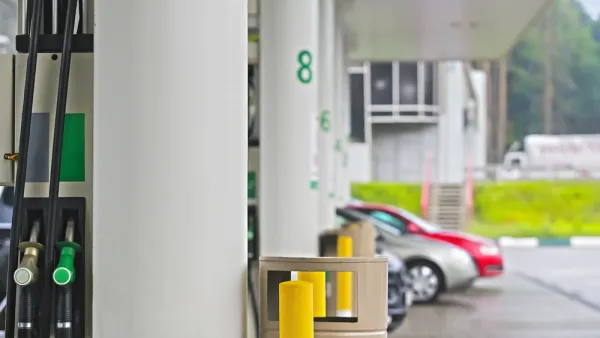
ICYMI: 12 States Hiked Gas Taxes on Monday
On July 1, Illinois and Ohio increased gas taxes by double digits: 19 cents per gallon and 10.5 CPG, respectively, followed by California at 5.6 CPG, all due to legislation passed this year or in 2017. Diesel tax hikes were even higher.
Missouri Governor: Don't Show Me a Gas Tax Hike!
It is an understatement that Increasing fuel taxes is challenging. If there is an opportune time to do it, it's when gas prices are relatively low, when the state decides to cut other taxes, and when there's bipartisan support.

Planetizen Federal Action Tracker
A weekly monitor of how Trump’s orders and actions are impacting planners and planning in America.

Amtrak, CN end decades-long dispute with eight-year agreement
The new operating agreement establishes an updated framework for the companies to work together, including processes to resolve disputes.

Northwest rail fans eager for Sept. 30 debut of Amtrak’s Airo fleet
Get ready for that new train smell and more seats. But they won’t go faster or run more frequently on the Cascades route in Washington and Oregon.

Brightline Florida files for bankruptcy
The transit company is over $5 billion in debt.

St. Louis Metro to test if single-car trains can reduce operating costs, maintain rider satisfaction
The pilot program will run from October to spring 2027, and begin with one single-car train operating on Metrolink’s Red and Blue lines.

Pennsylvania is building data centers in abandoned mines
Housing data centers in mines provides an alternative to destroying local forests and may spare residents from data centers’ noise and air pollution.

FREE Course: Walkable City 1: Why Walkability?
After describing his path towards focusing on walkability as the essence of good planning, Jeff Speck marches through his five principal reasons for making more walkable places.
Reinventing Malls: Planning Alchemy—Turning Gray Fields Into Gold
The course focuses on the opportunities and imperatives that shape reinvention of mall sites.

City of Thousand Oaks
City of Wisconsin Rapids
Harvard University Graduate School of Design
The Architects Foundation
University of Cincinnati Online
The Pocatello Development Authority
The Urban Renewal Agency of the City of Pocatello