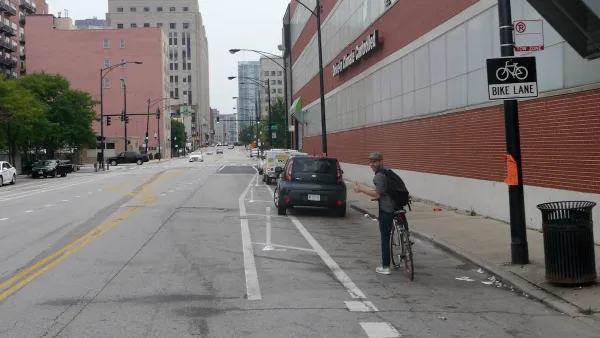
Proof that words matter—especially in court—came when Chicago tried to redefine bike lanes as recreational facilities.


Brendan Kevenides shares news on an interesting anecdote from the legal annals of Chicago's bike infrastructure that speaks to the contested definitions of multi-modal transportation. "In a hearing last week in the Circuit Court of Cook County the City of Chicago sought to have all of the bicycle lanes installed throughout the City declared 'recreational facilities.'"
"The effect of this creative legal maneuver would have been to immunize the municipality for injuries to bicyclists caused by the City’s failure to keep its bike lanes safe for riders," adds Kevenides.
Kevenides is an attorney at Freeman Kevenides, a law firm that represents "bicyclists, pedestrians, and other vulnerable road users." The law firm represented a bicyclist "injured when she struck a large water filled hole located in the middle of a marked bike lane at 1124 North Damen Avenue," which prompted the city's semantic defense.
In the end, a Cook County judge denied the city's attempt to define bike lanes as recreational facilities, and upheld the city's responsibility to maintain bike lanes under the penalty of actionable liability.
Read the full story: Chicago Cannot Deny Responsibility For Bike Lane Hazards

Chicago bike lane projects spark backlash from businesses, gentrification fears
A battle is brewing over Chicago's street space.
Chicago Pilot Would Keep Bike and Bus Lanes Clear — Without the Police
A proposal supported by many city officials and road safety advocates would shift right-of-way enforcement to ‘Rapid Response Aides’ to free up police resources and clear blocked lanes more quickly.

Chicago Sees Record Shared Bike, Scooter Use
Riders took over 11 million bike share and scooter trips in 2024.

Planetizen Federal Action Tracker
A weekly monitor of how Trump’s orders and actions are impacting planners and planning in America.

California plans to bury El Niño’s downpour
If the state plays its cards right, it may be able to store a billion acre-feet of El Niño’s water in aquifers.

Desperate measures: Advocates weigh draining Lake Powell to fill Colorado River
Draining the reservoir could reduce evaporation losses by a couple hundred thousand acre-feet.

In Texas, data centers are swallowing promised parkland
Residents who moved to Taylor, Texas for a rural community now have to contend with three data centers in their backyard.

How a Chicago-sized wind farm beat the odds and powered on
The project spanned five presidential administrations and a standoff with a U.S. military base.

MTA gives itself 30 days to transform pit into basketball court
The site has been under construction since 2022; the city originally estimated it would finish the court in 2024.

FREE Course: Walkable City 1: Why Walkability?
After describing his path towards focusing on walkability as the essence of good planning, Jeff Speck marches through his five principal reasons for making more walkable places.
Reinventing Malls: Planning Alchemy—Turning Gray Fields Into Gold
The course focuses on the opportunities and imperatives that shape reinvention of mall sites.

City of Rosemead
Rutgers University, Edward J. Bloustein School of Planning and Public Policy
One Hundred Miles
Hunter College, City University of New York (CUNY)
The Architects Foundation
University of Cincinnati Online
City of Cambridge
Montrose County
The Pocatello Development Authority