An earlier post on New York Gov. Andrew Cuomo's big capital project proposal this week gave barely a mention of his new plans for the renovation, or rebirth, of Penn Station, America's busiest rail station.


The editorial board of The New York Times recaps part of the governor's busy week proposing new renovations to Penn Station, compared in the editorial to "a minimum-security prison that sells magazines and popcorn."
Between Proposal 5 (lower Thruway tolls!) and 7 (a bigger Javits Convention Center!), was one to make a New Yorker perk up: Proposal 6, transforming Penn Station.
The editorial indicates that developers had been selected to perform the transformation of Penn Station and Farley Post Office building into Moynihan Station and that while the first phase is underway, "the overall project has been stalled."
"It is unclear exactly how the more than $3 billion project, which the governor is calling the Empire Station Complex, will be paid for, but Mr. Cuomo is expected to unveil a financial plan for his transportation network at next week’s State of the State speech," wrote The New York Times' Emma G. Fitzsimmons and Charles V. Bagli on Wednesday.
The developers initially selected for the project ten years ago, Related Companies and Vornado Realty, "had agreed to pay the state more than $200 million for the Farley building and $110 million for development rights that they planned to transfer across Eighth Avenue for a residential tower," wrote Fitzsimmons and Bagli.
Should the two companies not be selected for Empire State Complex, "the state would be required to reimburse Vornado and Related for more than $30 million," according to Fitzsimmons and Bagli.
As in the first post on Gov. Cuomo's infrastructure agenda, the editorial board references New York's premier, though controversial builder: "Mr. Cuomo seems to have gone from zero to Robert Moses in 60 seconds."
Read the full story: A New Old Plan for Penn Station

Formidable Barriers Threaten Penn Station Renovation
Last month N.Y. Gov. Andrew Cuomo proposed that Empire Station replace Penn Station, but many challenging parts, e.g., the Hudson River Tunnels, moving Madison Square Garden, could derail it. A related piece delves into the prior ARC tunnel project.
Massive, Expensive Redevelopment of Midtown Manhattan Proposed
New York Governor Cuomo's State of the State speeches last week included an ambitious proposal for a large-scale redevelopment project on Manhattan's west side, adjacent to Penn Station.
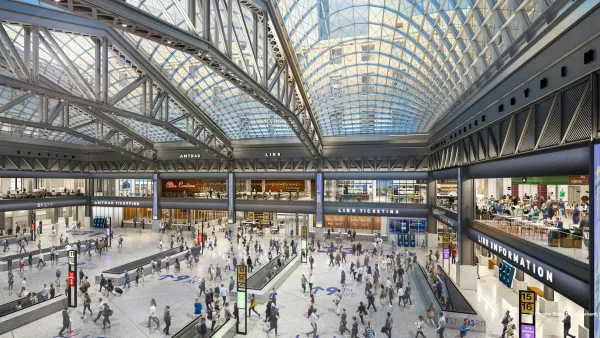
In New York's Next Penn Station, Function Does Not Always Follow Form
Some of the time and money invested in the visually spectacular Moynihan Station should have been spent looking at how well it actually works for commuters, writes Alon Levy.

Planetizen Federal Action Tracker
A weekly monitor of how Trump’s orders and actions are impacting planners and planning in America.

Amtrak, CN end decades-long dispute with eight-year agreement
The new operating agreement establishes an updated framework for the companies to work together, including processes to resolve disputes.

Judges permit Denver to divert 77,000 acre feet from the Colorado River for reservoir expansion
Overuse and climate change have caused the Colorado River’s water levels to plummet.

NYC DOT wants faster, more permanent street upgrades
The city is examining ways to build more concrete infrastructure without getting entangled in 'decades-long' projects.

'Something we’ve never seen before:' rising utility rates could strain city finances nationwide
Data centers, climate change and other factors have caused utility rates in the United States to increase by 38% since 2020.

Trump to overrule local leaders, lease millions of acres of America’s Pacific Island territories’ seafloors to mining companies
International law says that the Indigenous people of America’s territories have a right to prior and informed consent regarding projects that impact their countries.

FREE Course: Walkable City 1: Why Walkability?
After describing his path towards focusing on walkability as the essence of good planning, Jeff Speck marches through his five principal reasons for making more walkable places.
Reinventing Malls: Planning Alchemy—Turning Gray Fields Into Gold
The course focuses on the opportunities and imperatives that shape reinvention of mall sites.

Harvard University Graduate School of Design
KFH Group Inc.
Greater Baltimore Committee
The Architects Foundation
University of Cincinnati Online
The Pocatello Development Authority
The Urban Renewal Agency of the City of Pocatello