World leaders are meeting in Paris this week for the United Nation's COP21 talks. But what exactly are the main topics of discussion?


Representatives of more than 190 nations will soon meet for the 21st Conference of Parties (COP21) UN climate negotiations in Paris, even as the city is still mourning the deaths of 129 civilians in terrorist attacks.
Rooted in a complex web of history and culture, the tragedy also serves as a marker of the human risks of an unstable climate. A 2015 National Academy of the Sciences study demonstrated links between climate change and the political and economic instability in Syria that bolstered ISIS's growth.
With the inextricable and unpredictable links between the world’s nations clear in this as in so many other examples, the stakes for the negotiations are extremely high. But for many people working in the built environment, what exactly the conference is, how it differs from previous iterations, and how it might affect designers, developers, policy makers, and other stakeholders is somewhat unclear.
Read the full story: A quick guide to the COP21 climate talks
Cautious Optimism in the Wake of COP21
With the historic climate agreement reached in Paris at COP21, what implications will it have on the architecture, engineering and design industries? Doggerel spoke to U.S. Green Building Council Chair-elect Fiona Cousins for her perspective.
Could the Humble Heat Pump Be a Decarbonization Hero?
Buildings are responsible for a little less than half of greenhouse gas emissions in the U.S. Break this figure down further and you'll find that building heating accounts for about a fifth of all U.S. emissions.
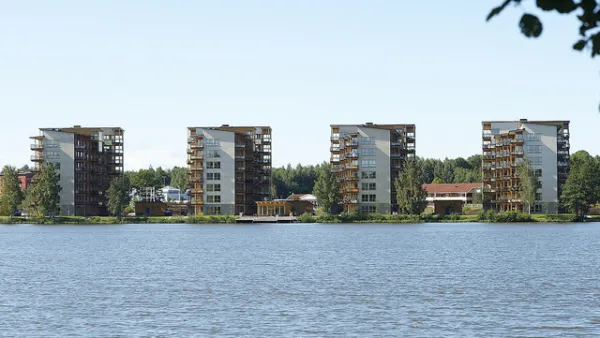
Fire Tests Enable New Timber Typologies
After a long time lost in the woods, architects and engineers are rediscovering timber. Recent fire tests have demonstrated that timber can be a viable building material and meet existing code requirements.

Washington state to charge fee to drivers with fuel-efficient cars
Revenue from the fee will go towards supporting the state’s highways.

Illinois considers spending $1 billion in taxpayer money on data center
A quantum computing campus and data center are currently under construction in Chicago.

Trump to blast ‘hydrocarbon highway’ through ‘world’s longest art gallery’
Environmental and historic preservation groups are suing to stop the project.

NYC, state sue feds over mixed-immigration-status housing assistance rule
The state’s lawsuit argues that the rule change violates the Administrative Procedure Act.

Michigan to turn neighborhood into virtual power plant
Residents will soon be able to divert their excess energy to the grid in exchange for compensation.

Data center, mining project swarm to long-awaited Alaska railroad line
The state-owned railroad approved final plans for the spur line this week; the project is expected to cost $311 million, mostly funded by the federal government

FREE Course: Walkable City 1: Why Walkability?
After describing his path towards focusing on walkability as the essence of good planning, Jeff Speck marches through his five principal reasons for making more walkable places.
Reinventing Malls: Planning Alchemy—Turning Gray Fields Into Gold
The course focuses on the opportunities and imperatives that shape reinvention of mall sites.

City of Charlotte
City of Rosemead
Rutgers University, Edward J. Bloustein School of Planning and Public Policy
University of Michigan School for Environment and Sustainability (SEAS)
Hunter College, City University of New York (CUNY)
The Architects Foundation
University District Partnership