Buildings are responsible for a little less than half of greenhouse gas emissions in the U.S. Break this figure down further and you'll find that building heating accounts for about a fifth of all U.S. emissions.


Heat pump basics
A heat pump’s job is to extract heat from the environment and direct it wherever it’s needed — a living room, for example, or a hot-water tank. It can also create cool air and water by transferring the collected heat away from the target area. Window air conditioners and refrigerators are both variants of this technology.
Heat pumps that draw heat from the ground or water (geothermal boreholes in the first instance, lakes or rivers in the second) are more efficient than those that pull it from the air. But all can transmit more energy (in the form of heat) than they require to operate (in the form of electricity) — at least outside of regions that frequently experience extreme cold. This makes them generally more efficient than other heating systems. If powered by zero-carbon electricity, they can heat buildings without generating greenhouse gas emissions.
Read the full story: Could the humble heat pump be a decarbonization hero?
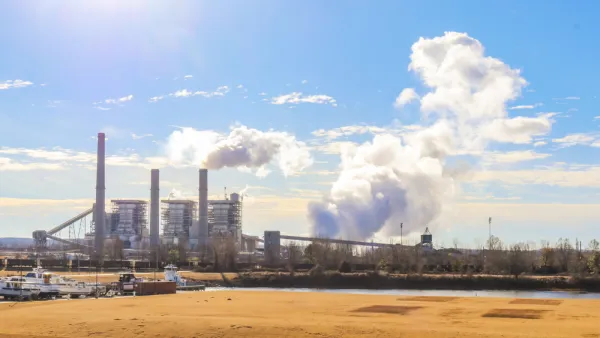
Report: U.S. Greenhouse Gas Reductions Not Hitting Paris Agreement Goal
The United States is making modest gains in the power and transportation sectors, but emissions in the industrial sector are holding steady, absent new reduction initiatives.

Study: Cutting U.S. Emissions by 50 Percent This Decade Is Possible
With coordinated effort at the local, state, and federal levels, the United States could meet its goal of cutting greenhouse gas emissions in half by 2030.

Court unfreezes $20B in federal climate grants
A U.S. Court of Appeals ruled that the Trump administration potentially violated the Inflation Reduction Act by attempting to claw back grants awarded under the Greenhouse Gas Reduction Fund program.

Planetizen Federal Action Tracker
A weekly monitor of how Trump’s orders and actions are impacting planners and planning in America.

California plans to bury El Niño’s downpour
If the state plays its cards right, it may be able to store a billion acre-feet of El Niño’s water in aquifers.

Desperate measures: Advocates weigh draining Lake Powell to fill Colorado River
Draining the reservoir could reduce evaporation losses by a couple hundred thousand acre-feet.

Mamdani’s pied-à-terre tax survives legal challenge
A panel of judges found that the plaintiffs failed to demonstrate injury as a result of New York City's implementation of the tax.

Eastern Nebraska is running out of electricity
Data centers and electrification are straining eastern Nebraska’s grid, throttling economic development.

Seattle passes record-breaking transit services expansion
Proposition 1 will double the city’s transit tax to add 95,000 more bus trips and preserve 180,000 bus trips annually.

FREE Course: Walkable City 1: Why Walkability?
After describing his path towards focusing on walkability as the essence of good planning, Jeff Speck marches through his five principal reasons for making more walkable places.
Reinventing Malls: Planning Alchemy—Turning Gray Fields Into Gold
The course focuses on the opportunities and imperatives that shape reinvention of mall sites.

City of Rosemead
Rutgers University, Edward J. Bloustein School of Planning and Public Policy
One Hundred Miles
University of Michigan School for Environment and Sustainability (SEAS)
Hunter College, City University of New York (CUNY)
The Architects Foundation
City of Cambridge
Montrose County
The Pocatello Development Authority