Housing often costs a literal fortune in California, and Governor Jerry Brown doesn't see an easy fix. Demand to live in the state is high, but there are local factors at work impeding housing construction.


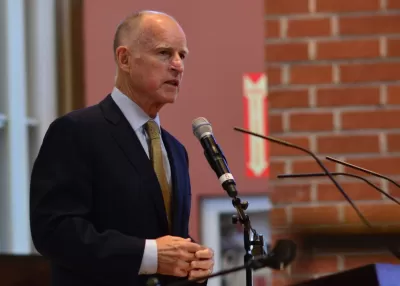
California bears the dubious distinction of the nation's second-highest housing prices (after Hawaii, but California is nearly 30 times more populous). Governor Jerry Brown recently shared some gloomy thoughts about the prospect of that changing anytime soon. "We are embedded in the culture we are embedded in," he said. "We can make some marginal changes, and I'm always looking for that."
This article identifies three barriers to more housing: the California Environmental Quality Act (CEQA), a preference for commercial development's higher tax revenues, and local opposition to nearly every proposed project. Although its intent was to protect vulnerable ecosystems, CEQA can be a potent weapon in the hands of NIMBY activists.
Brown is doubtful whether recent calls to reform CEQA and Prop. 13 (an entrenched 1978 measure limiting increases on property tax) will amount to much. He commented, "Reforming CEQA is the Lord's work. But the Lord's work doesn't always get done."
Read the full story: Gov. Brown shrugs off real estate trifecta fueling skyrocketing housing costs

NIMBYs at Center of California's Housing Shortage
Sacramento Bee's political columnist, Dan Walters, writes that NIMBYs are among the main reasons for the state's chronic housing crisis, and one of their main tools is the California Environmental Quality Act, which must be reformed by politicians.
Streamlined CEQA Reform Passes Under a New Bill
Senator Steinberg's CEQA reform bill, SB 731, which we have been following all year, died - but many of the most important aspects - LOS, aesthetic and parking impacts, have been transferred to SB 743 (Kings Arena bill), though applied more narrowly.

Infamous 315-Unit Lafayette Housing Development Finally Approved
In a dramatic sign of how far zoning reform has come in the state of California, CEQA wasn’t enough to stop a 315-unit apartment development first proposed 12 years ago in the city of Lafayette.

Planetizen Federal Action Tracker
A weekly monitor of how Trump’s orders and actions are impacting planners and planning in America.

California plans to bury El Niño’s downpour
If the state plays its cards right, it may be able to store a billion acre-feet of El Niño’s water in aquifers.

Desperate measures: Advocates weigh draining Lake Powell to fill Colorado River
Draining the reservoir could reduce evaporation losses by a couple hundred thousand acre-feet.

Mamdani’s pied-à-terre tax survives legal challenge
A panel of judges found that the plaintiffs failed to demonstrate injury as a result of New York City's implementation of the tax.

Eastern Nebraska is running out of electricity
Data centers and electrification are straining eastern Nebraska’s grid, throttling economic development.

Seattle passes record-breaking transit services expansion
Proposition 1 will double the city’s transit tax to add 95,000 more bus trips and preserve 180,000 bus trips annually.

FREE Course: Walkable City 1: Why Walkability?
After describing his path towards focusing on walkability as the essence of good planning, Jeff Speck marches through his five principal reasons for making more walkable places.
Reinventing Malls: Planning Alchemy—Turning Gray Fields Into Gold
The course focuses on the opportunities and imperatives that shape reinvention of mall sites.

City of Rosemead
Rutgers University, Edward J. Bloustein School of Planning and Public Policy
One Hundred Miles
University of Michigan School for Environment and Sustainability (SEAS)
Hunter College, City University of New York (CUNY)
The Architects Foundation
City of Cambridge
Montrose County
The Pocatello Development Authority