The Post Office once used trains but no more, unlike the United Parcel Service (UPS). A new reports recommends that the Post Office return to their past, though not necessarily sorting the mail on the train like you might see in a rail museum.


"Ever since the United States Postal Service decided to abandon its long relationship with the nation’s railroads in favor of trucking the mail, there have been questions raised about the breakup," writes Bill McAllister of Linn's Stamp News & Coin World.
A new report by the Postal Service’s inspector general raises that question once again, arguing that in the case of New Jersey mail the agency could save about $10.8 million a year by diverting some long-distance truck trips to rail.
Great Northern Railway Post Office Car No. 42, California State Railroad Museum, Sacramento
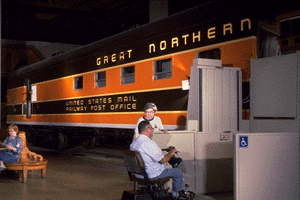
No one is suggesting a return to streamlined baggage-mail cars like the one shown above built for the Great Northern Railway that visitors can walk through at the California State Railroad Museum. Rather, they presumably would be truck trailers carried "piggyback," like the CSX Hot UPS Train (on You-Tube) as we noted in a post last year on rail's resurgence.
"The inspector general argued that postal management should more carefully test its assumptions about rail, and review rail options more consistently," writes McAllister.
Don't expect to see United States Postal Service trailers carried on a train soon, regrettably. "Postal management didn’t like that conclusion and argued against the IG’s recommendation," notes McAllister, though they "did agree to consider some of the recommendations."
FULL STORY: Can the U.S. Postal Service ride the rails to prosperity?

Freight Movement Drives Rail Resurgence
Freight rail is booming throughout the U.S. While shipping oil from North Dakota's Bakken shale basin has been a huge factor in the resurgence, Betsy Morris digs deeper and analyzes the surprising competition between road and rail.
Why are America's trains so slow?
A brief historical inquiry.
Who owns US railroad tracks?
Nearly three-quarters of Amtrak's trains operate on tracks owned by private companies. What does this mean for U.S. passenger rail?

Planetizen Federal Action Tracker
A weekly monitor of how Trump’s orders and actions are impacting planners and planning in America.

The state-sanctioned urbicide of Austin
People don’t kill cities. Freeways do.

US to reduce Colorado River water deliveries to Mexico
A new Colorado Treaty amendment reduces Mexico’s Colorado River water allocation by 250,000 acre feet.

5 New England states march closer to 800 megawatt wind energy project
Securing federal approval for the project may be complicated under the Trump administration, which has historically been hostile towards domestic wind power.

Baltimore to break ground on $50 million Transit Priority Project
The project will bring faster bus trips, safer streets and better bike connections to Baltimore.

Airbnb launches $250 million 'last-dollar financing' housing accelerator, makes first investment in Austin
The company will put $6.4 million towards affordable housing development in Texas’ capital.

FREE Course: Walkable City 1: Why Walkability?
After describing his path towards focusing on walkability as the essence of good planning, Jeff Speck marches through his five principal reasons for making more walkable places.
Reinventing Malls: Planning Alchemy—Turning Gray Fields Into Gold
The course focuses on the opportunities and imperatives that shape reinvention of mall sites.

Eagle County Government
Harvard University Graduate School of Design
Nashville Planning Department
The Architects Foundation
University of Cincinnati Online
The Pocatello Development Authority
The Urban Renewal Agency of the City of Pocatello
Journal of the American Planning Association