An app that compares fares across transportation network company platforms reveals several lessons about the state of competition in this new transportation frontier.


Brandon G. Donnelly shares news of a survey by whatsthefare that provides "a cost comparison between regular city taxis and ride sharing services such as a UberX, Lyft, and Sidecar in San Francisco, Los Angeles, and New York."
According to Donnelly, the most obvious realization after an initial examination of the data is that "regular taxis are far more expensive in San Francisco and Los Angeles compared to all of the ride sharing services."
The whatsthefare post goes into thorough detail about the comparison at different times of day and different cities, but instead of finding a clear winner in the fare wars, the posts concludes by surmising the "cost of loyalty" to any one of those systems in any of the country's major cities. If you're interested in cutting down on your own cost of loyalty, whatsthefare provides an app that will comparison shop for you before you go.
Read the full story: Comparing taxis to ride sharing services

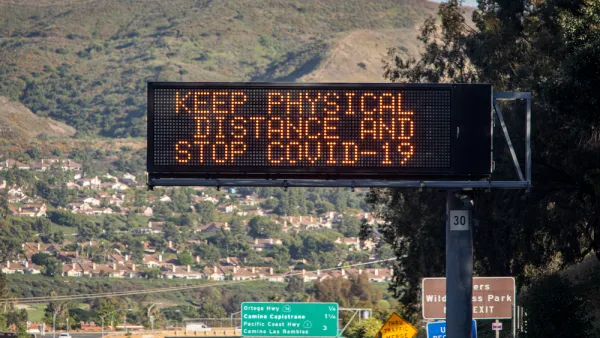
Second Anniversary of the COVID-19 Pandemic
March 11 marked the second anniversary of WHO's declaration of the pandemic and the beginning of its third year. Cases continue to plummet in the U.S. and plateau globally while war in Europe has overshadowed the virus that has killed 6 million.
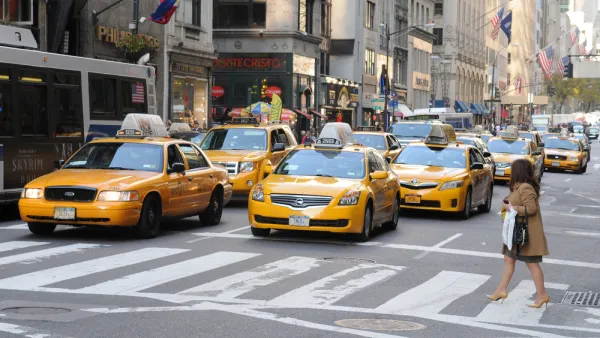
Ride-Hailing Prices Skyrocket as the U.S. Emerges From the Pandemic
A shortage of drivers and spiking demand are driving Uber and Lyft prices higher than ever as the companies struggle to achieve profitability.
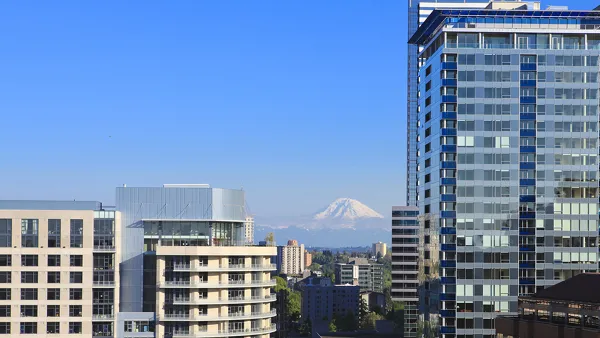
2020 Population Growth Rates for the 50 Biggest U.S. Cities
The Census Bureau released new data on May 27 that includes the first four months of the pandemic. Seattle tops the growth rate at 2.2% from July 1, 2019, to July 1, 2020, while Baltimore and San Francisco land at the bottom with -1.4%.

Planetizen Federal Action Tracker
A weekly monitor of how Trump’s orders and actions are impacting planners and planning in America.

Amtrak, CN end decades-long dispute with eight-year agreement
The new operating agreement establishes an updated framework for the companies to work together, including processes to resolve disputes.

Judges permit Denver to divert 77,000 acre feet from the Colorado River for reservoir expansion
Overuse and climate change have caused the Colorado River’s water levels to plummet.

NYC DOT wants faster, more permanent street upgrades
The city is examining ways to build more concrete infrastructure without getting entangled in 'decades-long' projects.

'Something we’ve never seen before:' rising utility rates could strain city finances nationwide
Data centers, climate change and other factors have caused utility rates in the United States to increase by 38% since 2020.

Trump to overrule local leaders, lease millions of acres of America’s Pacific Island territories’ seafloors to mining companies
International law says that the Indigenous people of America’s territories have a right to prior and informed consent regarding projects that impact their countries.

FREE Course: Walkable City 1: Why Walkability?
After describing his path towards focusing on walkability as the essence of good planning, Jeff Speck marches through his five principal reasons for making more walkable places.
Reinventing Malls: Planning Alchemy—Turning Gray Fields Into Gold
The course focuses on the opportunities and imperatives that shape reinvention of mall sites.

Harvard University Graduate School of Design
KFH Group Inc.
Greater Baltimore Committee
The Architects Foundation
University of Cincinnati Online
The Pocatello Development Authority
The Urban Renewal Agency of the City of Pocatello