They are fees, ruled the court on Oct. 31, overturning a May 1, Portsmouth circuit judge ruling in a major victory for both tolling and public-private partnerships. It allows tolls to fund the Elizabeth River Crossings, VDOT's P3 tunnels project.


The Elizabeth River Crossings is a public-private partnership (also known as a P3), working with the Virginia Department of Transportation (VDOT) to build a $2 billion, "two-lane tunnel under the Elizabeth River adjacent to the existing Midtown Tunnel." Known as the Elizabeth River Tunnels Project or by the Federal Highway Administration's Downtown Tunnel / Midtown Tunnel / MLK Extension, it connects the cities of Norfolk and Portsmouth.
"The Elizabeth River Tunnels Project is crucial to the future of the Hampton Roads transportation network," said Commonwealth of Virginia Transportation Secretary Sean Connaughton in a statement. [AASHTO Journal, Nov. 01]
On May 1, Judge James A. Cales Jr. said in a bench ruling that the General Assembly violated the state constitution by delegating the legislative power of taxation to the VDOT, an unelected entity.....," wrote Natalie Rodriguez of Law 360 on May 3.
Bloomberg's Sophia Pearson explains why the Virginia Supreme Court (PDF) overturned the decision.
The trial court erred in holding that the tolls are taxes because they are designed to raise revenue, the Supreme Court said. The tolls are paid “in exchange for a particularized benefit,” aren’t compelled by the government and are collected solely to fund the project, it said.
“We hold that the project tolls are user fees and not taxes,” the court said in its ruling. Thus lawmakers did not delegate the power of taxation to agencies such as the state’s transportation department in violation of the Virginia Constitution, it said.
Tolls would apply to the existing Downtown Tunnel "for the purpose of raising revenue to construct the new facilities" (the Midtown Tunnel and MLK extension) which constitutes "bundling", according to Patrick M. McSweeney, an attorney for the plaintiffs, wrote Natalie Rodriguez about the earlier decision. Neither Midtown nor Downtown Tunnels are tolled.
This aerial photo and detailed project map (PDF) labels the locations of all three tunnels (Midtown, Downtown, and proposed tunnel adjacent to Midtown) under the Elizabeth River, plus the MLK Extension.
AASHTO Journal cited Gov. Bob McDonnell who spoke of the critical importance of P3s in bringing private capital to fund essential infrastructure needs.
"Today's ruling confirms what my administration has been saying from the beginning: Virginia's Public-Private Transportation Act is a critical tool in addressing some of our toughest transportation challenges," said Gov. Bob McDonnell in a statement. "By attracting private sector capital and innovation and ensuring projects are completed in a timely, efficient, and cost-effective manner, our ability to partner with the private sector makes otherwise impossible projects doable. This is critically important for future job creation and economic growth in the Commonwealth."
Former Secretary of Transportation Ray LaHood also spoke to their importance on Oct. 16 when he stated that in addition to raising and indexing the gas tax, "federal and state governments should consider VMT taxes, public-private partnerships, and tolling to raise transportation funds."
Had the Va. Supreme Court upheld the lower court ruling in Danny Meeks, et al. v. Virginia Department of Transportation, et al, Virginia could "have been on the hook to repay the $422 million federal loan," wrote Dave Foster of The Virginian-Pilot on July 19, 2013.
Read the full story: Virginia May Charge Tolls for $2 Billion Tunnel Project
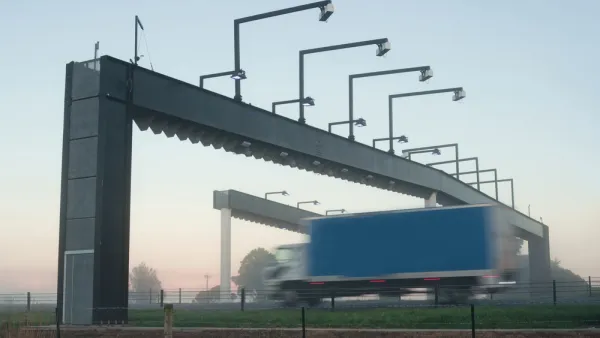
Toll Rates at Center of Controversy in Public-Private Partnership in Virginia
Elizabeth River Tunnels, a complex project involving a new tunnel, rehabilitating two existing tunnels, and extending an expressway, is financed by a public-private partnership that includes tolls that Gov. Terry McAuliffe (D) called "exorbitant."
Virginia Interstate Widening Would Convert Free Lanes to Toll Lanes
The Hampton Roads Transportation Planning Organization is proposing a 45-mile network of high-occupancy toll lanes on I–64 that includes conversions of 16 miles of carpool and three miles of general-purpose lanes. No unpriced lanes would be added.
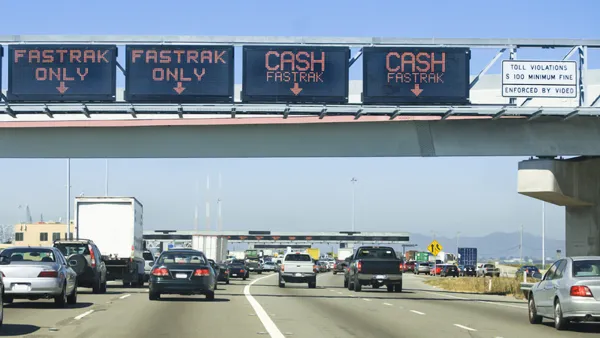
Poll Appears to Show Opposition to Toll Financing for Trump Infrastructure Plan
A Washington Post/ABC News poll released Jan. 17 showed the exact opposite result of a Reuters/Ipsos poll released two days later on the financing for President Trump's $1 trillion infrastructure plan. However, the polls took different approaches.

Planetizen Federal Action Tracker
A weekly monitor of how Trump’s orders and actions are impacting planners and planning in America.

Eastern Nebraska is running out of electricity
Data centers and electrification are straining eastern Nebraska’s grid, throttling economic development.

Study reveals best places in the U.S. for cycling, walking
New research from Streetlight Data examines bicycle and pedestrian miles per capita in the 100 largest U.S. cities by population.

Officials look to alter BART extension as price goes through the roof
Tariffs and the war with Iran are behind the rising cost.

To power data centers, Utah company may build hundreds of nuclear reactors on state land
In its permit application, Valar asked for the county to confirm that changes within its outlined plan would still be covered by the permit.

San Antonio is using environmental review to stall ICE detention center
San Antonio sued last month to pause work on the new detention center until the federal government studied its effect on the surrounding area.

FREE Course: Walkable City 1: Why Walkability?
After describing his path towards focusing on walkability as the essence of good planning, Jeff Speck marches through his five principal reasons for making more walkable places.
Reinventing Malls: Planning Alchemy—Turning Gray Fields Into Gold
The course focuses on the opportunities and imperatives that shape reinvention of mall sites.

City of Charlotte
City of Rosemead
Rutgers University, Edward J. Bloustein School of Planning and Public Policy
University of Michigan School for Environment and Sustainability (SEAS)
Hunter College, City University of New York (CUNY)
The Architects Foundation
City of Cambridge
The Pocatello Development Authority
The Urban Renewal Agency of the City of Pocatello