The ruling by Judge Bert A. Bunyan of the State Supreme Court in Brooklyn on Tuesday added steam to the NYC transportation commissioner Janette Sadik-Khan's campaign for pedestrian-oriented, cyclist-friendly streets.


Writing for The New York Times, Michael Grynbaum reports:
"The plaintiffs, a pair of well-connected civic groups in Brooklyn with ties to Iris Weinshall, a former city transportation commissioner, had accused the city's Transportation Department of cherry-picking statistics to create a favorable portrait of the lane and misleading residents about its benefits. The judge's decision did not address those claims or the merits of the lane itself."
"The suit, filed in March, had come to encapsulate a moment of unusual civic strife over one of City Hall's most notable policies. The city and its supporters say bicycle lanes are progressive, healthy additions to streets that reduce traffic accidents and promote more environmentally friendly modes of transport. Opponents have accused the city of neglecting the needs of car drivers and say the lanes can create dangers for pedestrians."
Expressing her opinion on the court's decision, Sadik-Khan emphatically asserts, "Merely not liking a change is no basis for a frivolous lawsuit to reverse it."

Located along Prospect Park West in Brooklyn, a mile-long, two-way bike path was installed last summer by the City.
Read the full story: Judge Rejects Groups’ Effort to Remove Bike Lane

Bike-Centered Brooklyn Bridge Redo Under Consideration
City officials in New York are discussing the possibility of converting a car traffic lane on the Brooklyn Bridge for use by people on bikes.
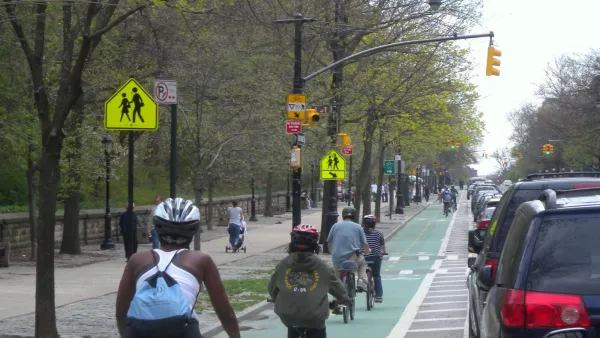
Protected Bike Lanes: How New York City Made It Happen
While resistance to protected bike lanes can be high, the economic and safety paybacks are substantial.
Questionable Progress in Los Angeles Traffic Safety
Despite enacting a Vision Zero policy in 2015, traffic fatalities continue to rise in Los Angeles

Planetizen Federal Action Tracker
A weekly monitor of how Trump’s orders and actions are impacting planners and planning in America.

Eastern Nebraska is running out of electricity
Data centers and electrification are straining eastern Nebraska’s grid, throttling economic development.

Washington state to charge fee to drivers with fuel-efficient cars
Revenue from the fee will go towards supporting the state’s highways.

Instead of building new housing, LA developers are turning mansions into mega-mansions
In the richest areas, the number of houses valued at $30 million with demolition permits has skyrocketed since 2018.

Illinois considers spending $1 billion in taxpayer money on data center
A quantum computing campus and data center are currently under construction in Chicago.

As development costs rise, Boston moves to lessen affordable housing requirements
The Boston Zoning Commission and the City Council still need to approve Boston Mayor Michelle Wu’s proposed changes

FREE Course: Walkable City 1: Why Walkability?
After describing his path towards focusing on walkability as the essence of good planning, Jeff Speck marches through his five principal reasons for making more walkable places.
Reinventing Malls: Planning Alchemy—Turning Gray Fields Into Gold
The course focuses on the opportunities and imperatives that shape reinvention of mall sites.

City of Charlotte
City of Rosemead
Rutgers University, Edward J. Bloustein School of Planning and Public Policy
University of Michigan School for Environment and Sustainability (SEAS)
Hunter College, City University of New York (CUNY)
The Architects Foundation
University District Partnership
City of Cambridge
The Pocatello Development Authority