Despite enacting a Vision Zero policy in 2015, traffic fatalities continue to rise in Los Angeles


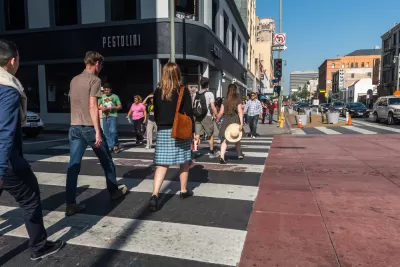
In a continuing tension between faster commutes and safer streets, the city of Los Angeles is struggling to enact policies to reduce traffic deaths. A Michael McDonald opinion piece in the L.A. Times questions why Mayor Eric Garcetti, who issued an executive order enacting a Vision Zero program in 2015 to eliminate traffic deaths in the city, has been hesitant recently to enforce changes that could save lives.
Public resistance to recent purported safety improvements has resulted in some of those projects being watered down. Much of the resistance is based on ager over traffic congestion and the perception that improvements will make things worse for commute times.
The opinion piece cites former New York City Mayor Michael Bloomberg's support for robust and controversial changes to streets, led by former Traffic Commissioner Janette Sadik-Khan. It implores Mayor Garcetti to do the same.
Read the full story: Angelenos are dying while angry motorists are torching L.A.'s street safety plans. Where is Mayor Garcetti?

Los Angeles Approves Road Safety Measure
Voters expressed strong support for road safety improvements.
Los Angeles to Put Mobility Plan to Voters
The city has made almost no progress on the mobility plan it adopted in 2015. Now, voters will decide whether, and how, L.A. will have to follow through.

Could Los Angeles Emulate Barcelona’s ‘Superblocks’?
A proposal in the city council could bring the ‘superblock’ model to Los Angeles, opening up neighborhood streets to more biking, walking, and public amenities.

Planetizen Federal Action Tracker
A weekly monitor of how Trump’s orders and actions are impacting planners and planning in America.

Northwest rail fans eager for Sept. 30 debut of Amtrak’s Airo fleet
Get ready for that new train smell and more seats. But they won’t go faster or run more frequently on the Cascades route in Washington and Oregon.

Trump is considering data centers on 6 states' public land — some state officials say they had no idea
If the administration approves the proposed projects, data center and data center-related developments will cover 17,600 acres of public land.

California may destroy its beaches trying to save homes from El Niño
Boulders and seawalls can protect homes from waves, but ultimately destroy sandy beaches.

California high-speed rail accomplishes only one legislative goal in 2026
The majority of the agency's failed pitches were never developed into written proposals.

Sharp cuts to federal passenger rail, public transit funding arrive today
The American Public Transportation Associations estimates the stopgap bill will result in an over 80% cut to federal passenger rail investment and 20% cut to public transit investment.

FREE Course: Walkable City 1: Why Walkability?
After describing his path towards focusing on walkability as the essence of good planning, Jeff Speck marches through his five principal reasons for making more walkable places.
Reinventing Malls: Planning Alchemy—Turning Gray Fields Into Gold
The course focuses on the opportunities and imperatives that shape reinvention of mall sites.

City of Thousand Oaks
City of Wisconsin Rapids
Harvard University Graduate School of Design
The Architects Foundation
University of Cincinnati Online
Northern Illinois Transit Authority (NITA)
The Pocatello Development Authority
The Urban Renewal Agency of the City of Pocatello