The California Department of Transportation released its draft carbon reduction strategy last month to apply for Carbon Reduction Program funds included in the Infrastructure Investment and Jobs Act. Road pricing plays a prominent role.


On April 21, 2022, the Federal Highway Administration (FHWA)'s Office of Planning, Environment, and Realty released a 16-page ‘implementation guidance’ [pdf] document for one of the climate programs included in the Infrastructure Investment and Jobs Act administered by FHWA.
The purpose of the Carbon Reduction Program (CRP) is to reduce transportation emissions through the development of State carbon reduction strategies and by funding projects designed to reduce transportation emissions.
Related in Planetizen on the CRP:
- Planetizen (expired) event: Experts unpack the $6 billion Carbon Reduction formula program, Jan. 18, 2023
- Planetizen news: Feds Release $60 Billion for Roads, Bridges, and Carbon Reduction, October 12, 2022
And on reducing transportation emissions on the federal level:
- Federal Plan Takes Aim at Transportation Emissions, January 10, 2023
- Proposed Rule Would Require Emission Reductions From U.S. Highway System, September 7, 2022
California's application
The program provides roughly $1.25B to $1.33 billion per fiscal year for five years. California's department of transportation, Caltrans, in partnership with the state’s metropolitan planning organizations (MPOs), developed a draft Carbon Reduction Strategy (CRS), the source article [pdf] for this post, to submit to the Federal Highway Administration for approval by November 2023, according to an older Caltrans webpage.
California's CRS focuses on the “Three Pillars:” zero-emission vehicles (ZEVs) and infrastructure, active transportation, and rail and transit. All CRP funds must be spent in support of the Three Pillars, according to the updated Caltrans CRP webpage.
Not by ZEVs alone
“Although transitioning to electric and hydrogen vehicle technologies is critical to carbon reduction, the CARB Scoping Plan is clear that California cannot achieve carbon neutrality with ZEVs alone,” states the strategy on pg. 4 under the sub-heading, Reducing Transportation’s Carbon Emissions.
Related:
- New Scoping Plan Sets Carbon Neutrality Goal for California, November 21, 2022
- Electric Vehicles Alone Will Not Reduce Emissions to Meet California's Climate Goal, November 29, 2018
Even with California’s mandate that all new car sales be ZEVs beginning in 2035, many vehicles will still have traditional internal combustion engines. To achieve carbon neutrality, Californians need to drive less: 25 percent below 2019 levels by 2030 and 30 percent below 2019 levels by 2045.
Vehicle Miles Traveled (VMT) reduction
The last page of the 19-page report,describes a fourth carbon reduction strategy: Roadway Pricing.
California will use its State CRP funding on projects that convert existing highway lanes into priced managed lanes. Roadway pricing--including Express and High Occupancy Toll (HOT) lanes, congestion pricing, and toll roads and bridges- -are critical to achieving carbon neutrality by 2045. The CARB Scoping Plan estimates that between 27% and 37% of the VMT reduction needed to reach carbon neutrality will come from roadway pricing
“California’s State CRP funds will be programmed through the State Highway Operations and Protection Program (SHOPP) on projects that convert existing lanes to priced managed lanes,” according to Caltrans. What's not clear, though, is what type of “existing lanes” Caltrans is referring to – general purpose or High Occupancy Vehicle lanes.
Hat tip to Steve Birdlebough, Sierra Club California Transportation and Sustainable Communities committee.
FULL STORY: California Transportation Carbon Reduction Strategy [pdf]

Virginia Interstate Widening Would Convert Free Lanes to Toll Lanes
The Hampton Roads Transportation Planning Organization is proposing a 45-mile network of high-occupancy toll lanes on I–64 that includes conversions of 16 miles of carpool and three miles of general-purpose lanes. No unpriced lanes would be added.
Popularity of Express Lanes Spreads Beyond Virginia
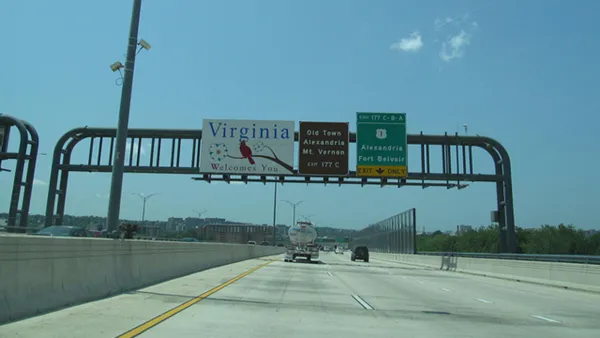
Dan Vock of Governing takes a broad look at congestion pricing, beginning with the success of Virginia's 66 Express Lanes, the ones where tolls initially topped $40. Notwithstanding complaints, managed lanes are spreading, but challenges remain.
When Carpool Lanes Cause Mayhem
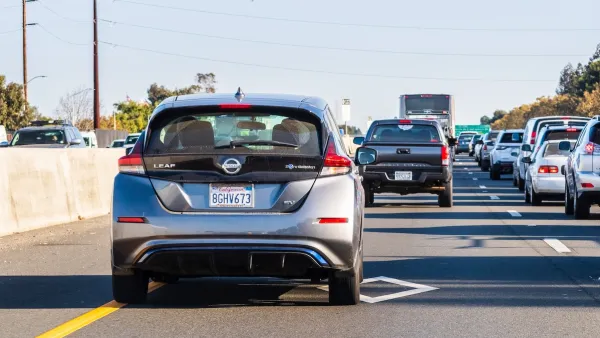
A newly widened Bay Area freeway serves as a reminder of the futility of HOV lanes. There are better ways to manage and mitigate traffic.

The state-sanctioned urbicide of Austin
People don’t kill cities. Freeways do.

US to reduce Colorado River water deliveries to Mexico
A new Colorado Treaty amendment reduces Mexico’s Colorado River water allocation by 250,000 acre feet.

New Jersey’s second-largest city bans standalone data centers
Jersey City will continue to allow co-location facilities, such as those meant for research institutions that store their own data.

Amtrak not solely to blame for New Jersey commuter rail's unreliability, report finds
A new study from the Garden State Initiative found that NJ Transit’s budget grew 20% across a 4 year period, but reliability declined significantly over the same period.

EPA erases limits on planet-warming pollution from power plants
Under Monday’s plan, power plants would still have some limits on how much mercury, arsenic and other contaminants they can emit.

Phoenix announces new on-demand transit service, more frequent RAPID buses
Both new services will launch in October, and are part of Phoenix's Project Effective Access Solutions for Easing Congestion.

FREE Course: Walkable City 1: Why Walkability?
After describing his path towards focusing on walkability as the essence of good planning, Jeff Speck marches through his five principal reasons for making more walkable places.
Reinventing Malls: Planning Alchemy—Turning Gray Fields Into Gold
The course focuses on the opportunities and imperatives that shape reinvention of mall sites.

Eagle County Government
Harvard University Graduate School of Design
Nashville Planning Department
The Architects Foundation
University of Cincinnati Online
The Pocatello Development Authority
The Urban Renewal Agency of the City of Pocatello
Journal of the American Planning Association