The funding comes from last year’s infrastructure law and will be distributed among the states, the District of Columbia, and Puerto Rico.


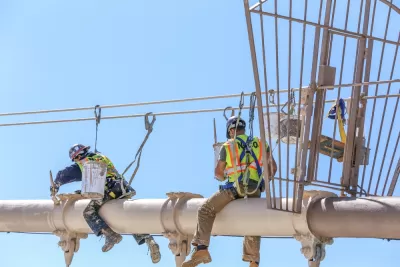
The nation’s roads, bridges, and tunnels will receive $60 billion in federal dollars as part of last year’s Infrastructure and Investment Jobs Act, reports Alex Gangitano in The Hill. The funding will go toward repair and maintenance projects and new initiatives like a nationwide electric vehicle charging system.
“Funding towards carbon reduction program, promoting resilient operations for cost-saving transportation, and a national electric vehicle (EV) infrastructure program is all new funding from the law,” Gangitano writes. The money raises bridge funding by almost 400 percent over fiscal year 2021.
“This is more than a $15 billion increase from the year before the bipartisan infrastructure law and what that ultimately adds up to is a lot more good projects that improve everyday life.”—Transportation Secretary Pete Buttigieg
While the funding is distributed among the states and Puerto Rico, “States that will receive the most include Texas, which will receive nearly $5.5 billion; New York, which will receive more than $2.7 billion; and California, which will receive more than $5.6 billion.”
FULL STORY: White House: Nearly $60B from infrastructure law sent to roads and bridges

Five Key Transportation Funding Proposals in Trump’s Budget
The President’s proposed 2026 budget would keep spending roughly the same for transit and rail and eliminate over $5 billion in funding for EV charging infrastructure.
Judge Orders Release of Frozen IRA, IIJA Funding
The decision is a victory for environmental groups who charged that freezing funds for critical infrastructure and disaster response programs caused “real and irreparable harm” to communities.
Executive Order Pauses Infrastructure, Clean Energy Funds
Trump’s order puts a freeze on unspent funding from the Inflation Reduction Act and the Infrastructure Investment and Jobs Act.

Planetizen Federal Action Tracker
A weekly monitor of how Trump’s orders and actions are impacting planners and planning in America.

The state-sanctioned urbicide of Austin
People don’t kill cities. Freeways do.

US to reduce Colorado River water deliveries to Mexico
A new Colorado Treaty amendment reduces Mexico’s Colorado River water allocation by 250,000 acre feet.

5 New England states march closer to 800 megawatt wind energy project
Securing federal approval for the project may be complicated under the Trump administration, which has historically been hostile towards domestic wind power.

Baltimore to break ground on $50 million Transit Priority Project
The project will bring faster bus trips, safer streets and better bike connections to Baltimore.

Airbnb launches $250 million 'last-dollar financing' housing accelerator, makes first investment in Austin
The company will put $6.4 million towards affordable housing development in Texas’ capital.

FREE Course: Walkable City 1: Why Walkability?
After describing his path towards focusing on walkability as the essence of good planning, Jeff Speck marches through his five principal reasons for making more walkable places.
Reinventing Malls: Planning Alchemy—Turning Gray Fields Into Gold
The course focuses on the opportunities and imperatives that shape reinvention of mall sites.

Eagle County Government
Harvard University Graduate School of Design
Nashville Planning Department
The Architects Foundation
University of Cincinnati Online
The Pocatello Development Authority
The Urban Renewal Agency of the City of Pocatello
Journal of the American Planning Association