A newly widened Bay Area freeway serves as a reminder of the futility of HOV lanes. There are better ways to manage and mitigate traffic.


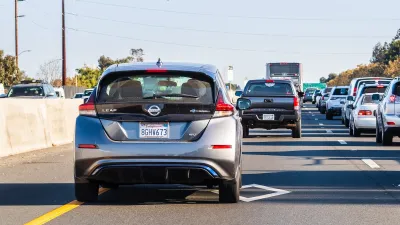
Carpool lanes, aka high occupancy (HOV) lanes, are meant to reduce roadway congestion, not create it. Reporting for The Press Democrat in Santa Rosa, California, on Oct. 2., Austin Murphy shares commentary from commuters in Marin and Sonoma counties on how the expansion of carpool hours on the HOV lanes on U.S. Highway 101 (formally named U.S. Route 101 or US 101) in the two North Bay counties (where it is also considered part of the Redwood Highway) has upended their lives.
"[A] disaster all around" is how one of the 150+ readers responded to Murphy's "prompt to share their thoughts on the new carpool lane hours." Another wrote, “Made my commute noticeably worse. There is congestion where there didn’t used to be.”
The responses were remarkable for their negativity and near-unanimity. People really don’t like Caltrans’ new high-occupancy vehicle (HOV) lane hours, which on Sept. 8 were extended in the morning from 5 to 10 a.m., and in the evening from 3 to 7 p.m., in both directions, in both counties.
Adding to the traffic congestion was the removal from the carpool lanes of presumably thousands of solo-motorists driving electric vehicles (EVs), as Planetizen posted on Sept. 21.
Adding insult to injury, said Santa Rosa City Council Member Jeff Okrepkie, is the timing of Caltrans’ move. It changed the hours just a few weeks before drivers of electric vehicles are scheduled to lose their carpool lane privileges, forcing many of those EVs into the regular lanes, which will add to the congestion.
Why the change?
Murphy explains the reasoning behind the change in operating hours of the carpool lane:
The California Department of Transportation imposed those expanded hours on this all-important corridor, from Richardson Bay Bridge in Marin to Windsor in Sonoma, to make the HOV lane operations consistent in both counties, and to “coordinate” them with carpool lane hours elsewhere in the Bay Area, according to Caltrans spokesman Jeff Weiss.
In addition, the decision was timed with the opening of the final segment of the HOV lane in the corridor, which was scheduled to be opened prior to the Sept. 8 change in operation hours, but was delayed.
That Sept. 8 launch of the new HOV lane hours had been planned to coincide with the completion of the Marin-Sonoma Narrows widening project, part of the larger, roughly $1.5 billion lane-addition project, stretching from Windsor to Sausalito, which began at the dawn of this century.
Murphy reports separately on the opening of the 16-mile highway widening project that added a continuous carpool lane through the Marin-Sonoma Narrows (and republished in The Mercury News) on Sept. 30.
How we got here
Carpool lanes may have originally been conceived as a way to mitigate highway widening by encouraging carpooling, particularly if buses use the corridor, which was the reason for the first two projects in Northern Virginia and New Jersey in 1969 and 1970, respectively. Half a century later, their focus is carpooling, which, like other forms of transit, has declined in mode share.
An alternative approach
North Bay commuters driving south on Highway 101 who cross the Golden Gate Bridge and remain on U.S.101 will find themselves driving on city streets for about 6 miles before the route becomes a divided highway in the South of Market Area. About eleven miles further south, the roadway, which also goes by the name Bayshore Freeway when it crosses from San Francisco into San Mateo County just north of San Francisco International Airport (SFO), the carpool lane resumes at the intersection with Interstate 380 in South San Francisco, but it's not called a high occupancy vehicle lane.
Managed lanes
Caltrans lists three types of 'managed lanes:' Express Lanes, High Occupancy Vehicles, and Park & Ride. In the North Bay, the carpool lanes on U.S. 101 are HOV lanes. On the Peninsula, they are high occupancy toll (HOT) lanes, aka express lanes, and there is a world of difference between the two types of managed lanes.
The difference between the two types of carpool lanes, from the perspective of 150+ people who contacted The Press Democrat to express their displeasure with the extended hours of the HOV lanes on U.S. 101in the North Bay, is really quite simple: they all would have access to the 'managed lane', regardless of time-of-day, had Caltrans widened the road with a HOT or express lane rather than an HOV lane, as they did on U.S. 101 on the Peninsula, but for a "price."
That is not to say that HOT (express) lanes are not without controversy. As Alyse DiNapoli, housing and transportation reporter for the San Mateo Daily Journal, acknowledges about a project by the San Mateo County Transportation Authority to extend the existing San Mateo 101 Express Lanes north to San Francisco in her report published Sept 15:
The data is especially critical as the San Mateo County Transportation Authority has started conducting research on expanding the project north of Interstate 380, either by converting an existing lane into an express lane or constructing a brand-new one. But the project has been controversial almost since the beginning. Transit advocates and some elected officials have expressed concern that the TA will not have the data to determine whether the current express lanes have improved congestion — one of the primary goals the agency touted for the project. In fact, some have suggested congestion has only increased, particularly for those in the nonexpress lanes.
Unfortunately, the acronym, HOT, is not used as commonly as HOV to describe priced lanes which carpoolers can use without being charge as long as they have the appropriate transponder, or toll tag, which is set correctly. The Federal Highway Administration published a 112-page "Guide for HOT Lane Development [pdf" or HTML] in December, 2002, that is referenced on the Caltrans express lane webpage under "express lane resources."
A final caveat about HOT lanes: while all express lanes in California are HOT lanes, i.e., vehicles with the requisite number of passengers, either two or three+, depending on the facility, will not be tolled with the proper toll tag set appropriately, express lanes elsewhere, such as in Maryland, may not provide the "carpooling benefit."

Tolling All Lanes
Bay Area transportation planners are studying a radical idea to reduce traffic congestion and fund driving alternatives: tolling all lanes on a freeway. Even more radical, the plan considers tolling parallel roads.
Another Reminder of the Futility of Carpool Lanes
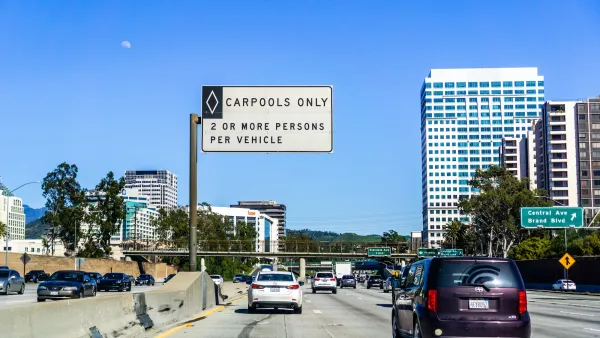
What's the great 'fix' for the flawed Highway 101 carpool lanes in Marin and Sonoma counties in the Bay Area? Reduce the HOV time by two and a half hours during the peak commutes to enable solo drivers greater access to 52 miles of widened freeway.
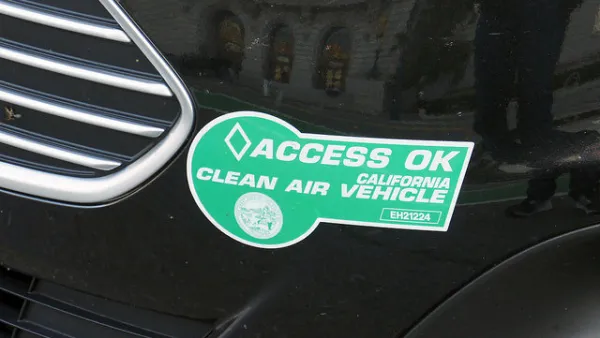
220,000 EV Drivers in California to Lose Carpool Lane Perk in 2019
The good news: the Clean Air Vehicle program for electric vehicles will be extended for at least three years. The bad news: not all EVs that have a decal now will be able to be renewed. Congestion on HOV and HOT lanes is a major concern.

Planetizen Federal Action Tracker
A weekly monitor of how Trump’s orders and actions are impacting planners and planning in America.

Amtrak, CN end decades-long dispute with eight-year agreement
The new operating agreement establishes an updated framework for the companies to work together, including processes to resolve disputes.

Judges permit Denver to divert 77,000 acre feet from the Colorado River for reservoir expansion
Overuse and climate change have caused the Colorado River’s water levels to plummet.

Philadelphia to invest $2 billion into upgrading city airports as PHL places last in customer satisfaction
Modernizations to Philadelphia's airports will include baggage system upgrades and a new automated parking garage guidance system.

The LA housing policies making developers turn away from the city
Despite LA’s housing shortage, developers say the city’s "mansion-tax" and pandemic-era policies make it an unappealing place to build housing.

New density bill would require 7 California cities to establish regional transit hubs
The bill would also require major cities in California to permit high-rise residential buildings.

FREE Course: Walkable City 1: Why Walkability?
After describing his path towards focusing on walkability as the essence of good planning, Jeff Speck marches through his five principal reasons for making more walkable places.
Reinventing Malls: Planning Alchemy—Turning Gray Fields Into Gold
The course focuses on the opportunities and imperatives that shape reinvention of mall sites.

City of Wisconsin Rapids
Harvard University Graduate School of Design
KFH Group Inc.
The Architects Foundation
University of Cincinnati Online
The Pocatello Development Authority
The Urban Renewal Agency of the City of Pocatello

