A few days after a judge’s ruling cleared three pending lawsuits blocking the development of People’s Park, the unhoused people living in the park were cleared and fence surrounds the site. Protestors took back the park within a day.


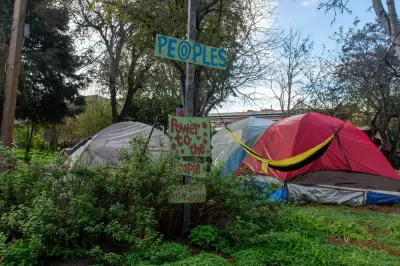
Alameda County Superior Court Judge Frank Roesch recently cleared the way for a planned development at People’s Park in Berkeley.
After hearing arguments from the defense and plaintiffs in the case of Make UC A Good Neighbor et al. v. Regents of the University of California last week, Roesch decided that the plaintiffs “had brought forward ‘nothing new,’ and UC Berkeley has not violated CEQA in its plans for new development,” according to an article by Supriya Yelimeli for Berkeleyside.
The proposed project would build two 12- and six-story dorm buildings to house for 1,100 university students and 125 unhoused people, according to a separate, paywalled, article by Katie Lauer for the Mercury News. People’s Park was founded in 1969 as a recreational space and location for protest at the height of the campus free speech movement during the Vietnam War—and has been the subject of repeated development attempts by the University of California in the decades since.
While the case was one of three to challenge the project, “Roesch said his tentative ruling will apply to all three lawsuits filed last summer,” according to Yelimeli.
Planetizen shared news in March 2022 that the city has brokered a historic deal to provide housing and services to the unhoused people living at the park and at risk of displacement from the development.
As reported in the article by Lauer, uniformed University of California Police Department officers in riot gear cleared the park in the early morning of August 3 and surrounded the park in fences. “Within an hour after midnight, each of the four streets bounding the 2.8-acre park were barricaded and cleared of any cars, in an attempt to keep people away from the area as dozens of construction workers and private security guards closed down the park,” reports Lauer.
By the evening, however, the university had halted work ad withdrawn police and construction workers from the site, according to an article updating the story by Jessica Garrison and Stuart Leavenworth for the Los Angeles Times. "
It was unclear what would happen next or when. University officials, who rushed to begin work just hours after a judge issued a ruling allowing it, said they would “assess the situation in order to determine how best to proceed” with construction of a project that would provide housing for students and homeless people," according to the artice.
FULL STORY: UC Berkeley construction to begin at People’s Park after court decision

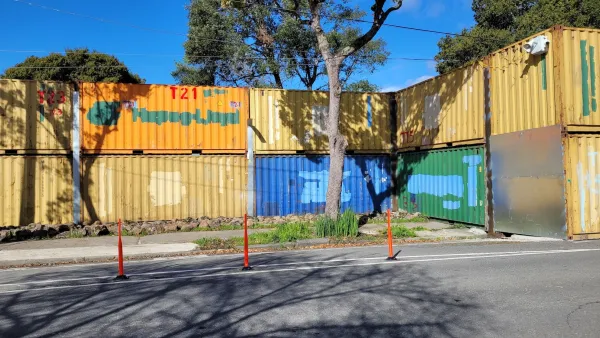
Berkeley promised to build supportive housing in People's Park. Where is it?
More than two years after People's Park was cordoned off, there is no word on a timeline for a promised affordable housing project.
Opinion: How California’s Environmental Law Empowers NIMBYs
Critics of a new provision calling “social noise” an environmental impact say the law can too easily be co-opted by anti-housing groups to block new development.
Judge Caps Enrollment at UC Berkeley Pending Environmental Impact Report
An Alameda County judge dealt a stunning rebuke of a plan to expand the campus of the University of California, Berkeley, with housing and new space for the Goodman School of Public Policy.

Planetizen Federal Action Tracker
A weekly monitor of how Trump’s orders and actions are impacting planners and planning in America.

The state-sanctioned urbicide of Austin
People don’t kill cities. Freeways do.

US to reduce Colorado River water deliveries to Mexico
A new Colorado Treaty amendment reduces Mexico’s Colorado River water allocation by 250,000 acre feet.

5 New England states march closer to 800 megawatt wind energy project
Securing federal approval for the project may be complicated under the Trump administration, which has historically been hostile towards domestic wind power.

Baltimore to break ground on $50 million Transit Priority Project
The project will bring faster bus trips, safer streets and better bike connections to Baltimore.

Airbnb launches $250 million 'last-dollar financing' housing accelerator, makes first investment in Austin
The company will put $6.4 million towards affordable housing development in Texas’ capital.

FREE Course: Walkable City 1: Why Walkability?
After describing his path towards focusing on walkability as the essence of good planning, Jeff Speck marches through his five principal reasons for making more walkable places.
Reinventing Malls: Planning Alchemy—Turning Gray Fields Into Gold
The course focuses on the opportunities and imperatives that shape reinvention of mall sites.

Eagle County Government
Harvard University Graduate School of Design
Nashville Planning Department
The Architects Foundation
University of Cincinnati Online
The Pocatello Development Authority
The Urban Renewal Agency of the City of Pocatello
Journal of the American Planning Association