Faced with the opportunity to redefine the traffic safety regime in one of the nation's most progressive states, Governor Gavin Newsom flinched.


Friday was a disappointing day for pedestrian and bike safety advocates in California.
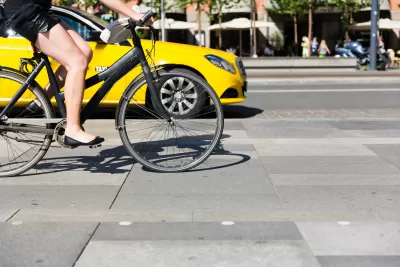
"Gov. Gavin Newsom on Friday night vetoed a pair of bills designed to make streets more welcoming to non-vehicular modes of transportation, including a measure that would have decriminalized jaywalking and another that sought to allow bicyclists to treat stop signs as yield signs," reports Dustin Gardiner in a paywalled article for the San Francisco Chronicle.
Planetizen picked up news of both the jaywalking and the Idaho Stop bills after they passed the state legislature—both this site and the original sources allowed some assumption that the two bills were a certainty for the governor's signature. Gov. Newsom had other plans.
Assembly Member Phil Ting (D-San Francisco), authored AB 1238 in an attempt to undo some of the discriminatory practices of jaywalking enforcement. "In a veto message, Newsom agreed that the state must address how unequal enforcement of jaywalking laws, and other minor violations, are used 'as a pretext to stop people of color,'" according to Gardiner. "But Newsom said he vetoed the bill because California has a high rate of pedestrian fatalities, the eighth highest per capita, and he worries the measure would encourage people to unsafely cross streets."
Though the equity angle is reason enough, other traffic safety and pedestrian and bike advocates point to numerous reasons for decriminalizing laws designed to prioritize the quick movement of automobiles over the free and safe movement of pedestrians.
"Newsom also vetoed AB122, by Assembly Member Tasha Boerner Horvath, D-Encinitas (San Diego County). "Under the bill, cyclists could have made so-called Idaho stops at stop-sign intersections — decelerating but not fully stopping before crossing if there’s no other traffic. The law would have sunsetted in 2028," reports Gardiner.
As for the governor's reasoning on a bill that would have enacted legal changes similar to those in place in an increasing number of cities and states around the country, with proven safety benefits, "the governor said he worried the bill would decease bicyclist safety when fatalities and serious injuries on the state’s streets have risen since 2010. He said the state could instead increase safety by designing streets that are more accessible to bicyclists and pedestrians," according to Gardiner.
FULL STORY: Newsom vetoes bills to decriminalize jaywalking, allow cyclists to avoid stops

Jaywalking Decriminalized in California
Another day, another historic planning-related bill signed into law in the Golden State.
Jaywalking Up for Decriminalization in Denver
Like other city and state leaders, Denver’s city council will weigh a proposal to decriminalize jaywalking in an effort to reduce interactions with law enforcement and improve transportation equity.
The Push To Decriminalize Jaywalking
Supporters of decriminalization argue that jaywalking laws don’t keep pedestrians safe and disproportionately burden Black and brown communities with fines.

The state-sanctioned urbicide of Austin
People don’t kill cities. Freeways do.

US to reduce Colorado River water deliveries to Mexico
A new Colorado Treaty amendment reduces Mexico’s Colorado River water allocation by 250,000 acre feet.

New Jersey’s second-largest city bans standalone data centers
Jersey City will continue to allow co-location facilities, such as those meant for research institutions that store their own data.

Amtrak not solely to blame for New Jersey commuter rail's unreliability, report finds
A new study from the Garden State Initiative found that NJ Transit’s budget grew 20% across a 4 year period, but reliability declined significantly over the same period.

EPA erases limits on planet-warming pollution from power plants
Under Monday’s plan, power plants would still have some limits on how much mercury, arsenic and other contaminants they can emit.

Phoenix announces new on-demand transit service, more frequent RAPID buses
Both new services will launch in October, and are part of Phoenix's Project Effective Access Solutions for Easing Congestion.

FREE Course: Walkable City 1: Why Walkability?
After describing his path towards focusing on walkability as the essence of good planning, Jeff Speck marches through his five principal reasons for making more walkable places.
Reinventing Malls: Planning Alchemy—Turning Gray Fields Into Gold
The course focuses on the opportunities and imperatives that shape reinvention of mall sites.

Eagle County Government
Harvard University Graduate School of Design
Nashville Planning Department
The Architects Foundation
University of Cincinnati Online
The Pocatello Development Authority
The Urban Renewal Agency of the City of Pocatello
Journal of the American Planning Association