Researchers found that while left-leaning respondents were more likely to favor transportation reform and sustainable modes, conservatives are not as far behind as we think.



"In a viral new paper published in this month’s Journal of the American Planning Association, researchers found that 63 percent of U.S. residents support transportation policies that 'shift more trips towards public transit, biking and walking,' regardless of their political affiliation." While many moderates and conservatives agree, this group skews left-of-center politically, and Congress has been engaged in a protracted battle over funding such programs, writes Streetsblog's Kea Wilson.
The study's authors examined why this divide falls along party lines and found several key factors. According to the study, "Conservatives are more misinformed about key transportation issues." Yet liberals also fail to grasp certain concepts, such as induced demand. "Only 45 percent of liberal-leaning respondents correctly guessed that adding a new lane or two a roadway is unlikely to reduce long-term congestion, compared to just 23 percent of conservatives, and 40 percent of moderates — despite the fact that researchers have been writing papers about the phenomenon since 1932."
And while "liberals are more likely to support sustainable modes," 59 percent of conservatives "still said that “using money from gas taxes to pay for walking, biking and transit” was the right thing to do." The researchers also found that liberals are more likely to think change is possible. This indicates that many conservatives might just need proof that policy changes could, in fact, make an impact.
Ultimately, "messaging matters," Wilson says. "[W]hile 63 percent of respondents were on board with mode shift, only 32 percent thought that transport policy should explicitly aim to 'reduce driving' — even though cutting car trips is a natural byproduct of getting people to try other ways of getting around." This indicates that "if leaders want to change hearts and minds, they should focus on what transport reform gives people rather than what it takes away." Terms like "the war on cars" create a negative image rather than showing the benefits of reduced car dependence.
Study co-author Nicholas Klein, assistant professor at Cornell University, "emphasizes that leaders don’t have to choose between selling the power of sustainable transportation and having honest conversations about the dangers of autocentricity — and to reach a majority of Americans, they should use a bit of both."
FULL STORY: Study: What’s Behind Partisan Splits Over Transport Reform?

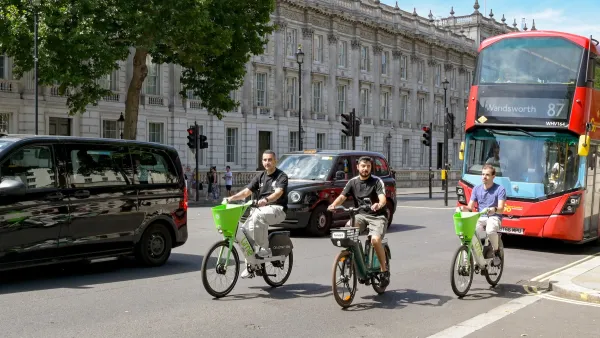
Bike use in London grew by 43% since 2019, but car use remains roughly the same
The city's efforts to reduce car use have stalled despite ambitious programs like congestion pricing and low-traffic neighborhoods.
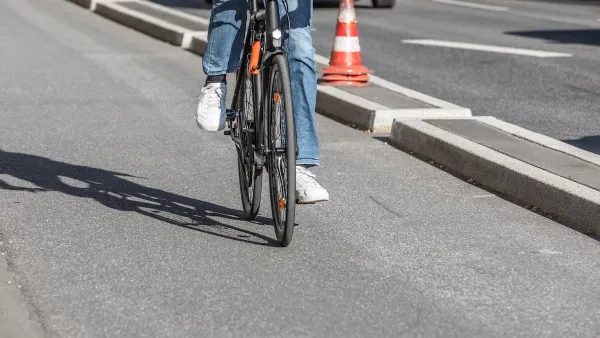
Southeast LA Road Safety Advocates Call for Improved Infrastructure
Streets in southeastern Los Angeles County have a severe lack of protected bike lanes and traffic safety measures, leading to high numbers of fatalities in a community where many residents depend on walking and biking for daily needs.
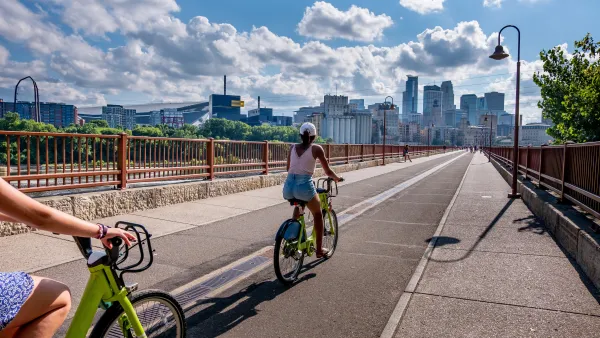
Minnesota Awards Active Transportation Grants
The grants are aimed at helping cities create action plans for improving their bike and pedestrian networks.

The state-sanctioned urbicide of Austin
People don’t kill cities. Freeways do.

US to reduce Colorado River water deliveries to Mexico
A new Colorado Treaty amendment reduces Mexico’s Colorado River water allocation by 250,000 acre feet.

New Jersey’s second-largest city bans standalone data centers
Jersey City will continue to allow co-location facilities, such as those meant for research institutions that store their own data.

Amtrak not solely to blame for New Jersey commuter rail's unreliability, report finds
A new study from the Garden State Initiative found that NJ Transit’s budget grew 20% across a 4 year period, but reliability declined significantly over the same period.

EPA erases limits on planet-warming pollution from power plants
Under Monday’s plan, power plants would still have some limits on how much mercury, arsenic and other contaminants they can emit.

Phoenix announces new on-demand transit service, more frequent RAPID buses
Both new services will launch in October, and are part of Phoenix's Project Effective Access Solutions for Easing Congestion.

FREE Course: Walkable City 1: Why Walkability?
After describing his path towards focusing on walkability as the essence of good planning, Jeff Speck marches through his five principal reasons for making more walkable places.
Reinventing Malls: Planning Alchemy—Turning Gray Fields Into Gold
The course focuses on the opportunities and imperatives that shape reinvention of mall sites.

Eagle County Government
Harvard University Graduate School of Design
Nashville Planning Department
The Architects Foundation
University of Cincinnati Online
The Pocatello Development Authority
The Urban Renewal Agency of the City of Pocatello
Journal of the American Planning Association