New research indicates a positive association between overall cycling levels and ridership rates for women-identified riders.


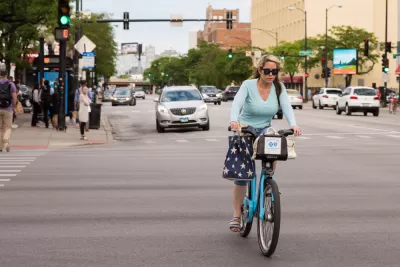
A new study reveals that "cities that do the best job of catering to the needs of women cyclists also have the highest level of cycling overall," reports Kea Wilson for Streetsblog. "In a comprehensive analysis of travel surveys from 11 countries across the globe, a team of international researchers found that the United States ranked second-to-last for both cycling mode share overall, and for cycling mode share specifically among women-identified riders."
The study also found "a strong positive association between the level of cycling and women’s representation among cyclists." In areas where cycling mode share was more than 7 percent, "women made as many cycle trips as men, and sometimes even greater." The research suggests that "when communities make transportation choices that successfully encourage women to ride, everyone comes out to join them."
The report also referenced "the many ways that women’s unique transportation needs shape their experience on two wheels — and not just their need for safety from drivers. Women are not only less likely to ride on dangerous roads with little protected infrastructure than their male counterparts, but that they take shorter trips by bike and travel more often for reasons unrelated to a traditional work commute, like running household errands." Despite women outnumbering men by 400,000 in New York City's population, the city—which has the highest share of women riders of the American cities surveyed—"still had a 66-percent male ridership."
The study's results indicate that "the presence of diverse women on bikes is the single best indicator of a healthy cycling ecosystem."
Read the full story: Study: Cycling Rates Low Unless Women Are Riding
The Most Bike-Friendly States in the Nation
The League of American Bicyclists ranks states based on bike infrastructure and safety efforts.
Op-ed: True bike safety requires more than the 'Dutch reach'
Making roads safe for all users takes policy and cultural changes that go beyond small behavioral interventions.
After San Diego Installed a Protected Bike Lane, Ridership More Than Doubled — and Hasn’t Stopped Growing.
“When people feel safe, they ride.”

Planetizen Federal Action Tracker
A weekly monitor of how Trump’s orders and actions are impacting planners and planning in America.

California plans to bury El Niño’s downpour
If the state plays its cards right, it may be able to store a billion acre-feet of El Niño’s water in aquifers.

Desperate measures: Advocates weigh draining Lake Powell to fill Colorado River
Draining the reservoir could reduce evaporation losses by a couple hundred thousand acre-feet.

In Texas, data centers are swallowing promised parkland
Residents who moved to Taylor, Texas for a rural community now have to contend with three data centers in their backyard.

How a Chicago-sized wind farm beat the odds and powered on
The project spanned five presidential administrations and a standoff with a U.S. military base.

MTA gives itself 30 days to transform pit into basketball court
The site has been under construction since 2022; the city originally estimated it would finish the court in 2024.

FREE Course: Walkable City 1: Why Walkability?
After describing his path towards focusing on walkability as the essence of good planning, Jeff Speck marches through his five principal reasons for making more walkable places.
Reinventing Malls: Planning Alchemy—Turning Gray Fields Into Gold
The course focuses on the opportunities and imperatives that shape reinvention of mall sites.

City of Rosemead
Rutgers University, Edward J. Bloustein School of Planning and Public Policy
One Hundred Miles
Hunter College, City University of New York (CUNY)
The Architects Foundation
University of Cincinnati Online
City of Cambridge
Montrose County
The Pocatello Development Authority