The Television City revamp will more than double the currently available space and include a multi-modal mobility hub, pedestrian improvements, and a "robust" transportation demand management program.


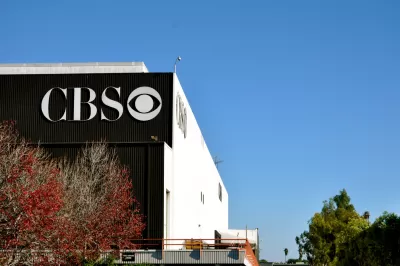
The iconic CBS Television City studio campus in Los Angeles "will be subject to a major expansion and modernization project headed by the L.A.-based multidisciplinary design practice RIOS," according to an announcement by the facility's owners, Hackman Capital Partners. "The plan calls for redeveloping a sea of surface parking lots on the perimeter of Television City into 1.1 million square feet of additional studio and office space, more than doubling the existing 750,000 square feet of available space at the complex," writes Matt Hickman in The Architect's Newspaper. "The complex will gain 15 new soundstages, support facilities and production base camps, a new commissary, a multi-modal mobility hub, public realm and pedestrian/streetscape upgrades, and a 'robust transportation demand management program.'"
The original plan for the campus, designed by architects William Pereira and Charles Luckman as "the first purpose-built television studio" and completed in 1952, "focused on flexibility and adaptability, calling for the eventual relocation, adaptation, and development of 24 stages and 2.5 million square feet of production space." Bob Hale, creative director of RIOS, said in a statement that the new plan "realizes Pereira’s futuristic vision, allowing the studio to accommodate evolving technologies, sustainable infrastructure, and enhanced community and production experiences." Once complete, the project is also expected to bring "nearly 19,000 direct, indirect, and induced jobs" to the area, according to a study by the Los Angeles Economic Development Corporation.
Read the full story: RIOS to lead $1.25 billion revamp of L.A.’s landmark Television City

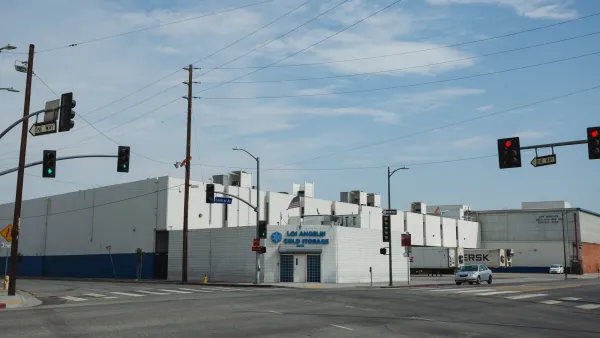
LA approves $2B 'urban village' plan for former cold storage facilities
The project promises an interconnected neighborhood with a focus on public space.
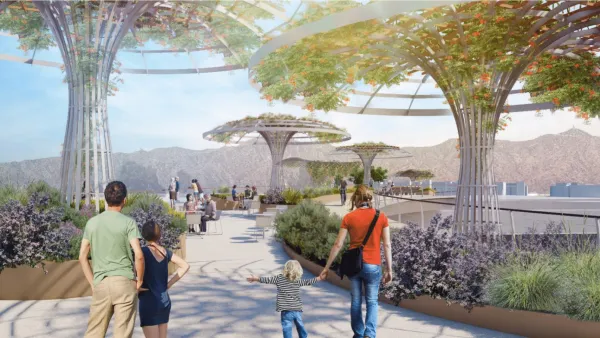
'Transformative' pedestrian bridge planned for LA River in Glendale Narrows
A new bridge will link Griffith Park and the Glendale Narrows Riverwalk.
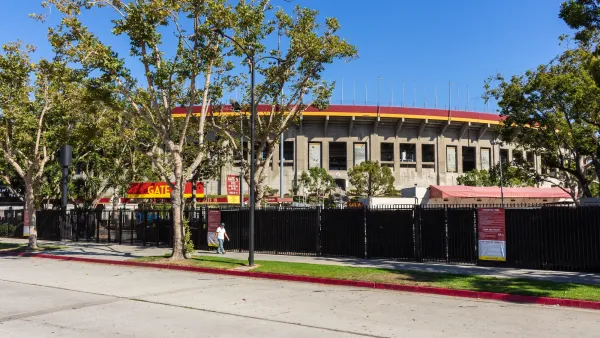
LA authorizes $9.5M for sidewalk repairs around Olympic venues
The city is hosting the Olympic and Paralympic Games in 2028.

Planetizen Federal Action Tracker
A weekly monitor of how Trump’s orders and actions are impacting planners and planning in America.

The state-sanctioned urbicide of Austin
People don’t kill cities. Freeways do.

Colorado’s Largest Data Center Could Rise Next to Homes — Without a Public Hearing
The proposed campus would consume 11 times the power of Denver International Airport; as it has across the country, opposition mounts.

Nation's most wind-powered state turns to coal as data centers increase energy demand
For the first time in decades, Iowa has increased its generation of coal power.

NYC cools commuters with city's first rain garden above a bus stop
New York City officials say the plants in the rain garden can absorb 16 gallons of rainwater during heavy storms.

Brightline West’s future may rely on $6 billion federal loan
The company has until Nov. 2 to make a $400 million equity investment into its proposed high-speed rail line.

FREE Course: Walkable City 1: Why Walkability?
After describing his path towards focusing on walkability as the essence of good planning, Jeff Speck marches through his five principal reasons for making more walkable places.
Reinventing Malls: Planning Alchemy—Turning Gray Fields Into Gold
The course focuses on the opportunities and imperatives that shape reinvention of mall sites.

Greater Baltimore Committee
Eagle County Government
Harvard University Graduate School of Design
The Architects Foundation
University of Cincinnati Online
The Pocatello Development Authority
The Urban Renewal Agency of the City of Pocatello
Journal of the American Planning Association