The thirst for urban expansion and new highway capacity hit a roadblock on the fringe of the Dallas-Fort Worth metropolis.


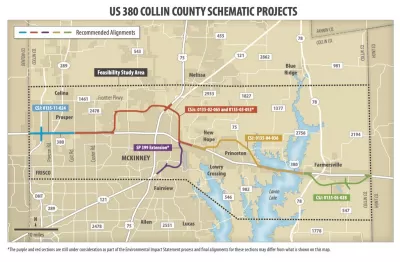
A contentious battle over a planned expansion of Highway 380 in the Dallas-Fort Worth region is detailed in a recent article by Peter Simek.
Highway 380 is "hardly more than a little two-lane road," according to Simek, connecting remote farming communities between Greenville and into New Mexico, passing through the city of McKinney, where Simek lays the scene.
"In 2016, residents living along Highway 380 received notices from the Texas Department of Transportation informing them that Highway 380 would soon be transformed into a major freeway—a limited-access traffic artery as wide as 10 lanes in parts."
TxDOT is proposing the expansion in response to previous growth that has expanded the footprint of Dallas-Fort Worth region to these former agricultural lands. And more growth is expected: "According to the Texas Demographic Center, Collin County’s population is expected to grow from fewer than 800,000 people in 2010 to more than 3.8 million by 2050," according to Simek.
Growth or not, residents of McKinney aren't happy about the TxDOT's plans for Highway 280.
But just as traffic engineers tend to see limited-access freeways as the best solution to the challenges of urban growth, people generally don’t want freeways running through their backyards. As TxDOT began rolling out a suite of options for the design and location of the new freeway, the Highway 380 planning process devolved into the most contentious community battle in Collin County history.
The TxDOT chose a preferred alternative, with an estimated cost of $2.5 billion, for the expansion in March 2019 and embarked on an environmental study of the project at the beginning of 2020. Simek's focus, however, is on the local opposition to the plan, and the coalition of local residents and organizations working to prevent the project, turning neighbor against neighbor, in some cases, along the way.
Read the full story: Does McKinney Really Need a New Highway?
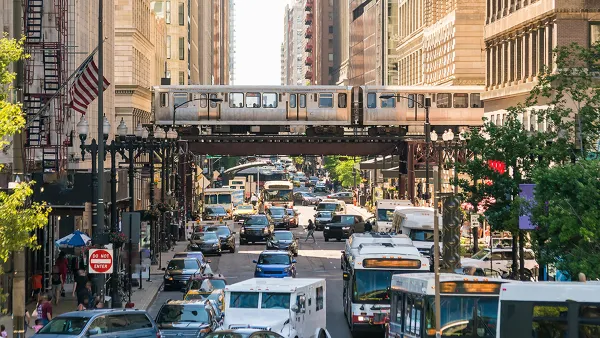
Planning for Congestion Relief
The third and final installment of Planetizen's examination of the role of the planning profession in both perpetuating and solving traffic congestion.

How Planning Fails to Solve Congestion
Solutions for congestion are never as simple and easy as armchair planners and engineers would like you to believe—especially those who suggest that congestion can be solved by forever building more roadway capacity.
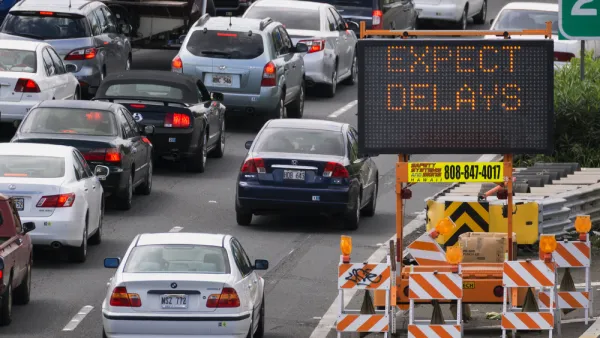
Planning and the Complicated Causes and Effects of Congestion
What do planners know about congestion, and what can they do about it? Explanations and solutions are less obvious than they seem (part one of a three-part series).

Desperate measures: Advocates weigh draining Lake Powell to fill Colorado River
Draining the reservoir could reduce evaporation losses by a couple hundred thousand acre-feet.

Eastern Nebraska is running out of electricity
Data centers and electrification are straining eastern Nebraska’s grid, throttling economic development.

Malls are becoming the midtowns of the future
Mall and office park redevelopments are a generational opportunity to create new nodes of urbanity.

NYC breaks ground on anti-flooding infrastructure project
New York City's new system will reduce stormwater flows to local sewers by 90%.

One Kentucky town’s secret to affordable housing
The Smoketown Community Land Trust has already built seven affordable homes for community members.

Houston gains petal-shaped cooling infrastructure to make streets more ‘delightful’
The city has installed the pavilions along 15 blocks in Houston.

FREE Course: Walkable City 1: Why Walkability?
After describing his path towards focusing on walkability as the essence of good planning, Jeff Speck marches through his five principal reasons for making more walkable places.
Reinventing Malls: Planning Alchemy—Turning Gray Fields Into Gold
The course focuses on the opportunities and imperatives that shape reinvention of mall sites.

City of Rosemead
Rutgers University, Edward J. Bloustein School of Planning and Public Policy
One Hundred Miles
University of Michigan School for Environment and Sustainability (SEAS)
Hunter College, City University of New York (CUNY)
The Architects Foundation
City of Cambridge
Montrose County
The Pocatello Development Authority