Washington's largest diesel emissions polluter will transition its fleet to diesel-hybrids and then to battery-electric propulsion to comply with Gov. Inslee's emissions-reduction executive order which will also please the orcas in Puget Sound.


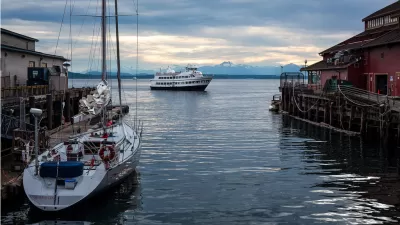
There's a reason why the Evergreen State was one of only two states (the other being Hawaii) to receive an A+ from U.S. PIRG in terms of how it is spending its share of the nearly $3 billion national Volkswagen Diesel Emissions Environmental Mitigation Trust.
Public transit is a big winner in the $112.7 million allocation, with up to $35 million dedicated to converting the first of the state's three largest ferries to hybrid-electric power and $13.3 million to purchase 50 electric transit buses in Benton, Clark, King, Pierce, Snohomish, and Spokane counties.
"Reducing diesel exhaust and carbon pollution from marine vessels is one of the priorities identified for Washington’s share of the VW settlement by the Washington Department of Ecology, which oversees investing the settlement funds," according to the Washington State Department of Transportation's (WSDOT) press release of Oct. 22.
“Air pollution from diesel emissions is one of the most pressing public health threats facing Washington, and converting these ferries to hybrid propulsion will slash pollution in our state,” said Ecology Director Maia Bellon.
According to Jason Deign of Greentech Media (source article), the ferry system owned and operated by WSDOT under its Washington State Ferries (WSF) division, is the second-largest in the world. Only the Star Ferry in Hong Kong carries more passengers, according to Wikipedia.
"The ferry system is the largest consumer of diesel fuel in the state with over 18 million gallons of diesel burned each year, and the three Jumbo Mark II ferries account for 26 percent of total fuel consumption," according to WSDOT.
This step brings the state ferry system closer to meeting the goals outlined in Gov. Jay Inslee’s Executive Order 18-01 (pdf 81 kb), which directs WSF to move toward a zero emissions fleet. [Executive order signed Jan. 16, 2018].
Inslee, who withdrew from the Democratic 2020 presidential primary race in August, had made climate change the central theme his campaign, calling it “the most urgent challenge of our time.” His statement on the conversion of the first of the three jumbo ferries reflected that priority.
“Converting the biggest, dirtiest ferries in the fleet is a huge milestone in our efforts to decarbonize the state and fulfill our obligation to help defeat climate change,” said Inslee. “In addition to reducing emissions, moving to an all-electric ferry fleet will save taxpayers money on ferry operating costs, virtually eliminate engine noise and vibration that can hurt orca whales, and improve reliability of service.”
Whales really are an important consideration for ferries traversing Puget Sound, as the King 5 News video accompanying their article on the $35 million retrofit on the first jumbo ferry illustrates. "The Jumbo Mark II ferries carry 202 cars and 1800 passengers each and primarily operate on the Seattle/Bainbridge and Edmonds/Kingston routes," reports Hannah Everman.
Siemens wins contract
"WSF has selected Siemens to conduct a propulsion control system replacement and hybrid conversion studies and system design for the three ferries," reports Nick Blenkey for MARINE LOG.
Siemens will proceed with the design of the hybrid conversion which includes removal of two propulsion generators, installation of battery storage, and development of the rapid charging system. Siemens engineers will then work alongside the selected shipyard to complete the hybridization process on all three vessels. The project will also include rapid shore charging stations at each pier.
As noted in a post last February, "Washington Ferry Ridership Continues to Grow," hybrid-electric propulsion and terminal electrification are a critical part of Washington State Ferries 2040 Long Range Plan released last January.
"To cut fuel consumption, the Plan recommends building new vessels to use hybrid propulsion technology instead of full diesel engines," notes page 98 in Section 6: Sustainability and resilience [pdf].
The use of this propulsion technology has benefits of reduced engine noise and vibration, potentially lessening effects on orcas and other marine life.
Once WSF implements the capital investments in vessel and terminal infrastructure identified in the Plan, by 2040 the agency will have replaced 13 existing diesel vessels with electric-hybrid vessels and will have converted six vessels to plug-in hybrid. All hybrid vessels will be capable of charging at the terminal to realize the maximum benefit of hybrid propulsion
Global trend
Deign goes on to indicate that moving toward zero-emissions technology in marine applications, particularly ferries, is part of a global trend that was launched in Europe, led by Norway, earlier this decade.
August saw the launch of the world’s largest all-electric ferry to date, a 200-passenger, 30-car carrying vessel called Ellen covering the stretch between Fynshav and Søby in southern Denmark.
According to Siemens, "Scandinavia is the first region in the world to rely increasingly on battery-powered and thus environmentally-friendly technologies in the shipbuilding industry."
International Maritime Organization regulation
To end on a related and most timely note, a new global regulation takes effect on New Year's Day that will force vessels to reduce sulfur oxide emissions, "bringing significant benefits for both human health and the environment," states the Dec. 20 press release by the International Maritime Organization (IMO), a United Nations specialized agency.
"Ships will have to use cleaner fuels that are still under development and may cost up to 50% more than traditional fuel known as bunker, or they will have to be fitted with sulfur-trapping exhaust systems called scrubbers that go for as much as $10 million per ship," reported Costas Paris for The Wall Street Journal in September.
To comply with the 2016 Paris climate accord, IMO members have also agreed to slash greenhouse-gas emissions by half by 2050, compared with 2008 levels. Ships now contribute up to 3% of the world’s global pollution, an amount comparable to that of major emitting countries.
Related in Planetizen:
- Report: Many States Spent Volkswagen Settlement Money on More Diesel Vehicles, May 28, 2019
- Washington Ferry Ridership Continues to Grow, February 13, 2019
- Cleaning-Up the World's Dirtiest Fuel by 2020, August 28, 2018
- Electrifying Maritime Transport – San Francisco Bay to Show the Way, July 2, 2018
- A Really, Really Big Fuel Cell Vehicle Possibly Coming to the Bay Area, August 3, 2015
FULL STORY: World’s Second-Largest Ferry Operator Switching From Diesel to Batteries

Cleaning-Up the World's Dirtiest Fuel by 2020
A 2016 rule approved by a specialized agency of the U.N. is forcing large ships that burn bunker oil, the dirtiest type of fuel, to either burn a more costly low-sulfur variety, apply scrubbers, or turn to LNG.
Waterborne Transit Ridership Growing Around Seattle, Too
More than buses and trains are doing well in the Seattle region. Ridership on the state system of ferries has also climbed steadily in recent years.
The Great Scandinavian Pandemic Experiment
Perhaps no nation has captured more media attention in its handling of the coronavirus pandemic than Sweden. Unlike most of Europe, it never went into lockdown, relying mostly on voluntary social distancing. The state epidemiologist devised the plan.

The state-sanctioned urbicide of Austin
People don’t kill cities. Freeways do.

US to reduce Colorado River water deliveries to Mexico
A new Colorado Treaty amendment reduces Mexico’s Colorado River water allocation by 250,000 acre feet.

New Jersey’s second-largest city bans standalone data centers
Jersey City will continue to allow co-location facilities, such as those meant for research institutions that store their own data.

Amtrak not solely to blame for New Jersey commuter rail's unreliability, report finds
A new study from the Garden State Initiative found that NJ Transit’s budget grew 20% across a 4 year period, but reliability declined significantly over the same period.

EPA erases limits on planet-warming pollution from power plants
Under Monday’s plan, power plants would still have some limits on how much mercury, arsenic and other contaminants they can emit.

Phoenix announces new on-demand transit service, more frequent RAPID buses
Both new services will launch in October, and are part of Phoenix's Project Effective Access Solutions for Easing Congestion.

FREE Course: Walkable City 1: Why Walkability?
After describing his path towards focusing on walkability as the essence of good planning, Jeff Speck marches through his five principal reasons for making more walkable places.
Reinventing Malls: Planning Alchemy—Turning Gray Fields Into Gold
The course focuses on the opportunities and imperatives that shape reinvention of mall sites.

Eagle County Government
Harvard University Graduate School of Design
Nashville Planning Department
The Architects Foundation
University of Cincinnati Online
The Pocatello Development Authority
The Urban Renewal Agency of the City of Pocatello
Journal of the American Planning Association