When Volkswagen funded a $3 billion environmental mitigation trust as the result of a settlement in the cheating scandal three years ago, states could have used that money to fund things like electric buses.


"States are missing opportunities to jumpstart transportation electrification using money from the Volkswagen emissions cheating settlement, according to a report released recently by two national advocacy groups," reports Frank Jossi.
The U.S. Public Interest Research Group Education Fund and the Environment America Research & Policy Center prepared the report, assigning letter grades to depending on "how they are allocating money from the settlement. Most states earned D or F grades for allowing money to be spent on diesel and other fossil fuel vehicles," explains Jossi.
Jossi's coverage focuses on the Midwest, where no states earned good marks. "The region’s top-performing states on the scorecard — Minnesota, Michigan and Ohio — received C grades. Illinois, Indiana, Iowa, Kansas, Missouri and Nebraska earned D’s while North and South Dakota and Wisconsin were given failing marks."
In addition to the explanations of the Volkswagen settlement provided by Jossi, the U.S. PIRG posted the report online and provided the following explanation about the Environmental Mitigation Trust funds created by the settlement.
Under the terms of the settlement, states can spend their share of the Environmental Mitigation Trust funds in several different ways, including by purchasing newer diesel vehicles, natural gas vehicles, and electric vehicles, as well as repowering older diesel vehicles with newer engines or electric motors. States are also allowed to use up to 15 percent of their award on electric vehicle (EV) charging infrastructure. How each state spends its share of the funds within these allowable uses is up the state but must be set forth in a “Beneficiary Mitigation Plan” submitted to a trustee.
The report would have granted states higher grades if they'd focused this spending on electric vehicles. Instead, 37 states received a D or an F.
Read the full story: Report: States missing opportunities to electrify transportation with VW money

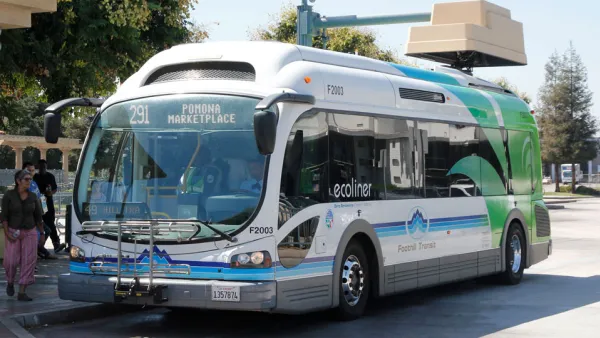
California to Invest $1 Billion in Electric Trucks, Buses, Charging Infrastructure
The investment comes not from the state legislature but from two regulatory bodies, the Air Resources Board and the Public Utilities Commission, authorizing the expenditure of VW settlement funds and utility ratepayer funds, respectively.
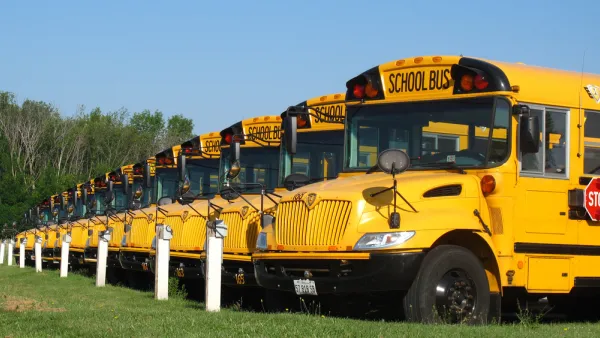
Campaign Launched to Electrify School Buses
U.S. PIRG wants states to use funding from multi-billion dollar Volkswagen settlements to convert the nation's school bus fleet, 95% of which is diesel-powered, to zero-emission buses to reduce children's exposure to toxic air pollution.
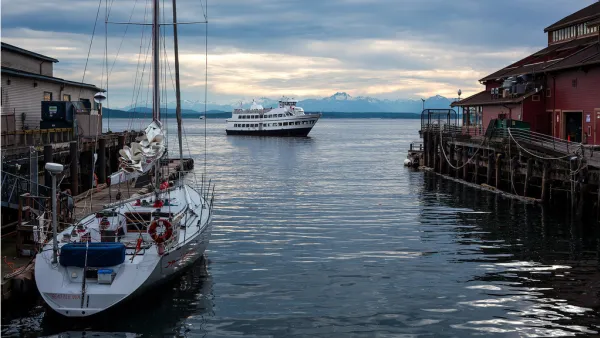
Washington State to Transition to Battery Electric Ferries
Washington's largest diesel emissions polluter will transition its fleet to diesel-hybrids and then to battery-electric propulsion to comply with Gov. Inslee's emissions-reduction executive order which will also please the orcas in Puget Sound.

Planetizen Federal Action Tracker
A weekly monitor of how Trump’s orders and actions are impacting planners and planning in America.

California plans to bury El Niño’s downpour
If the state plays its cards right, it may be able to store a billion acre-feet of El Niño’s water in aquifers.

Chicago breaks ground on $3 billion megadevelopment
The new neighborhood, titled Foundry Park, will one day host 3,700 residences.

Satanic Place Names
From streams and lakes to valleys and canyons, I mapped more than 1,000 places named after the Devil.

California High-Speed Rail Authority CEO resigns after $600,000 scandal
Under Ian Choudri, the authority used taxpayer dollars to fund first class flights and trips to nightclubs.

Want to study the Missouri River? Soon, you may need unanimous approval from 10 states
Legislation would require 10 governors’ permission to study or build projects moving water outside the basin.

FREE Course: Walkable City 1: Why Walkability?
After describing his path towards focusing on walkability as the essence of good planning, Jeff Speck marches through his five principal reasons for making more walkable places.
Reinventing Malls: Planning Alchemy—Turning Gray Fields Into Gold
The course focuses on the opportunities and imperatives that shape reinvention of mall sites.

City of Rosemead
Rutgers University, Edward J. Bloustein School of Planning and Public Policy
One Hundred Miles
Hunter College, City University of New York (CUNY)
The Architects Foundation
University of Cincinnati Online
City of Cambridge
Montrose County
The Pocatello Development Authority