Two jokes in one: The Onion reports a totally fake news story about New York builds a super expensive fake subway station just to bust fare evaders.


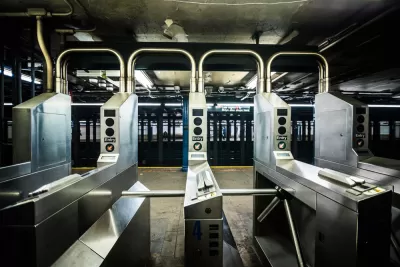
A lot of people get really angry when they see people jump fare gates or otherwise avoid paying for a ride. Other people get really angry when they see the surveillance power of the government expanded, and vulnerable people arrested and prosecuted for fare evasion. And yet other people get really angry when transit investments cost more than they do anywhere else in the world.
Enter the satirical news site, The Onion.
The Onion is clearly choosing sides in the ongoing debate about the consequences of fare evasion. While a few cities in the United States (e.g., Philadelphia, D.C., and Portland) are in the process of decriminalizing fare evasion, New York City has been attracting attention for news of a bolstered police force at subway stations, and additional surveillance technology, to deter fare evasion.
The Onion's response is to imagine a totally fabricated scenario that involves the NYPD spending big dollars on a fake subway station.
In a new effort by the MTA and law enforcement to crack down on fare evasion, New York City reportedly opened a $500 million decoy subway station this week to catch turnstile jumpers.
The typical return on investment from transit infrastructure is clearly also under the microscope here:
“This sprawling, state-of-the-art station will have all the sights and sounds of a regular terminal, including turnstiles that will not accept MetroCards regardless of their available balance, increasing the likelihood of attempts to avoid payment,” said MTA project manager Greg Langdon, adding that the act of fare evasion would cause the floor to open up, sending the commuter down a chute connected to a windowless underground holding cell.
The rest of the jokes are available in the source article.
FULL STORY: NYC Opens $500 Million Decoy Subway Station To Catch Turnstile Jumpers

Transit Faces a Fiscal Cliff in New York City—Sooner Than Expected
It's like March 2020 all over again.

Friday Funny: Who's Neglecting Transit Payments Now?
Satirical news website The Onion turns up the heat on New York politicians, this time flipping the tables of the fare evasion debate.
NYC to Upgrade 1/3 of its Subway Car Fleet
The MTA is seeking proposals for up to 2,390 new subway cars to upgrade its aging fleet.

Planetizen Federal Action Tracker
A weekly monitor of how Trump’s orders and actions are impacting planners and planning in America.

The state-sanctioned urbicide of Austin
People don’t kill cities. Freeways do.

US to reduce Colorado River water deliveries to Mexico
A new Colorado Treaty amendment reduces Mexico’s Colorado River water allocation by 250,000 acre feet.

5 New England states march closer to 800 megawatt wind energy project
Securing federal approval for the project may be complicated under the Trump administration, which has historically been hostile towards domestic wind power.

Baltimore to break ground on $50 million Transit Priority Project
The project will bring faster bus trips, safer streets and better bike connections to Baltimore.

Airbnb launches $250 million 'last-dollar financing' housing accelerator, makes first investment in Austin
The company will put $6.4 million towards affordable housing development in Texas’ capital.

FREE Course: Walkable City 1: Why Walkability?
After describing his path towards focusing on walkability as the essence of good planning, Jeff Speck marches through his five principal reasons for making more walkable places.
Reinventing Malls: Planning Alchemy—Turning Gray Fields Into Gold
The course focuses on the opportunities and imperatives that shape reinvention of mall sites.

Eagle County Government
Harvard University Graduate School of Design
Nashville Planning Department
The Architects Foundation
University of Cincinnati Online
The Pocatello Development Authority
The Urban Renewal Agency of the City of Pocatello
Journal of the American Planning Association