The humble curb is getting crowded: not only with new modes of transportation, but also with a slew of new data tools aiming to keep track of it all.


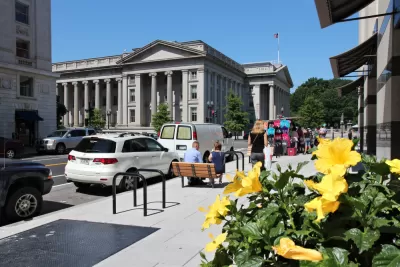
Andrew Small and Laura Bliss report on an increasingly active space: data platforms providing real-time information on how curbs are being used. They include Open Curbs, a tool from Sidewalk Labs spinoff Coord, "which pins the locations of wheelchair cuts, fire hydrants, bus stops, and other physical assets that define the curb to digital maps, available to anyone who's interested in using them."
The idea is to give public officials, mobility companies, and researchers a better picture of what's going on in a space that, according to Coord CEO Stephen Smyth, remains "relatively un-digitized." Many of these startups focus on the often-fraught nexus between new mobility companies and the public sector. For instance, a tool from data company Populus "gives cities access to parking data from e-scooters and e-bikes operated by private companies." Another, from transit data startup Remix, provides data visualization and analysis options.
On the public end, the Los Angeles Department of Transportation is experimenting with its own API that obtains real-time trip data from private scooter companies. This lets the city "understand where vehicles are distributed across the city, and to adjust and enforce regulations for private mobility companies directly through their apps."
While many see potential in smarter systems for curb management, Small and Bliss write that "the new, data-oriented products that aim to pave over conflicts at the curb are also raising new conflicts about privacy and governance of public space."
FULL STORY: The Race to Code the Curb


Sidewalk Labs Launches 'Operating System' for Urban Data
The 'Coord' platform will give mobility companies a centralized place to access and use local data on parking, curb space, tolls, and the like.

Promised Data-Driven Infrastructure On Hold at Hudson Yards
When the Manhattan megadevelopment got its start, big data was a major part of Hudson Yards' marketing pitch. Now it's "probably the last thing we'll get to."

Mapping the Law of the Land: Curbside Access
More uses and modes than ever are fighting for curb space in growing cities. Here's an app to make sense of what you can do, and when, along this valued real estate.

The state-sanctioned urbicide of Austin
People don’t kill cities. Freeways do.

US to reduce Colorado River water deliveries to Mexico
A new Colorado Treaty amendment reduces Mexico’s Colorado River water allocation by 250,000 acre feet.

New Jersey’s second-largest city bans standalone data centers
Jersey City will continue to allow co-location facilities, such as those meant for research institutions that store their own data.

Amtrak not solely to blame for New Jersey commuter rail's unreliability, report finds
A new study from the Garden State Initiative found that NJ Transit’s budget grew 20% across a 4 year period, but reliability declined significantly over the same period.

EPA erases limits on planet-warming pollution from power plants
Under Monday’s plan, power plants would still have some limits on how much mercury, arsenic and other contaminants they can emit.

Phoenix announces new on-demand transit service, more frequent RAPID buses
Both new services will launch in October, and are part of Phoenix's Project Effective Access Solutions for Easing Congestion.

FREE Course: Walkable City 1: Why Walkability?
After describing his path towards focusing on walkability as the essence of good planning, Jeff Speck marches through his five principal reasons for making more walkable places.
Reinventing Malls: Planning Alchemy—Turning Gray Fields Into Gold
The course focuses on the opportunities and imperatives that shape reinvention of mall sites.

Eagle County Government
Harvard University Graduate School of Design
Nashville Planning Department
The Architects Foundation
University of Cincinnati Online
The Pocatello Development Authority
The Urban Renewal Agency of the City of Pocatello
Journal of the American Planning Association