A new controversy about the Trump family's potential to profit from Trump administration policies emerged the same week as news that an executive order was forming a White House Opportunity and Revitalization Council.



"Mr. Trump plans to sign an executive order at the White House that will push federal resources to so-called opportunity zones — a small but lucrative provision tucked into his signature tax cut that in recent months has vaulted to prominence among real estate developers and other investors," reports Jim Tankersley.
"Mr. Trump’s order seeks to encourage development in the zones and reassure investors that they are viable places for investment," adds Tankersley. "It will create a White House Opportunity and Revitalization Council, covering 13 federal agencies and led by Ben Carson, the Housing and Urban Development secretary. The council will work to prioritize opportunity zones in a variety of federal efforts, including grant funding, loan guarantees, infrastructure spending and crime prevention."
The executive order moves the Opportunity Zone program further along the process, but also shows how much work remains for implementation. According to Tankersley, the new council will be tasked with deciding where to focus investments, and the Trump Administration must still complete two rounds of regulations to govern the zones and the investment funds. The Treasury Department released an initial guidance on the Opportunity Zones program in October.
Initial criticism of the program—focused on the potential for Opportunity Zones to benefit projects and neighborhoods that are a stretch to portray as distressed—got new ammunition this week, as the Associated Press reported that Jared and Ivanka Trump stand to profit from Opportunity Fund investments.
Read the full story: Trump to Steer More Money to ‘Opportunity Zones’
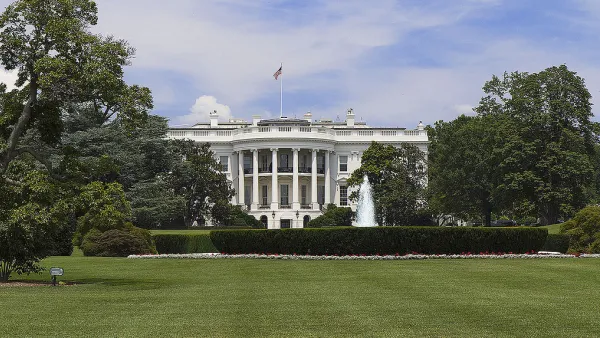
Next White House Struggle: Whether to Exit the Paris Climate Agreement
Ending Obama's so-called "war on coal" may go international with the exit from the December 2015 Paris Climate Agreement if EPA Administrator Scott Pruitt has his way, but he may encounter formidable opposition from Trump's administration and family.

Five Years Later: What Have Opportunity Zones Accomplished?
Two recent studies are among the first to attempt a comprehensive account of the effects of the Investing in Opportunity Program, one of the signature place-based policies of the Trump era.
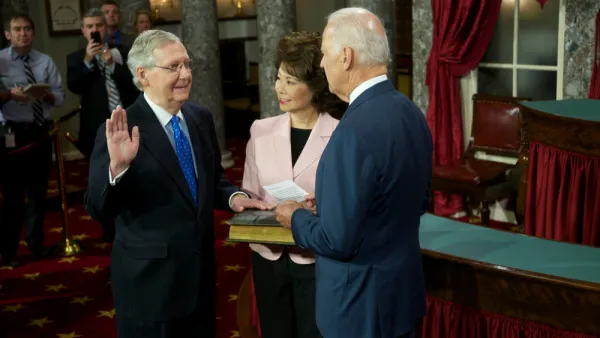
Transportation Secretary's Resignation Announcement Greeted With Derision
Transportation Secretary Elaine Chao became the first cabinet secretary to announce her resignation due to the storming of the Capitol by Trump supporters, but at least one high-profile member of congress has derided the announcement.

Planetizen Federal Action Tracker
A weekly monitor of how Trump’s orders and actions are impacting planners and planning in America.

California plans to bury El Niño’s downpour
If the state plays its cards right, it may be able to store a billion acre-feet of El Niño’s water in aquifers.

Desperate measures: Advocates weigh draining Lake Powell to fill Colorado River
Draining the reservoir could reduce evaporation losses by a couple hundred thousand acre-feet.

Mamdani’s pied-à-terre tax survives legal challenge
A panel of judges found that the plaintiffs failed to demonstrate injury as a result of New York City's implementation of the tax.

Eastern Nebraska is running out of electricity
Data centers and electrification are straining eastern Nebraska’s grid, throttling economic development.

Seattle passes record-breaking transit services expansion
Proposition 1 will double the city’s transit tax to add 95,000 more bus trips and preserve 180,000 bus trips annually.

FREE Course: Walkable City 1: Why Walkability?
After describing his path towards focusing on walkability as the essence of good planning, Jeff Speck marches through his five principal reasons for making more walkable places.
Reinventing Malls: Planning Alchemy—Turning Gray Fields Into Gold
The course focuses on the opportunities and imperatives that shape reinvention of mall sites.

City of Rosemead
Rutgers University, Edward J. Bloustein School of Planning and Public Policy
One Hundred Miles
Hunter College, City University of New York (CUNY)
The Architects Foundation
University of Cincinnati Online
City of Cambridge
Montrose County
The Pocatello Development Authority