Washington Gov. Jay Insee distinguished himself in the 2020 presidential Democratic primary as the "climate candidate," yet he vetoed a section of a transportation electrification bill that set a goal of ending sales of gas-powered cars by 2030.


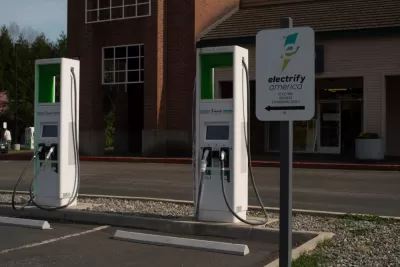
What's more controversial than transitioning from carbon-emitting internal combustion engines to zero-emissions electric power in passenger vehicles? For Gov. Jay Inslee of Washington, who proposed banning the sale of internal combustion-powered vehicles by 2035 as a candidate in the 2020 Democratic primary, road funding, rather than tailpipe emissions, proved to be a bigger challenge.
Jameson Dow has been covering the legislation for Electrek, a news and commentary site covering the transition from fossil-fuel transport to electric transport, since February when the "Washington state’s House Transportation Committee voted 17-12 to advance a bill [pdf] requiring all light-duty vehicles of model year 2030 and later registered in the state to be electric." The bill was sponsored by Coltura, a Washington-based environmental group whose goal is to phase out gasoline.
The mandate changed to a goal when the "legislature passed 'Clean Cars 2030,' a bill setting a goal to require all light-duty vehicles of model year 2030 or later to be electric," wrote Dow on April 15. "The bill passed as part of a larger package directing utilities to prepare the state for all-electric transportation."
Should electric vehicles pay for roads? How?
House Bill 1287, "Concerning preparedness for a zero emissions transportation future," not only dealt with the need for battery-electric and fuel cell vehicle infrastructure but how to transition from a gas tax-funded state transportation budget that doesn't apply to vehicles that don't consume gasoline or diesel fuel. An amendment in the engrossed second substitute bill [pdf] linked the two objectives:
A goal is established that all publicly and privately owned passenger and light duty vehicles of model year 2030 or later sold, purchased, or registered in Washington state be electric vehicles, contingent upon a road usage charge or equivalent vehicle miles traveled fee or tax being in effect in Washington with at least 75 percent of registered passenger and light duty vehicles in Washington participating.
Gov. Inslee "had been expected to sign the bill this morning, but vetoed the 100% EV plan stating that 'achieving a goal of 100% electric vehicles is too important to tie to the implementation of a separate policy like the road usage charge,'" wrote Dow on May 13.
He did not specifically take issue with either the road usage fee or the ban on new gas vehicles, but rather with the fact that the two were tied together – that for the gas car ban to happen, the road usage fee must be implemented first.
Inslee explained why he applied the line-item veto in a Google document, also included in the source article.
"It is not clear what will happen to the effort from here" adds Dow. "The legislature may decide to send another bill to Inslee’s desk without tying the two parts together, or Inslee could theoretically figure out a way to set some sort of goal by executive order."
While many states, including Washington, have operated road usage charge pilot programs, only Oregon and Utah operate actual road usage charge programs with paying motorists, though both are very limited in participation.
Related in Planetizen:
-
Gone by 2035: Gas-Powered Car Sales Have an Expiration Date in California, September 24, 2020
-
Utah Officials Want to Replace the State Gas Tax [See section: Washington state has answers], March 3, 2020
-
Washington Attempts to Adopt a Cleaner Cars and Clean Fuels Programs, January 21, 2020
-
Phasing Out the Internal Combustion Engine No Easy Task, September 18, 2018
-
12-Cent Gas Tax Increase Deal in Washington State, June 30, 2015
FULL STORY: WA Gov. Inslee vetoes 2030 gas car ban, citing road usage fee concerns

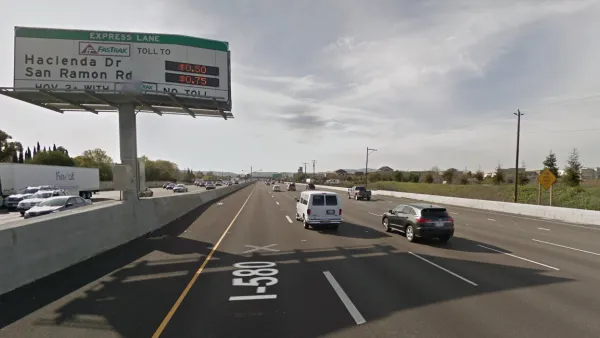
Innovative Road Funding Pilot Program Advances in California
State Sen. Scott Wiener authored legislation dubbed the Gas Tax Alternative Pilot to extend the California Road Charge Program that completed its pilot in 2017. The program takes on more significance with the 2035 sales ban of gas-powered vehicles.
Washington Attempts to Adopt a Cleaner Cars and Clean Fuels Programs
A Pew Stateline article tackles the challenges of reducing carbon emissions from transportation compared to electricity generation and looks at recent initiatives announced by Washington Gov. Jay Inslee aimed at decarbonizing transportation.
Washington Governor Delays Progress on Mileage Fee, Again
For the second time in two years, Gov. Jay Inslee has dealt a legislative setback to transportation planning efforts to prepare for the 2035 ban on the sale of gas-tax paying light duty motor vehicles to reduce carbon emissions.

The state-sanctioned urbicide of Austin
People don’t kill cities. Freeways do.

US to reduce Colorado River water deliveries to Mexico
A new Colorado Treaty amendment reduces Mexico’s Colorado River water allocation by 250,000 acre feet.

New Jersey’s second-largest city bans standalone data centers
Jersey City will continue to allow co-location facilities, such as those meant for research institutions that store their own data.

Amtrak not solely to blame for New Jersey commuter rail's unreliability, report finds
A new study from the Garden State Initiative found that NJ Transit’s budget grew 20% across a 4 year period, but reliability declined significantly over the same period.

EPA erases limits on planet-warming pollution from power plants
Under Monday’s plan, power plants would still have some limits on how much mercury, arsenic and other contaminants they can emit.

Phoenix announces new on-demand transit service, more frequent RAPID buses
Both new services will launch in October, and are part of Phoenix's Project Effective Access Solutions for Easing Congestion.

FREE Course: Walkable City 1: Why Walkability?
After describing his path towards focusing on walkability as the essence of good planning, Jeff Speck marches through his five principal reasons for making more walkable places.
Reinventing Malls: Planning Alchemy—Turning Gray Fields Into Gold
The course focuses on the opportunities and imperatives that shape reinvention of mall sites.

Eagle County Government
Harvard University Graduate School of Design
Nashville Planning Department
The Architects Foundation
University of Cincinnati Online
The Pocatello Development Authority
The Urban Renewal Agency of the City of Pocatello
Journal of the American Planning Association