New road capacity doesn't solve congestion, according to the central argument of a new report by Transportation for America.


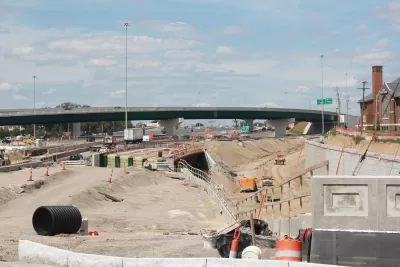
Transportation for America's new report, titled "The Congestion Con: How more money and more lanes equals more traffic," examines the big questions raised by congestion, like how strategies designed to reduce congestion fail, and whether congestion reduction should be the goal of transportation planning.
The key problem presented by the report: the history of U.S. road construction hasn't reduced congestion. "We added 30,511 new freeway lane-miles of road in the largest 100 urbanized areas between 1993 and 2017, an increase of 42 percent. That rate of freeway expansion significantly outstripped the 32 percent growth in population in those regions over the same time period. Yet this strategy has utterly failed to “solve” the problem at hand—delay is up in those urbanized areas by a staggering 144 percent," according to the introduction to the report.
The report doesn't just point out the problem, however, it also proposes solutions: "The report also has five simple policy recommendations to make better use of our billions of dollars without pouring yet more into a black hole of congestion 'mitigation.'"
Read the full story: The Congestion Con
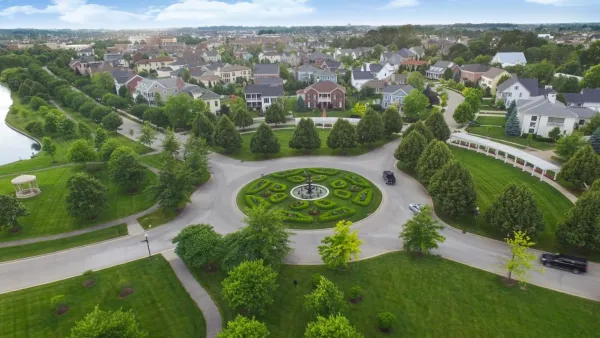
America's 'roundabout city' is in … Indiana?
Carmel, Indiana has built over 150 roundabouts as part of a broader mobility and development strategy.
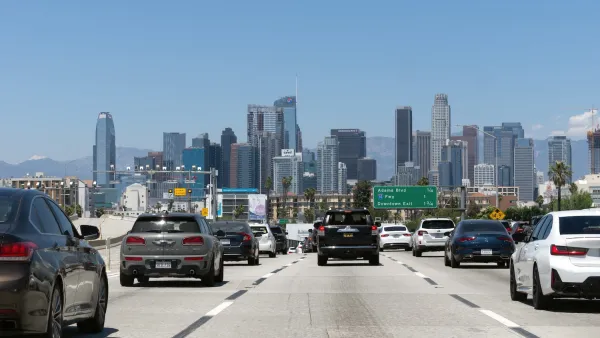
Report: Caltrans Models, Which Guide Billions in Transportation Funding, are Inaccurate and Outdated
Many of the predictive models used by California’s transportation agency fail to account for post-pandemic travel patterns and induced demand.

When Will We Believe in Induced Demand?
The well-documented concept has yet to catch on in state departments of transportation, but acknowledging it could dramatically transform U.S. transportation policy.

Planetizen Federal Action Tracker
A weekly monitor of how Trump’s orders and actions are impacting planners and planning in America.

Eastern Nebraska is running out of electricity
Data centers and electrification are straining eastern Nebraska’s grid, throttling economic development.

Washington state to charge fee to drivers with fuel-efficient cars
Revenue from the fee will go towards supporting the state’s highways.

Instead of building new housing, LA developers are turning mansions into mega-mansions
In the richest areas, the number of houses valued at $30 million with demolition permits has skyrocketed since 2018.

Illinois considers spending $1 billion in taxpayer money on data center
A quantum computing campus and data center are currently under construction in Chicago.

As development costs rise, Boston moves to lessen affordable housing requirements
The Boston Zoning Commission and the City Council still need to approve Boston Mayor Michelle Wu’s proposed changes

FREE Course: Walkable City 1: Why Walkability?
After describing his path towards focusing on walkability as the essence of good planning, Jeff Speck marches through his five principal reasons for making more walkable places.
Reinventing Malls: Planning Alchemy—Turning Gray Fields Into Gold
The course focuses on the opportunities and imperatives that shape reinvention of mall sites.

City of Charlotte
City of Rosemead
Rutgers University, Edward J. Bloustein School of Planning and Public Policy
University of Michigan School for Environment and Sustainability (SEAS)
Hunter College, City University of New York (CUNY)
The Architects Foundation
City of Cambridge
The Pocatello Development Authority
The Urban Renewal Agency of the City of Pocatello