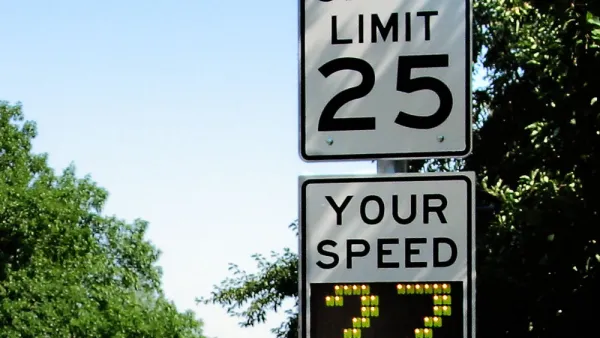
A report on how to implement Vision Zero traffic safety improvements in the city of Minneapolis included an ambitious menu of options, including lower speed limits citywide.



Miguel Otárola reports from Minneapolis, where the city is considering lowering speed limits "on most, if not all, city-owned streets" as a traffic safety measure included in the city's ongoing Vision Zero initiative.
"The speed limit on most city streets is 30 miles per hour. City officials leading the safety-improvement work said they are still unsure where they will lower speed limits and by how much. They will conduct a 'technical analysis' in order to make sure the changes are 'defensible,' said Steve Mosing, traffic operations engineer for the city."
The state of Minnesota recently relaxed its laws to allow the city the ability to lower speed limits.
As noted by Otárola, transportation officials working on Vision Zero for the city also recommended increasing the number of street design improvements aimed toward improving safety outcomes, in addition to deploying traffic cameras and reforming the city’s traffic-enforcement unit.
FULL STORY: Minneapolis considers lower speed limits citywide

Speed Limit Reform Spreading Across Minnesota
After the Twin Cities lowered speed limits in the urban core of the region in 2020, a trio of suburban cities are planning to follow. Two of the cities are planning to set some speed limits as low as 20 mph.

'20 Is Plenty' in the Twin Cities
The first 20 mile per hour speed limit signs have been installed this week in the Twin Cities.

Twin Cities to Lower Speed Limits
Minneapolis and St. Paul are teaming up, with new authority granted by the State legislature, to lower speed limits in both cities.

Planetizen Federal Action Tracker
A weekly monitor of how Trump’s orders and actions are impacting planners and planning in America.

The state-sanctioned urbicide of Austin
People don’t kill cities. Freeways do.

US to reduce Colorado River water deliveries to Mexico
A new Colorado Treaty amendment reduces Mexico’s Colorado River water allocation by 250,000 acre feet.

5 New England states march closer to 800 megawatt wind energy project
Securing federal approval for the project may be complicated under the Trump administration, which has historically been hostile towards domestic wind power.

Baltimore to break ground on $50 million Transit Priority Project
The project will bring faster bus trips, safer streets and better bike connections to Baltimore.

Airbnb launches $250 million 'last-dollar financing' housing accelerator, makes first investment in Austin
The company will put $6.4 million towards affordable housing development in Texas’ capital.

FREE Course: Walkable City 1: Why Walkability?
After describing his path towards focusing on walkability as the essence of good planning, Jeff Speck marches through his five principal reasons for making more walkable places.
Reinventing Malls: Planning Alchemy—Turning Gray Fields Into Gold
The course focuses on the opportunities and imperatives that shape reinvention of mall sites.

Eagle County Government
Harvard University Graduate School of Design
Nashville Planning Department
The Architects Foundation
University of Cincinnati Online
The Pocatello Development Authority
The Urban Renewal Agency of the City of Pocatello
Journal of the American Planning Association