It's been awhile since the proposed BQX Streetcar project had any forward momentum in New York City.



Mayor Bill de Blasio recently announced a budget proposal that included funding for 350 passenger vessels in the NYC Ferry fleet, but conspicuously lacked any funding for another of his signature legacy initiatives: the Brooklyn Queens Connector, also known as the BQX.
"A 16-mile streetcar service proposed for the Brooklyn-Queens waterfront is unfunded in the Economic Development Corp.'s proposed budget, suggesting that preliminary planning might not begin for at least a year—should the city ever move forward with the project," reports Joe Anuta.
According to Anuta, the city is nearing the conclusion of a feasibility study. That study has already revealed details that could add $2.5 billion to the estimated cost of the project.
Planetizen last checked in with the de Blasio Administration's commitment to the BQX project in April, with a story about the project's DOA or MIA funding status. It doesn't seem like there's been any positive development since then either.
Read the full story: Mayor's BQX streetcar left out of city budget

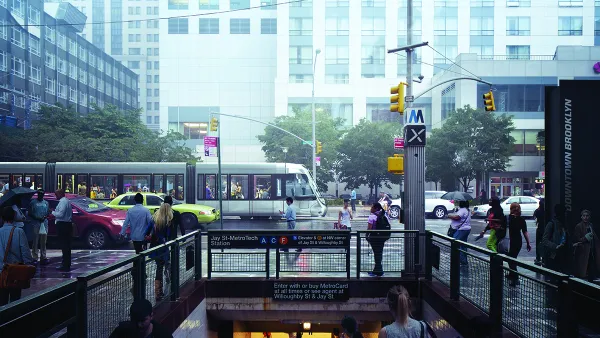
Brooklyn-Queens Streetcar Will Live or Die in the Next Administration
Construction on the Brooklyn-Queens Streetcar, a potential legacy project for New York Mayor Bill de Blasio, was supposed to begin in 2019. The fate of the heavily debated project will rest with the next mayor.
Brooklyn-Queens Connector Streetcar Plans Released
Plans for the Brooklyn-Queens Connector, otherwise known as the BQX, are still on the table, despite reports of the project's demise.
More Details of Brooklyn-to-Queens Streetcar Proposal Emerge
One interesting detail to note: the BQX streetcar proposal, as its currently known, originated not from the de Blasio Administration but from a Brooklyn-based real estate company.

Planetizen Federal Action Tracker
A weekly monitor of how Trump’s orders and actions are impacting planners and planning in America.

California plans to bury El Niño’s downpour
If the state plays its cards right, it may be able to store a billion acre-feet of El Niño’s water in aquifers.

Chicago breaks ground on $3 billion megadevelopment
The new neighborhood, titled Foundry Park, will one day host 3,700 residences.

California High-Speed Rail Authority CEO resigns after $600,000 scandal
Under Ian Choudri, the authority used taxpayer dollars to fund first class flights and trips to nightclubs.

Want to study the Missouri River? Soon, you may need unanimous approval from 10 states
Legislation would require 10 governors’ permission to study or build projects moving water outside the basin.

Desperate measures: Advocates weigh draining Lake Powell to fill Colorado River
Draining the reservoir could reduce evaporation losses by a couple hundred thousand acre-feet.

FREE Course: Walkable City 1: Why Walkability?
After describing his path towards focusing on walkability as the essence of good planning, Jeff Speck marches through his five principal reasons for making more walkable places.
Reinventing Malls: Planning Alchemy—Turning Gray Fields Into Gold
The course focuses on the opportunities and imperatives that shape reinvention of mall sites.

City of Rosemead
Rutgers University, Edward J. Bloustein School of Planning and Public Policy
One Hundred Miles
Hunter College, City University of New York (CUNY)
The Architects Foundation
University of Cincinnati Online
City of Cambridge
Montrose County
The Pocatello Development Authority