Eliminating the requirement for two staircases in multi-story residential buildings lets developers use smaller lots and more flexible designs to create denser housing.



Months after Austin legalized single-staircase buildings up to five stories tall, the city’s first three-story, single-stair building acquired its permits.
According to an announcement by McKinney York Architects, who designed the project, in Building Design + Construction, “The simple concept of this six-unit apartment complex celebrates an open central stair that forms an inviting entry and divides the building into two discrete volumes. Limited to a 4,400-sf lot, the project prioritizes sustainability and efficiency by taking advantage of existing infrastructure already serving the central city.”
Single-staircase construction for residential buildings has been outlawed in some U.S. cities due to safety concerns, many of which are rendered obsolete by modern building materials and fire prevention mechanisms. Now, some cities and states are rolling back restrictions on single-stair buildings to make room for more flexible and dense housing developments.
Read the full story: First three-story, single-stair project permitted in Austin, Texas

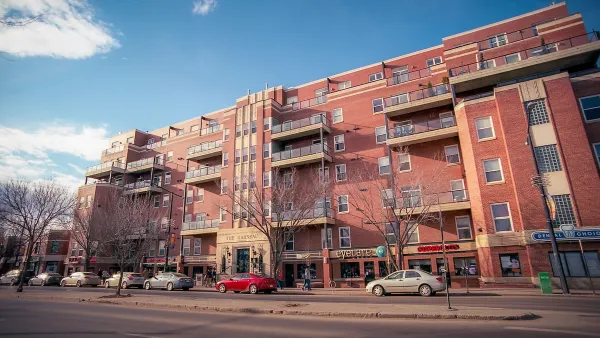
Even Edmonton Wants Single Staircase Buildings
Canada's second most affordable major city joins those angling to nix the requirement for two staircases in multi-family buildings.
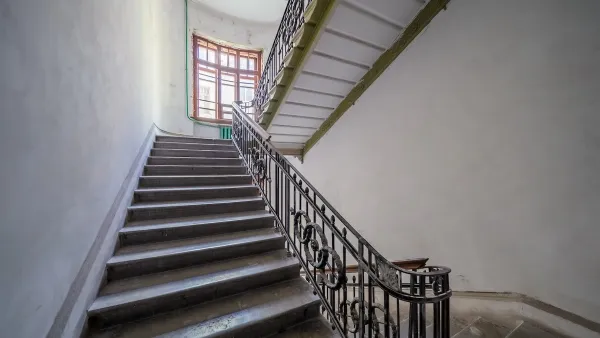
Study: Single-Staircase Buildings Pose No Additional Risks
Zoning codes have long prohibited single-stair residential buildings due to safety concerns, but changing that could lower the cost of construction and allow for more flexible housing designs.
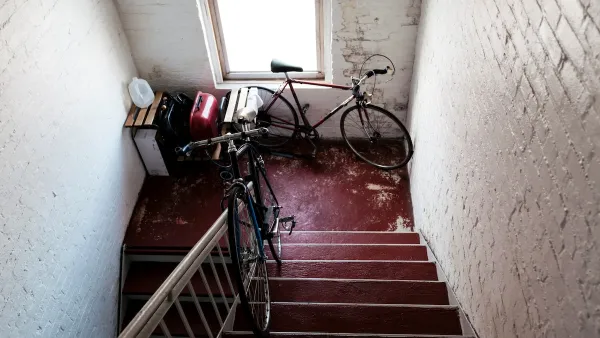
Single-Stair Reform Gains Strength
The movement to legalize single-stair multi-story buildings is gathering momentum, with the typology offering a more efficient, flexible, and healthy way to build housing.

Planetizen Federal Action Tracker
A weekly monitor of how Trump’s orders and actions are impacting planners and planning in America.

California plans to bury El Niño’s downpour
If the state plays its cards right, it may be able to store a billion acre-feet of El Niño’s water in aquifers.

Chicago breaks ground on $3 billion megadevelopment
The new neighborhood, titled Foundry Park, will one day host 3,700 residences.

Satanic Place Names
From streams and lakes to valleys and canyons, I mapped more than 1,000 places named after the Devil.

California High-Speed Rail Authority CEO resigns after $600,000 scandal
Under Ian Choudri, the authority used taxpayer dollars to fund first class flights and trips to nightclubs.

Want to study the Missouri River? Soon, you may need unanimous approval from 10 states
Legislation would require 10 governors’ permission to study or build projects moving water outside the basin.

FREE Course: Walkable City 1: Why Walkability?
After describing his path towards focusing on walkability as the essence of good planning, Jeff Speck marches through his five principal reasons for making more walkable places.
Reinventing Malls: Planning Alchemy—Turning Gray Fields Into Gold
The course focuses on the opportunities and imperatives that shape reinvention of mall sites.

City of Rosemead
Rutgers University, Edward J. Bloustein School of Planning and Public Policy
One Hundred Miles
Hunter College, City University of New York (CUNY)
The Architects Foundation
University of Cincinnati Online
City of Cambridge
Montrose County
The Pocatello Development Authority