The Brutalist design by a famed landscape architect will be preserved, but not without better visibility and improved lighting.


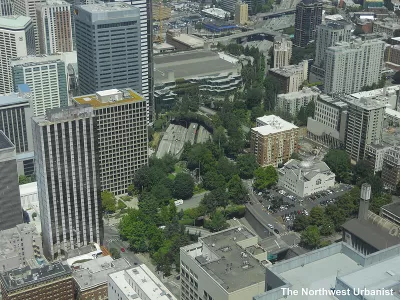
Seattle is moving forward with “preservation-minded” renovations on Freeway Park, which was designed by the late modern landscape architect Lawrence Halprin and built in 1976.
While it is widely considered to be the “world’s first freeway cap park,” and therefore the first example of what has become a wildly popular strategy for making American cities more livable, The Architect’s Newspaper reports that in the last several decades, “the Brutalist park had fallen into severe disrepair, and residents said that they avoid the somewhat isolated park for safety reasons.”
"The park’s mid-life crisis is a common one for late modern structures and landscapes," Antonio Pacheco wrote several months ago, noting that potential changes include better pedestrian visibility and more lighting. “As the doggedly polemical works of the 1970s and 1980s begin to age, their often austere faces are being met with interventions aimed at softening the edges a bit.”
Funding for the renovation comes partly from grants obtained by the Freeway Park Association and, if approved by the city council, partly from funding related to the expansion of the Washington State Convention Center; incidentally, the same public benefits package may partially finance a second cap park over the same downtown freeway.
Read the full story: Preservation-minded renovation of Halprin’s Freeway Park moves forward

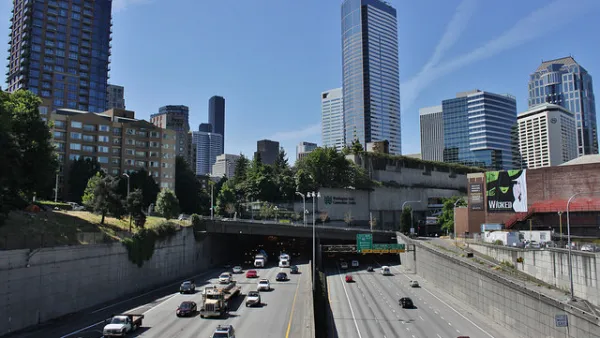
Seattle Residents Angling For New Cap Park Over I-5
As Seattle’s Convention Center expansion moves forward, community members want the public benefit discussion to focus on a new downtown park over I-5.
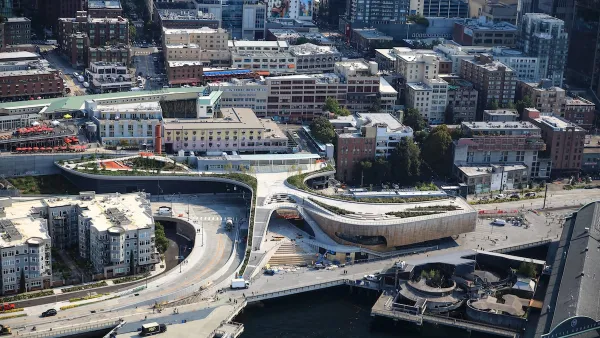
Seattle’s New Overlook Walk Offers Ample Park Space Near Pike Place Market
The elevated park and event space replaces part of the demolished Alaskan Way Viaduct, connecting the city’s famous Pike Place Market to the waterfront.
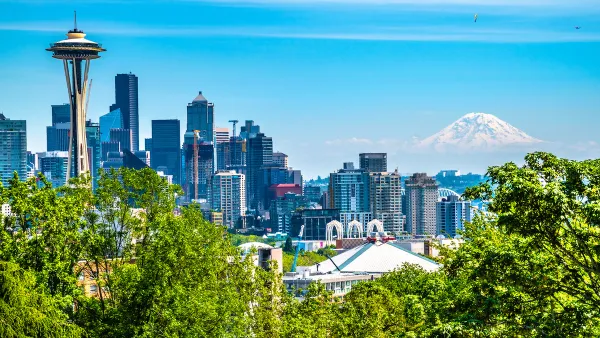
Seattle to Host 2024 Urban Parks Conference
In June 2024, City Parks Alliance, in partnership with Seattle Parks and Recreation, will hold the Greater & Greener conference, which will include a mix of indoor sessions and outdoor experiences focusing on urban parks.

Planetizen Federal Action Tracker
A weekly monitor of how Trump’s orders and actions are impacting planners and planning in America.

The state-sanctioned urbicide of Austin
People don’t kill cities. Freeways do.
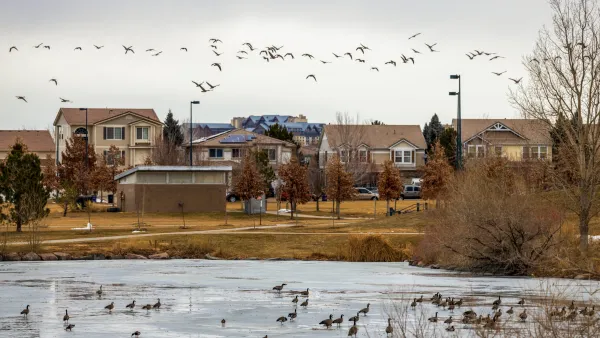
Colorado’s Largest Data Center Could Rise Next to Homes — Without a Public Hearing
The proposed campus would consume 11 times the power of Denver International Airport; as it has across the country, opposition mounts.

Nation's most wind-powered state turns to coal as data centers increase energy demand
For the first time in decades, Iowa has increased its generation of coal power.

NYC cools commuters with city's first rain garden above a bus stop
New York City officials say the plants in the rain garden can absorb 16 gallons of rainwater during heavy storms.

Brightline West’s future may rely on $6 billion federal loan
The company has until Nov. 2 to make a $400 million equity investment into its proposed high-speed rail line.

FREE Course: Walkable City 1: Why Walkability?
After describing his path towards focusing on walkability as the essence of good planning, Jeff Speck marches through his five principal reasons for making more walkable places.
Reinventing Malls: Planning Alchemy—Turning Gray Fields Into Gold
The course focuses on the opportunities and imperatives that shape reinvention of mall sites.


Greater Baltimore Committee
Eagle County Government
Harvard University Graduate School of Design
The Architects Foundation
University of Cincinnati Online
The Pocatello Development Authority
The Urban Renewal Agency of the City of Pocatello
Journal of the American Planning Association