The New York Times transit reporter looks into the lack of progress on the $2.5 billion project proposed by Mayor Bill de Blasio in his 2016 State of the City speech. The mayor responds angrily to a Daily News article casting doubt on the project.


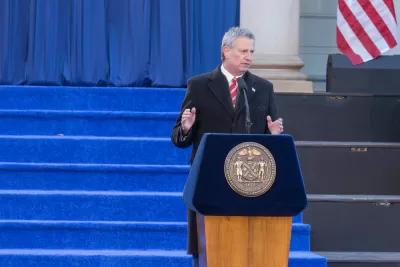
"Mr. de Blasio has said little about the streetcar in recent months and his office has not identified a route, leading to persistent speculation that the proposal is dead," reports Emma G. Fitzsimmons for The New York Times on April 10.
The mayor appeared on last Friday's "Brian Lehrer Show" on WNYC and responded to a question from Nick, an informed listener. From transcript:
Nick: I heard some reports this week that (you) might be backing off the proposed BQX trolley from Astoria to Sunset Park, Brooklyn. I live in Astoria so I am extra curious about what is going to happen with this project....
Mayor: ... this is an instance where a real disservice has been done by the media, specifically the Daily News ....I don’t understand how a journalist goes out of their way to misrepresent the facts and I have seen it way too often lately at the Daily News.
More about the April 3 Daily News article below. An April 6 editorial in that paper, "Is "BQX DOA? TBD," did seem quite fair in this reader's opinion. It focused on the finances making the project possible:
As outlined following the mayor’s unveiling of the plan in his 2016 State of the City, the projected $2.5 billion cost would be covered by the sale of property-value-capturing bonds.
That's Plan A, according to the editorial. And it doesn't seem unreasonable as the mayor is using value capture to finance subway improvements in East Midtown as posted last month. Plan B: If the money isn't there, time to rethink the project. And it reminds readers in Plan C that from a federal funds perspective, the most pressing need is rebuilding the Hudson River rail tunnel, which the Trump administration appears to strongly oppose.
Supporters of the streetcar, comprised of transit leaders and real estate developers, have grown restless, adds Fitzsimmons.
“We are calling on your administration to take concrete steps to indicate that this critical infrastructure project will indeed break ground during your mayoralty,” the letter from the board for the Friends of the Brooklyn Queens Connector, which was obtained by The New York Times, said.
Doubts about the application of value capture
Mr. de Blasio said he wanted to connect a string of growing neighborhoods along the waterfront and claimed that rising real estate tax revenue could finance the streetcar. But his deputy mayor, Alicia Glen, raised doubts last week about whether that model was still feasible.
Ms. Glen told reporters that if the streetcar did not pay for itself, the city would have to decide whether to cover the costs, according to an article in the Daily News that Mr. de Blasio later attacked [on WNYC]. Ms. Glen and the mayor both suggested Senator Chuck Schumer, a Democrat, might help secure federal funding [debunked in aforementioned Daily News editorial].
Fitzsimmons describes many of the other challenges, political as well as from a transit perspective, facing the project, many of which have been covered last year by Planetizen, noted below. The Daily News article by Dan Rivoli that so angered de Blasio is recommended reading in any case. Snip:
“They’ve always needed it to pay for itself. It’s such an outrageously expensive project and it’s going to have such low ridership,” Jon Orcutt, policy director at Transit Center, a research nonprofit, told The News on Tuesday. “If they don’t know the answer now, I suspect the answer is it won’t pay for itself and it would be a bad use of city funding.”
Related posts in Planetizen that cast some doubt on the viability of the streetcar project:
- Who Opposes New York's BQX Streetcar? Not Who You Think, November 28, 2017
-
MIA or DOA? The Brooklyn-Queens Streetcar Fading Fast, August 4, 2017
-
Op-Ed: Brooklyn-to-Queens Streetcar Won't Pay for Itself, February 7, 2017
Hat tip to Mark Boshnack.
FULL STORY: Is Mayor de Blasio’s Brooklyn-Queens Streetcar Dead?

MIA or DOA? The Brooklyn-Queens Streetcar Fading Fast
The lack of news on the proposed Brooklyn Queens Connector (BQX) is hardly a death knell, but that doesn't mean no news is good news, either.
Another Transit Lesson for New York (and Other Cities) from Toronto
Just as Toronto's subway cars provide an example of the benefits that await New Yorkers when their new 'open gangway' cars arrive in 2020, Toronto's extensive streetcar network also provides an example for New York — of what not to do.
Brooklyn-Queens Streetcar Will Live or Die in the Next Administration
Construction on the Brooklyn-Queens Streetcar, a potential legacy project for New York Mayor Bill de Blasio, was supposed to begin in 2019. The fate of the heavily debated project will rest with the next mayor.

The state-sanctioned urbicide of Austin
People don’t kill cities. Freeways do.

US to reduce Colorado River water deliveries to Mexico
A new Colorado Treaty amendment reduces Mexico’s Colorado River water allocation by 250,000 acre feet.

New Jersey’s second-largest city bans standalone data centers
Jersey City will continue to allow co-location facilities, such as those meant for research institutions that store their own data.

Amtrak not solely to blame for New Jersey commuter rail's unreliability, report finds
A new study from the Garden State Initiative found that NJ Transit’s budget grew 20% across a 4 year period, but reliability declined significantly over the same period.

EPA erases limits on planet-warming pollution from power plants
Under Monday’s plan, power plants would still have some limits on how much mercury, arsenic and other contaminants they can emit.

Phoenix announces new on-demand transit service, more frequent RAPID buses
Both new services will launch in October, and are part of Phoenix's Project Effective Access Solutions for Easing Congestion.

FREE Course: Walkable City 1: Why Walkability?
After describing his path towards focusing on walkability as the essence of good planning, Jeff Speck marches through his five principal reasons for making more walkable places.
Reinventing Malls: Planning Alchemy—Turning Gray Fields Into Gold
The course focuses on the opportunities and imperatives that shape reinvention of mall sites.

Eagle County Government
Harvard University Graduate School of Design
Nashville Planning Department
The Architects Foundation
University of Cincinnati Online
The Pocatello Development Authority
The Urban Renewal Agency of the City of Pocatello
Journal of the American Planning Association