Four miles of the 10-mile North Tarrant Express project opened to motorists on April 5. The $1.6 billion project, built by a public-private partnership working with TxDOT, includes rebuilding general purpose and frontage road lanes.


"About 10 a.m. Thursday, just before the four-mile stretch of new toll lanes — also known as TEXpress lanes — opened to the public, a caravan of elected officials and other dignitaries took a drive on the new toll lanes, stopping on a flyover ramp near the south end of the 820/35W interchange to take photographs and speak about the project," reports Gordon Dickson for the Fort Worth Star-Telegram on April 5. "With the opening of the two new toll lanes in each direction, it is now possible to take toll lanes nearly 10 miles..."
The Interstate 35W project area includes Fort Worth, the fifth largest city in the Lone Star State with 833,000 people, and Tarrant County, the state's third most populous county.
"During peak traffic times, expect to pay a $1.25 for the four-mile stretch, but that pricing model will change," reports Sebastian Robertson for WFAA News on April 5. "After six months, the price will fluctuate by usage."
"[O]fficials with North Tarrant Express (NTE) Mobility Partners, the team of companies overseeing the $1.4 billion** makeover [known as the North Tarrant Express project] of the I-35W corridor, said they expect to be finished with the entire I-35W project by Sept. 30, and possibly weeks earlier," adds Dickson.
The public-private partnership (P3) includes Cintra, a subsidiary of Madrid-based Ferrovial, and Paris-based Meridiam.
Local push-back against Texas Transportation Commission's elimination of toll-backed road projects
Last December, the Texas Transportation Commission, reacting to pressure from Gov. Greg Abbott and Lt. Gov. Dan Patrick to not spend funds from statewide propositions passed by voters in 2014 and 2015 on express lanes, voted 5-0 to eliminate 15 express lane projects from their 10-year capital plan. Both ballot measures diverted existing funding streams (the state's Rainy Day Fund and sales taxes, respectively,) to transportation and prohibited spending the revenue on toll lanes.
"Tarrant County Commissioner Glen Whitley used [Thursday's 'flyover'] opportunity to praise the contractors for getting the toll lanes completed about six months ahead of schedule, and he called for state leaders to sign the documents needed to extend the I-35W improvements north from Heritage Trace Parkway to Eagle Parkway near Alliance Airport. That piece of I-35W development has stalled because Gov. Greg Abbott and other state leaders have clamped down on the Texas Department of Transportation's participation in any future toll projects," adds Dickson.
Footnote: **Gordon Dickerson clarified in an email on April 8 that "$200 million was a piece of the [$1.6 billion] project done by the Texas Department of Transportation's own contractors, rather than by NTE Mobility Partners."
Hat tip to IBTTA Smart Brief.
Read the full story: Traffic relief finally comes to this awful stretch of highway — at a price

Construction of I–66 Toll Lanes Outside the Capital Beltway Begins this Weekend
Widening of Interstate 66 for 22.5 miles in Northern Virginia will accommodate two toll lanes in each direction, accessible to trucks. The $3.7 billion project, to be built by public-private partnership at no cost to the state, will open in 2022.
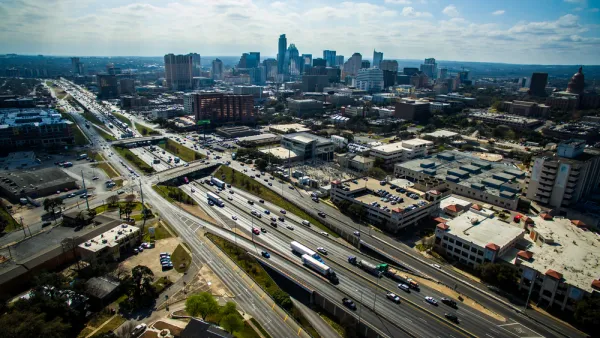
$8 Billion Transportation Vision for Austin: Three-Level Freeway, Tollway
Interstate 35 through Central Austin would be transformed into a three-level roadway wIth toll lanes in the middle, according to an 8.1 billion vision proposed by TxDOT.
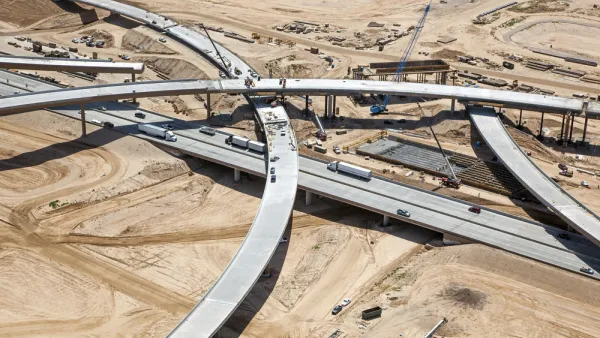
Toll and Tax, or Just Tax, to Pay for Highway Expansion?
A political decision by the Texas Transportation Commission last December to drop projects which included toll lanes was thought to doom 15 road expansions from their 10-year capital plan, but some will go forward with HOV as opposed to HOT lanes.

Planetizen Federal Action Tracker
A weekly monitor of how Trump’s orders and actions are impacting planners and planning in America.

California plans to bury El Niño’s downpour
If the state plays its cards right, it may be able to store a billion acre-feet of El Niño’s water in aquifers.

Chicago breaks ground on $3 billion megadevelopment
The new neighborhood, titled Foundry Park, will one day host 3,700 residences.

California High-Speed Rail Authority CEO resigns after $600,000 scandal
Under Ian Choudri, the authority used taxpayer dollars to fund first class flights and trips to nightclubs.

Want to study the Missouri River? Soon, you may need unanimous approval from 10 states
Legislation would require 10 governors’ permission to study or build projects moving water outside the basin.

Desperate measures: Advocates weigh draining Lake Powell to fill Colorado River
Draining the reservoir could reduce evaporation losses by a couple hundred thousand acre-feet.

FREE Course: Walkable City 1: Why Walkability?
After describing his path towards focusing on walkability as the essence of good planning, Jeff Speck marches through his five principal reasons for making more walkable places.
Reinventing Malls: Planning Alchemy—Turning Gray Fields Into Gold
The course focuses on the opportunities and imperatives that shape reinvention of mall sites.

City of Rosemead
Rutgers University, Edward J. Bloustein School of Planning and Public Policy
One Hundred Miles
Hunter College, City University of New York (CUNY)
The Architects Foundation
University of Cincinnati Online
City of Cambridge
Montrose County
The Pocatello Development Authority