Large-scale road and rail projects aim to facilitate travel from the south of Italy all the way up to Sweden and Finland.


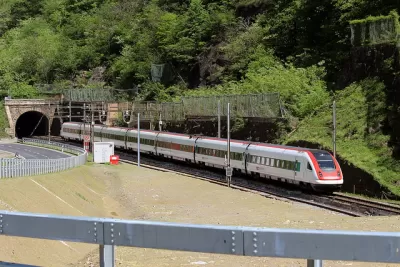
Central Europe has a number of borders and natural choke points that can make traveling difficult. "With their tightly interlinked shipping lanes and industrial supply chains, Copenhagen and Hamburg are already one economy in many senses. But getting between them is a hassle," according to an article in The Economist. Another hassle waits in crossing the Austrian and Swiss Alps, but projects including a Brenner Tunnel are bringing trains under the Alps to make this travel easier than it's ever been before.
The split between Eastern and Western Europe might be famous, but from a geographic perspective the split between northern and southern Europe is more pronounced, The Economist argues. "It is soluble. But the continent’s north-south rift is in many ways deeper: it involves intransigent barriers like high mountains and foaming seas, as well as deep cultural and economic differences. In its own way, the Malmo-Palermo express would be as great a political achievement as its Paris-Moscow counterpart," The Economist contends.
Read the full story: Two giant engineering projects will alter the European landscape

The World's Highest Rates of Coronavirus Infections and Deaths
Brazil and the U.S. lead the world in daily COVID-19 cases and deaths. Western Europe is undergoing a third wave of infections, resulting in a new round of lockdowns, yet most of these nations are not among the 12 hotspots shown on a global tracker.
The Great Scandinavian Pandemic Experiment
Perhaps no nation has captured more media attention in its handling of the coronavirus pandemic than Sweden. Unlike most of Europe, it never went into lockdown, relying mostly on voluntary social distancing. The state epidemiologist devised the plan.
Solving Sweden's Trash Deficit
You read that right, Sweden's trash problem is that it doesn't have enough of it. Due to a spectacularly successful rate of recycling, the country doesn't have enough garbage to power its waste-to-energy program. It's solution: import trash.

Planetizen Federal Action Tracker
A weekly monitor of how Trump’s orders and actions are impacting planners and planning in America.

California plans to bury El Niño’s downpour
If the state plays its cards right, it may be able to store a billion acre-feet of El Niño’s water in aquifers.

Desperate measures: Advocates weigh draining Lake Powell to fill Colorado River
Draining the reservoir could reduce evaporation losses by a couple hundred thousand acre-feet.

California city breaks ground on transit connector
The project includes three mobility hubs and a pedestrian bridge.

After public outcry, Massachusetts city releases housing development tracker
Cambridge’s tracker currently shows 250 housing projects in various stages of development.

40 years after approval, Chicago breaks ground on new park
The park honors Jean Baptiste Point du Sable, the city’s first permanent non-native settler.

FREE Course: Walkable City 1: Why Walkability?
After describing his path towards focusing on walkability as the essence of good planning, Jeff Speck marches through his five principal reasons for making more walkable places.
Reinventing Malls: Planning Alchemy—Turning Gray Fields Into Gold
The course focuses on the opportunities and imperatives that shape reinvention of mall sites.

City of Rosemead
Rutgers University, Edward J. Bloustein School of Planning and Public Policy
One Hundred Miles
Hunter College, City University of New York (CUNY)
The Architects Foundation
University of Cincinnati Online
City of Cambridge
Montrose County
The Pocatello Development Authority