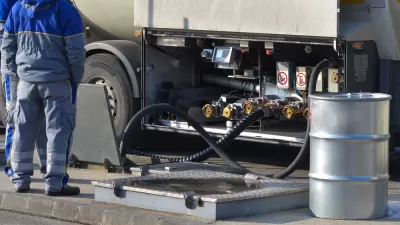
News of the GOP's rejection of a gas tax increase comes from reports on two recent private meetings between Republican leaders and the Trump Administration.


for The Washington Post on
The discussions underscore the difficulty Trump faces as he seeks to finance his 2016 campaign promise of a $1 trillion national infrastructure upgrade...The White House is expected to release an infrastructure plan as soon as this month, but that plan is not expected to dictate how the projects would be paid for..
White House officials said they still have not made a final determination as to whether they will pursue an increase in the gas tax, even though GOP leaders have made clear an increase will not have enough Republican support to become law.
Nor should Trump expect help from Senate Minority Leader Chuck Schumer (D-NY) who told the Daily Beast that he opposes hiking the gas tax to finance the president's infrastructure plan, reported Sam Stein on Nov. 23, 2017.
“The bottom line is that we don’t want to raise taxes on working people right now,” Schumer said. “As it stands now that is where we are at. Income distribution is so bad, I would rather pay for infrastructure by taking the money that comes from overseas [repatriation] and putting it into infrastructure.”
Former Transportation Secretary Ray LaHood, who now serves as co-chair of Building America’s Future, a bipartisan coalition dedicated to infrastructure investment, called Schumer’s remarks shortsighted.
Not entirely ruled out
White House aides have said the president’s broader infrastructure plan would be designed with $200 billion in federal funding and rely on states, localities, or private investors to cover the remaining $800 billion, but Trump has waffled on this, saying he doesn’t believe partnerships between the federal government and private investors would work.
And states will need to be careful on how they finance their share of infrastructure projects, as illustrated by the administration's threatened rejection of the all-important Hudson River rail tunnel project due to New York's and New Jersey's reliance on borrowing from the federal government.
Opposition to increasing gas tax not shared by GOP governors and state legislatures.
Last year, eight states increased their gas taxes, most of which had GOP governors and/or GOP-controlled state legislatures:
California, Tennessee, Montana, Indiana, South Carolina (overriding a governor's veto), Utah (more of an adjustment), West Virginia and Oregon.
However, it was an odd-numbered year; don't count on many this year.
Hat tip to AASHTO Daily Transportation Update.
FULL STORY: GOP leaders reject gas tax increase after Trump floats the idea

What's Behind the Removal of Public-Private Partnerships from Trump's Infrastructure Plan?
Partnering with the private sector carries risks. Witness the mess that followed the selection of a private firm to build an interstate in Indiana in 2014 that Vice President Mike Pence should have prevented in his prior position as governor.
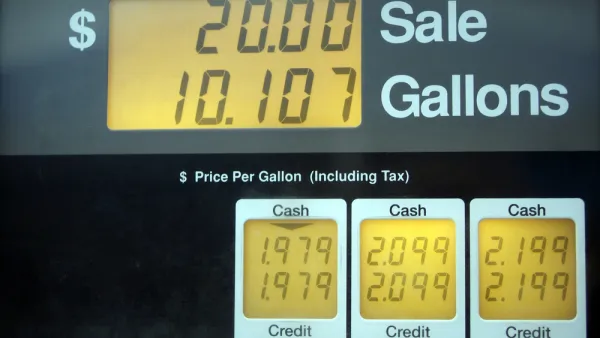
Trump Open to Hiking Gas Tax to Fund Infrastructure Package
Like so many of the president's assertions, the statement, made in a Bloomberg interview on Monday morning, could be open to interpretation, but he's gone where none of his predecessors since Bill Clinton on the issue of raising the gas tax.
Pelosi-Schumer-Trump Infrastructure Plan Already Meeting Resistance
Introduced on April 30, the $2 trillion conceptual plan is likely to be dismissed by Congressional Republicans wary of increasing taxes and adding to the deficit, according to an extensive article by The Hill published three days later.

The state-sanctioned urbicide of Austin
People don’t kill cities. Freeways do.

US to reduce Colorado River water deliveries to Mexico
A new Colorado Treaty amendment reduces Mexico’s Colorado River water allocation by 250,000 acre feet.

New Jersey’s second-largest city bans standalone data centers
Jersey City will continue to allow co-location facilities, such as those meant for research institutions that store their own data.

Amtrak not solely to blame for New Jersey commuter rail's unreliability, report finds
A new study from the Garden State Initiative found that NJ Transit’s budget grew 20% across a 4 year period, but reliability declined significantly over the same period.

EPA erases limits on planet-warming pollution from power plants
Under Monday’s plan, power plants would still have some limits on how much mercury, arsenic and other contaminants they can emit.

Phoenix announces new on-demand transit service, more frequent RAPID buses
Both new services will launch in October, and are part of Phoenix's Project Effective Access Solutions for Easing Congestion.

FREE Course: Walkable City 1: Why Walkability?
After describing his path towards focusing on walkability as the essence of good planning, Jeff Speck marches through his five principal reasons for making more walkable places.
Reinventing Malls: Planning Alchemy—Turning Gray Fields Into Gold
The course focuses on the opportunities and imperatives that shape reinvention of mall sites.

Eagle County Government
Harvard University Graduate School of Design
Nashville Planning Department
The Architects Foundation
University of Cincinnati Online
The Pocatello Development Authority
The Urban Renewal Agency of the City of Pocatello
Journal of the American Planning Association