Exclusives

FEATURE
Technology Gives Form and Face to a Forgotten Place
In an excerpt from his new book, Anthony Townsend explains how a volunteer effort is combining consumer technologies with open source GIS to chart one of Africa’s largest and most notorious slums.
BLOG POST
How a Railway Near the Bastille Revolutionized How We Think About Obsolete Infrastructure
Joseph Heathcott presents a historical narrative of the decline, revitalization, and gentrification of the Parisian neighborhood surrounding the Promenade Plantée and Viaduct des Arts, the pioneering repurposing of obsolete urban infrastructure.
FEATURE
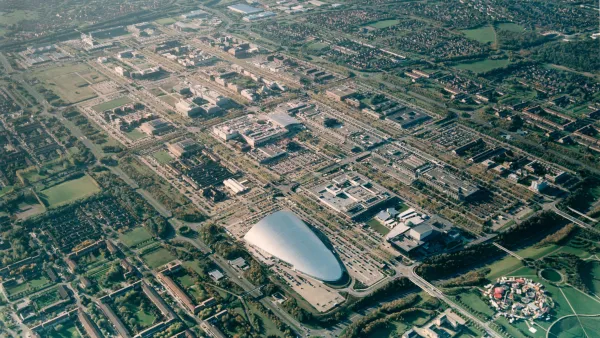
The UK’s Most Infamous ‘New Town’ Pioneers a Food System Revolution
Urban agriculture is a promising solution to a variety of ills afflicting our increasingly urbanizing planet. Milton Keynes, Britain's largest New Town of the 20th Century, is forging a path towards food sovereignty by growing its urban farms.
BLOG POST
Gentrification, Shmentrification
Despite media commentary about urban gentrification and the decline of suburbia, suburbs still have far less than a proportionate share of regional poverty.
BLOG POST
LEED-ND Projects Reduce Driving, But Is There a Simpler Way to Measure Success?
New research by Ewing et al finds that vehicle miles traveled in LEED-ND projects may be as much as 60% lower than regional averages. However, objective models of transportation outcomes may prove more efficient than LEED’s points-based system.
BLOG POST
Abu Dhabi Planning Charrette
Abu Dhabi is updating its strategic development plan. Consultant Todd Litman reports on the city's recent urban planning charrette.
BLOG POST
Can Urban Forests Save the Planet?
Urban forests may possess the power to battle climate change. We just have to figure out what is more important: quantity or quality?

FEATURE
A New Breed of Pedestrian Advocate is Making City Streets Safer for Everyone
As cities such as New York recognize the need to stop treating pedestrians as second-class citizens, the Pedestrian/Traffic Manager (PTM) has emerged as a new tool in the effort to improve the mobility and safety of those on foot.
BLOG POST
I have a Problem With Your “Issues”
Good planning requires clear problem and goal statements. Calling a problem an “issue” is ambiguous, which is a real problem.
BLOG POST
Is Turnabout Fair Play?
If American politicans and bureaucrats had favored public transit or pedestrians as aggressively as they favored cars in the 20th century, public policy would be very different indeed.
BLOG POST
A Vision for LA's New Web-Based Zoning Code
For the first time since 1946, Los Angeles is completely revising its zoning code. Urban Insight, the team behind Planetizen, is pleased to be part of this project. One of our key goals is to create a modern web-based version of the zoning code.
BLOG POST
Congestion Costing Point-Counter-Point
Conventional transportation planning tends to exaggerate congestion costs and roadway expansion benefits, and undervalues other transportation solutions such as improving alternative modes, pricing reforms and smart growth policies.
BLOG POST
The Garden City at "The World's End"
The new film The World's End may be a hilarious British comedy about an epic pub crawl interrupted by the Apocalypse, but it also presents the viewer with a provocative perspective on competing views of liberty.
BLOG POST
Electric Will Supplant Fossil Fuel Cars on Safety
Advocating safety for the successful electric replacement of internal combustion engine cars solves many of the challenges of an automobile-inclusive future urbanity, and there will be no other kind.

FEATURE
Lessons from West: Do Texas Land Use Laws Put Residents at Risk?
After a fertilizer plant explosion killed 15 people in West, observers blamed Texas's lax zoning regulations. Analysis of the locations of such plants across the Western U.S. seeks to determine whether Texas land use law is uniquely unregulated.
BLOG POST
Obstacles to a "Metropolitan Revolution"
In theory, cities might be able to revitalize their economies and infrastructure. But in reality, state governments can create all kinds of obstacles to city policy.
BLOG POST
Taking Bicycle Parking to the Streets
We can best thank Portland and other pioneers for all their hard work with on-street bicycle parking (a.k.a. "bike corrals") by simply benefitting ourselves from their efforts. Here's how...
FEATURE
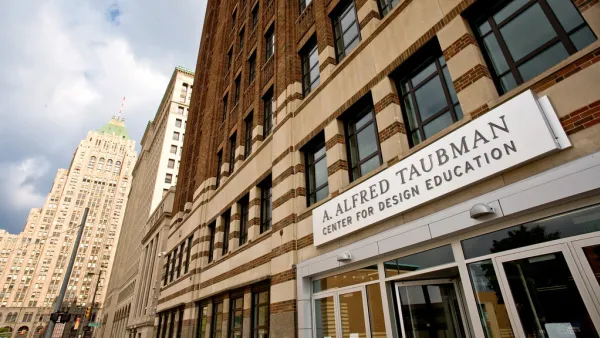
Using Mixed‐Use Education to Build Communities
Urban Planning is rarely seen as a remedy for the state of the education system. However, thoughtful community design that integrates schools in new ways can lead to successful learning environments and vibrant communities.
BLOG POST
Planning for Obsolescence
As college becomes less affordable, alternatives to the traditional four-year model have been making inroads, leading some to question its lasting viability. If universities struggle, it will impact not only campuses, but cities, as well.
BLOG POST
Who's Returning To The City
Are children, millenials and baby boomers returning to cities? The best answer: sometimes, sometimes, and maybe not.
Harvard University Graduate School of Design
KFH Group Inc.
Greater Baltimore Committee
The Architects Foundation
University of Cincinnati Online
The Pocatello Development Authority
The Urban Renewal Agency of the City of Pocatello

FREE Course: Walkable City 1: Why Walkability?
After describing his path towards focusing on walkability as the essence of good planning, Jeff Speck marches through his five principal reasons for making more walkable places.
Reinventing Malls: Planning Alchemy—Turning Gray Fields Into Gold
The course focuses on the opportunities and imperatives that shape reinvention of mall sites.