Environment
Minneapolis Sets Zero Waste Goals
The Minneapolis City Council is considering steps that would increase the amount of its waste stream that gets recycled.
Really Bad News from Antarctica
For those who thought that glacial melting due to climate change mainly affected Greenland and mountain glaciers like in the Himalayas, think again. A new NASA/UC Irvine study reports that melting of West Antarctica's glaciers "appears unstoppable".
Bi-Partisan Energy Efficiency Bill Stalls while Obama Pushes Initiative
A bi-partisan Senate bill to dramatically reduce carbon emissions by increasing energy efficiency got caught-up in Keystone XL pipeline politics, while President Barak Obama pursued his own energy efficiency agenda at a Walmart in Mtn. View, Calif.
Matching Urban Nature to Community Values
Researcher Chris Ives suggests that rather than relying solely on economic gains to justify urban nature and biodiversity, community values may be more effective in gaining public support.

How Planners Can Improve Public Health
Public health was one of the many topics to merge from the American Planning Association's recent national gathering. Here's a look at the proceedings from the conference's Planning Healthy Communities Symposium.
U.S. Coal Exports to Europe Breaking Records
If President Obama is waging a "war on coal," as his critics claim, then Europe must be enjoying a love affair with America's high-carbon fossil fuel, and the most polluting variety at that. How could the world's greenest continent turn so brown?
Difficulties Arise in Decommissioning of San Onofre Nuclear Plant
The decision to decommission the San Onofre power plant came in June 2013, after a radiation leak shut down the plant in January 2012. The process of decommissioning the plant, however, might take decades.
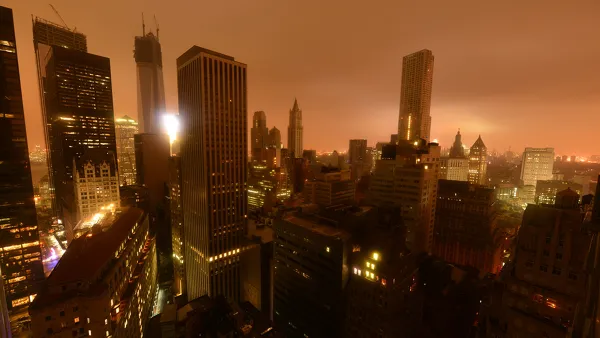
Resiliency Growing Pains
Resiliency is rapidly influencing urban sustainability and hazard mitigation planning. Global Green has identified key questions and findings through Sustainable Neighborhood Assessments in four communities impacted by Hurricane Sandy.
Climate Change Impacts all of U.S., warns National Climate Assessment
For the third time since 2000, the federal government has issued a National Climate Assessment, as mandated by Congress in 1990, to “understand, assess, predict, and respond" to climate change. The report was approved by President Obama on Tuesday.
Agriculture Department Releases Five-Year Census Data—'Christmas for Farm Nerds'
The U.S. Department of Agriculture recently released its 2012 Agriculture Census. The census provides data like how much wheat the state of Kansas produced and the average age of U.S. farm operators.
Can Price Help Conserve Water in Arizona?
A growing population and drought across the West is leading some experts to call for changes in the way governments and utilities charge for water. The difference between the way Tucson and Phoenix, for instance charge for water, is striking.
Washington State Developing Best Practices to Address Sea-Level Rise
Acknowledging that rising sea levels are a major concern for waterfront cities in Washington, the Municipal Research and Services Center (MRSC) non-profit put together a review of the current policy and planning efforts to meet the challenge.
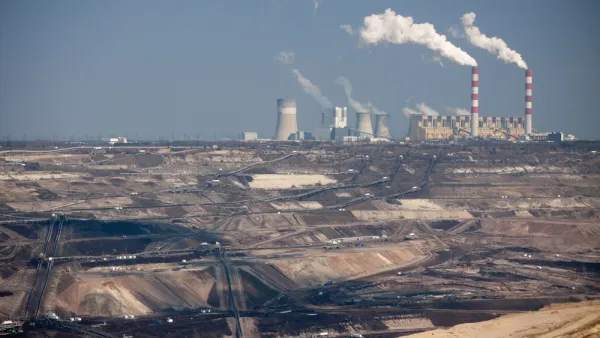
Climate Change: a Global Commons Problem
A quick city planner's guide to the voluminous Intergovernmental Panel on Climate Change report out earlier this month.

Streets Without Trees
Street trees add an interesting dimension to the built environment, providing shade, visual relief and more. They frame the public realm so well that we might be shocked to witness our Main Streets without them. This series of images does just that.
Madrid To Charge Polluting Cars More for Parking
To deal with its high pollution levels, which rank worse than the EU average, Madrid will implement a new parking fee system that charges more for the most polluting cars. Electric cars will park for free.
Decisive Supreme Court Win for Clean Air and Public Health
In a huge and perhaps unexpected win for the EPA, the Supreme Court on April 29 reversed an appellate court panel ruling that had rejected their attempt to regulate interstate air pollution caused by about 1,000 coal-fired power plants in 28 states.
Celebrating the Botanical Diversity of Cities
The word “ecology” has been co-opted so widely that it has lost real meaning, yet ecological thinking remains a powerful lens for understanding complex adaptive systems. A new book aims for a more rigorous engagement of ecology and design.
Do Tall Cities Require the Regulation of Sunlight?
Planners, lawyers and homeowners have been arguing the question of "solar rights" for two millennia. A recent article presents a primer on the historic and contemporary importance of the debate.
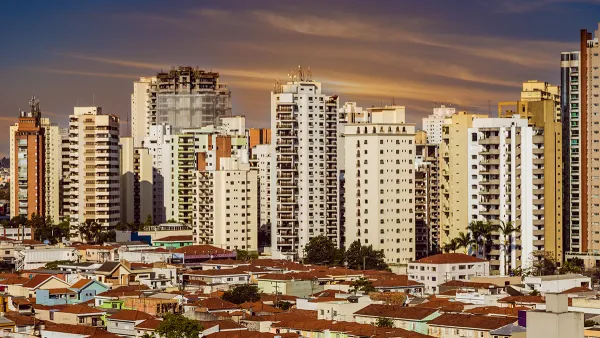
Ecocity versus Duplicity
If certain elements of masterplanning are not carefully chosen—and their impacts not carefully explained to final decision makers—then there runs great risk that the cities we design from scratch perform worse than the cities we already have.
NOAA Launching Storm Surge Mapping System
Americans tend to pay more attention to wind strength than storm surge when evaluating whether or not to evacuate before a hurricane. A new NOAA mapping project is designed to change perceptions about the multiple risks of storm events.

FREE Course: Walkable City 1: Why Walkability?
After describing his path towards focusing on walkability as the essence of good planning, Jeff Speck marches through his five principal reasons for making more walkable places.
Reinventing Malls: Planning Alchemy—Turning Gray Fields Into Gold
The course focuses on the opportunities and imperatives that shape reinvention of mall sites.

City of Rosemead
Rutgers University, Edward J. Bloustein School of Planning and Public Policy
One Hundred Miles
University of Michigan School for Environment and Sustainability (SEAS)
Hunter College, City University of New York (CUNY)
The Architects Foundation
City of Cambridge
The Pocatello Development Authority
The Urban Renewal Agency of the City of Pocatello









